Lore check
Titanic: No 300-Foot Gash, and She Did Not Sink in One Piece
Both 1912 inquiries concluded that Titanic sank intact, and the wreck lies in two pieces. The iceberg's openings, by her builders' own estimate, added up to about 12 square feet.
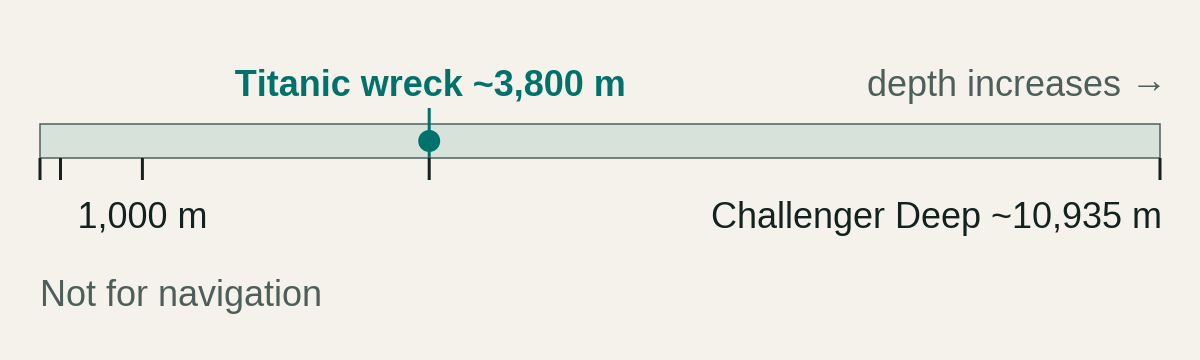
Sounding line: the Titanic wreck at about 3,800 m (12,467 ft) (NOAA Ocean Exploration), against the full depth of the ocean down to Challenger Deep.
Credit and data
"Sounding line: the Titanic wreck at about 3,800 m" by Ocean Life & Lore, https://oceanlifeandlore.com/wrecks/titanic/, licensed under CC BY 4.0 (https://creativecommons.org/licenses/by/4.0/).
Data: NOAA Ocean Exploration, Titanic Bow (https://oceanexplorer.noaa.gov/multimedia/daily-image-media-20210415/), US federal government work, retrieved 2026-10-15; NOAA Ocean Exploration, R.M.S. Titanic: June 2004 (https://oceanexplorer.noaa.gov/multimedia/video-playlist-best-titanic/), US federal government work, retrieved 2026-10-15; NOAA Ocean Service, How far does light travel in the ocean? (https://oceanservice.noaa.gov/facts/light_travel.html), US federal government work, retrieved 2026-10-15; NOAA Ocean Exploration, How deep is the ocean? (https://oceanexplorer.noaa.gov/ocean-fact/ocean-depth/), US federal government work, retrieved 2026-10-15.
Spec card
- Name
- RMS Titanic
- Type
- Passenger liner of the White Star Line; three-screw steamship of 46,328 gross tons
- Built
- Belfast, by Harland and Wolff; launched 31 May 1911
- Lost
- 15 April 1912, North Atlantic; position in the 1912 inquiry reports 41° 46′ N, 50° 14′ W
- Cause — official finding
- Struck an iceberg at 11:40 p.m. on 14 April; the six compartments forward of No. 4 boiler room were opened to the sea and she foundered 2 h 40 min later (British Wreck Commissioner's report, 1912); water flowed over the bulkhead tops at E deck (US Senate report, 1912)
- Cause — current evidence
- Seams parted and plating opened in separate places, about 12 sq ft in all, rather than one 300 ft gash; the hull broke in two (Foecke 1998, NIST-IR 6118, citing the Marine Forensics Panel; Wilding 1912 estimate of the area)
- Depth
- About 3,800 m (12,467 ft) (NOAA Ocean Exploration); 3,840 m (12,600 ft) on NOAA Ocean Exploration's 2004 expedition page
- Found
- 1985, expedition on the Woods Hole Oceanographic Institution research vessel Knorr with the towed camera sled Argo; described by J. L. Michel and R. D. Ballard (1994)
- Status
- UK Protection of Wrecks (RMS Titanic) Order 2003, in force 18 November 2019: license needed to enter the hull within 1 km of 41° 43.84′ N, 49° 57.23′ W. US R.M.S. Titanic Maritime Memorial Act of 1986: Titanic "should be designated as an international maritime memorial"
titanic-spec.csv CSV (source and license record)
Data: British Wreck Commissioner's Court, Report on the Loss of the "Titanic" (s.s.), Cd. 6352, 1912 (https://www.titanicinquiry.org/BOTInq/BOTReport/botRep01.php), public domain (UK Crown copyright expired), retrieved 2026-10-15; US Senate Committee on Commerce, "Titanic" Disaster, Senate Report No. 806, 1912 (https://www.titanicinquiry.org/USInq/USReport/AmInqRep01.php), US federal government work, retrieved 2026-10-15; Testimony of Edward Wilding, British Wreck Commissioner's Inquiry, day 19, 1912 (https://www.titanicinquiry.org/BOTInq/BOTInq19Wilding03.php), public domain (UK Crown copyright expired), retrieved 2026-10-15; Foecke, Metallurgy of the RMS Titanic, NIST-IR 6118, 1998 (https://nvlpubs.nist.gov/nistpubs/Legacy/IR/nistir6118.pdf), US federal government work, retrieved 2026-10-15; NOAA Ocean Exploration, Titanic Bow (https://oceanexplorer.noaa.gov/multimedia/daily-image-media-20210415/), US federal government work, retrieved 2026-10-15; NOAA Ocean Exploration, R.M.S. Titanic: June 2004 (https://oceanexplorer.noaa.gov/multimedia/video-playlist-best-titanic/), US federal government work, retrieved 2026-10-15; WHOI Oceanus, The Quest to Map Titanic, 2012 (https://www.whoi.edu/oceanus/feature/the-quest-to-map-titanic/), factual values, no license stated, retrieved 2026-10-15; Protection of Wrecks (RMS Titanic) Order 2003, SI 2003/2496 (https://www.legislation.gov.uk/uksi/2003/2496/made), Open Government Licence v3.0, retrieved 2026-10-15; 16 U.S.C. 450rr, R.M.S. Titanic Maritime Memorial Act of 1986 (https://www.govinfo.gov/content/pkg/USCODE-2024-title16/html/USCODE-2024-title16-chap1-subchapLXI-sec450rr.htm), US federal government work, retrieved 2026-10-15.
TL;DR. Titanic flooded through openings that her builders' marine architect put at about 12 square feet in all, spread along roughly 200 to 300 feet of hull, not through one long gash. Both 1912 inquiries concluded she sank intact; the wreck found in 1985 lies in two main pieces. Whether weak rivets started the leaks is still unsounded.
Down this page 8 sections
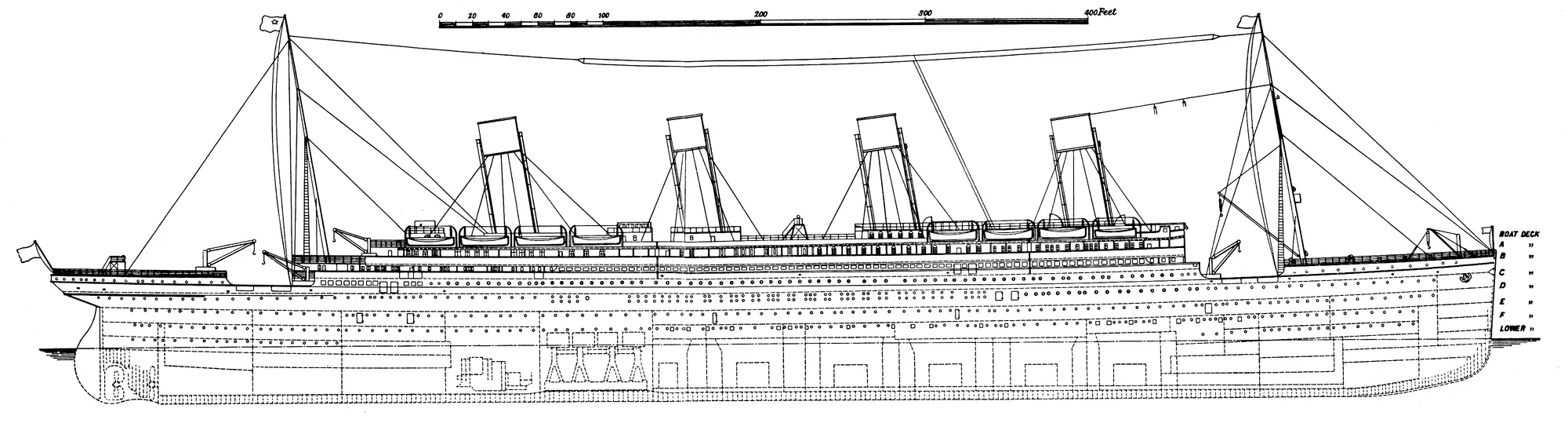
Side plan of Titanic and her sister ship Olympic, printed in the journal Engineering in May 1911, the month Titanic was launched. The scale bar at the top runs to 400 ft.
Credit and data
"Olympic and Titanic Side Plan 1911" by an uncredited draughtsman (Engineering, 26 May 1911) — https://commons.wikimedia.org/wiki/File:Olympic_and_Titanic_Side_Plan_1911.png — Public domain (drawing published without a credit in the journal Engineering, 1911; US: published before 1931; EU: anonymous work, term 70 years from publication, expired)

Titanic sank through openings that, added together, came to about 12 square feet, by her builders' estimate in 1912. By the British inquiry's account, the iceberg struck her starboard side at 11:40 p.m. on 14 April 1912, about 10 feet above the keel, and left the six compartments forward of No. 4 boiler room open to the sea. She had been built so that any two of her 16 watertight compartments could flood without endangering her, the US Senate committee reported.
With six open, water spilled over the tops of bulkheads that ended at E deck, and she foundered two hours and forty minutes after the collision, with the loss of 1,490 lives by the British count. That is the official finding of 1912. The wreck, found in 1985 and lying at about 3,800 m (12,467 ft) according to NOAA Ocean Exploration, has since overturned the official finding that she sank intact, and later analysis found no 300-foot gash.
Why did Titanic sink, according to the 1912 inquiries?
Two inquiries reported in 1912: the Committee on Commerce of the US Senate, and a British court under the Wreck Commissioner, Lord Mersey. They differ on the clock: the US report puts the lookout's warning at 11:46 p.m. ship's time, and the British report puts the collision at 11:40 p.m. On the damage they largely agree. The British report places it low on the starboard side, about 10 feet above the keel, in the forepeak, the first three holds and boiler rooms 6 and 5.
The US committee found that the five forwardmost compartments flooded "practically immediately." Its account of why that sank the ship turns on the bulkheads. Fifteen transverse bulkheads divided the hull into 16 compartments, but 14 of them stopped at D or E deck, and the openings through E deck "were not designed for watertight closing." As the bow went down, water overflowed E deck into the compartments behind, so "the supposedly watertight compartments were NOT watertight," the committee wrote.
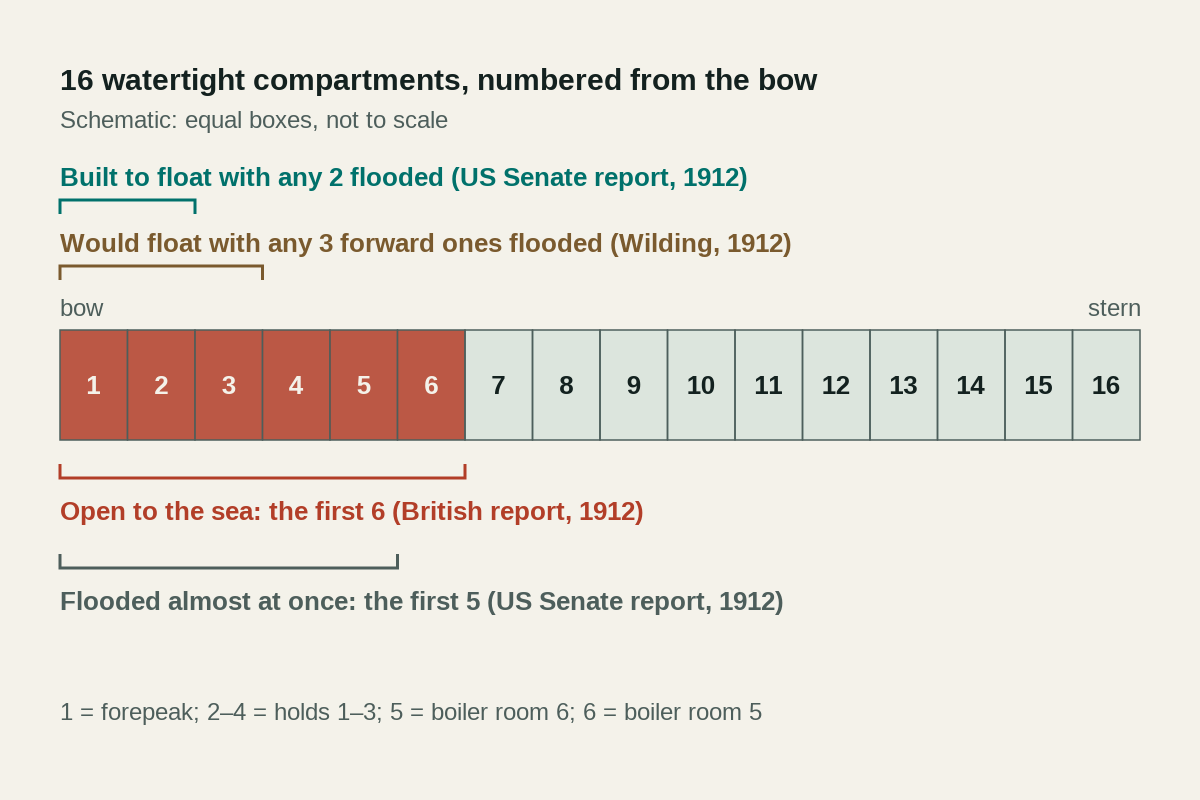
Open full-size chart, or scroll it sideways to read every label
Schematic, not to scale. Titanic was built so that any two compartments could flood (US Senate report, 1912); the British report found the first six open to the sea.
Credit and data
"Titanic: built for two flooded compartments, six were opened" by Ocean Life & Lore, https://oceanlifeandlore.com/wrecks/titanic/, licensed under CC BY 4.0 (https://creativecommons.org/licenses/by/4.0/).
Data: US Senate Committee on Commerce, "Titanic" Disaster, Senate Report No. 806, 1912 (https://www.titanicinquiry.org/USInq/USReport/AmInqRep01.php), US federal government work, retrieved 2026-10-15; British Wreck Commissioner's Court, Report on the Loss of the "Titanic" (s.s.), Cd. 6352, 1912 (https://www.titanicinquiry.org/BOTInq/BOTReport/botRep01.php), public domain (UK Crown copyright expired), retrieved 2026-10-15; Testimony of Edward Wilding, British Wreck Commissioner's Inquiry, day 19, 1912 (https://www.titanicinquiry.org/BOTInq/BOTInq19Wilding03.php), public domain (UK Crown copyright expired), retrieved 2026-10-15.
The British court timed the flooding from the crew's testimony. Ten minutes after the collision, water stood about 14 feet above the keel in the damaged compartments except No. 5 boiler room, and the ship disappeared at 2:20 a.m. on 15 April. Edward Wilding, a marine architect at the builders, Harland and Wolff, told the court she would have floated with any three of the forward compartments flooded.
Was Titanic really called unsinkable?
The story goes that the White Star Line advertised Titanic as unsinkable. The nearest wording in the 1911 sources checked here is more careful. The trade journal The Shipbuilder, in its midsummer 1911 special number on the Olympic and Titanic, explained that the captain could close the watertight doors with an electric switch and so "make the vessel practically unsinkable."
The design had a stated limit. The US Senate committee reported that the ship was arranged so that any two main compartments could flood without involving her safety. J. Bruce Ismay, president of the International Mercantile Marine Co., the American company at the top of the chain that owned Titanic, testified that she was built to float with her two largest compartments full of water.
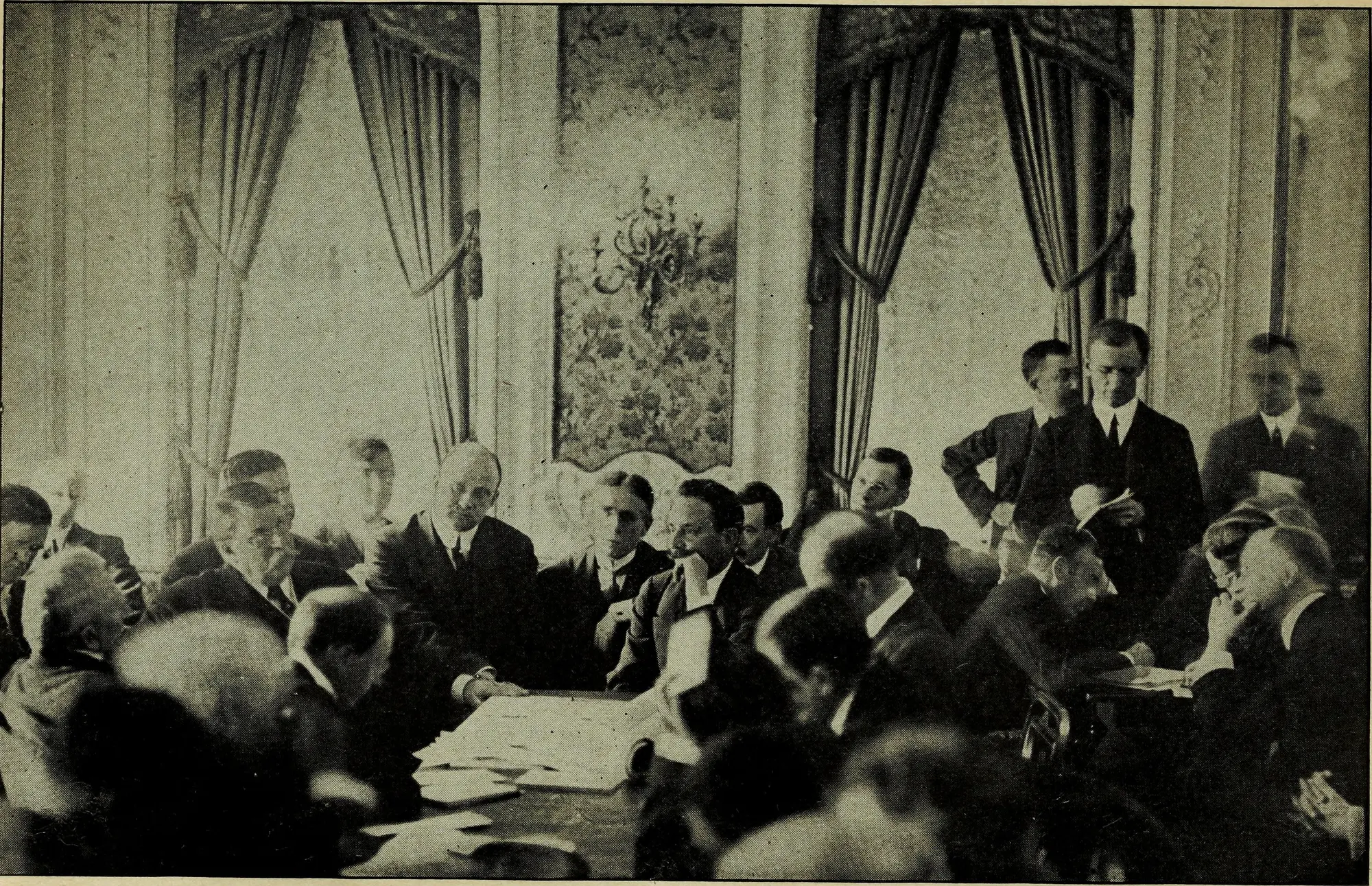
J. Bruce Ismay, hand to his face, before the US Senate committee in 1912, as printed in a book that year. The committee reported his testimony on how much flooding the ship could take.
Credit and data
"J. Bruce Ismay being questioned by Senate Investigating Committee" by Underwood & Underwood (printed in Marshall Everett, Wreck and Sinking of the Titanic, 1912) — https://commons.wikimedia.org/wiki/File:J._Bruce_Ismay_being_questioned_by_Senate_Investigating_Committee.jpg — Public domain (press photograph credited only to the agency Underwood & Underwood, published in a US book in 1912; US: published before 1931; EU: no photographer named, term 70 years from publication, expired)

The belief spread wider than the wording. In July 1912 J. Bernard Walker, editor of Scientific American, cited the shortage of lifeboats as proof of "the widespread belief that a great ship like the Titanic was practically unsinkable." Tim Foecke's 1998 report for the US National Institute of Standards and Technology (NIST) says the popular press "dubbed her ‘unsinkable’." None of these sources shows a White Star advertisement using the word without the qualifier.
How big was the iceberg damage really?
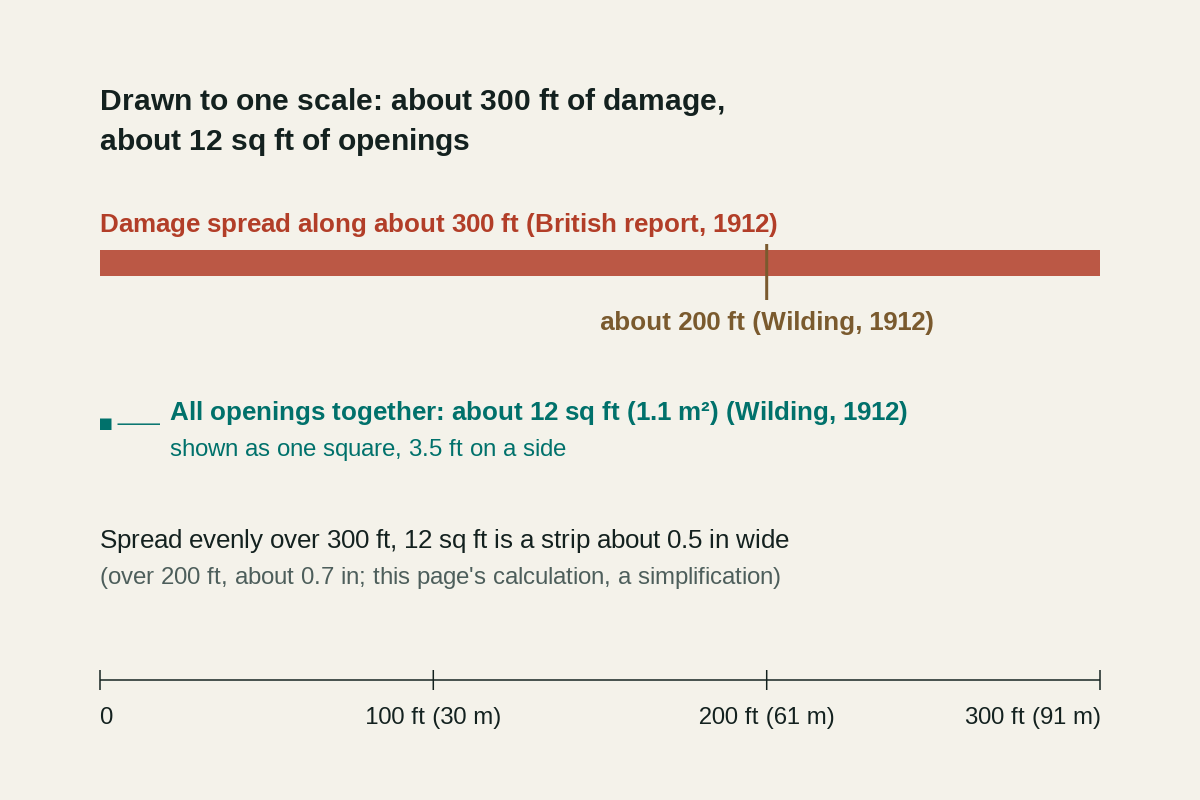
The story goes that the iceberg sliced a long gash down Titanic's side. The idea was in print within months. Walker's book of July 1912 said she "ripped open 200 feet of her plating" and called the damage "the long rent which was torn in her plating."
The British report of 1912 says only that the damage "extended over a length of about 300 ft." Wilding worked out the size of the openings from the flooding: about 16,000 tons of water in about 40 minutes, which needed a total opening of "somewhere about 12 square feet." Spread over the 200 feet or so of hull that he took the damage to cover, that averaged about three-quarters of an inch, so he concluded the holes were "in places, that is, not a continuous rip."
By this page's calculation, 12 square feet spread evenly over the British report's 300 feet would be a slot about half an inch wide.
Open full-size chart, or scroll it sideways to read every label
Drawn to one scale: the British report's 300 ft of damage, and Wilding's estimate of all the openings together, about 12 sq ft, shown as one square 3.5 ft on a side.
Credit and data
"Titanic: about 300 ft of damage, about 12 sq ft of openings" by Ocean Life & Lore, https://oceanlifeandlore.com/wrecks/titanic/, licensed under CC BY 4.0 (https://creativecommons.org/licenses/by/4.0/).
Data: British Wreck Commissioner's Court, Report on the Loss of the "Titanic" (s.s.), Cd. 6352, 1912 (https://www.titanicinquiry.org/BOTInq/BOTReport/botRep01.php), public domain (UK Crown copyright expired), retrieved 2026-10-15; Testimony of Edward Wilding, British Wreck Commissioner's Inquiry, day 19, 1912 (https://www.titanicinquiry.org/BOTInq/BOTInq19Wilding03.php), public domain (UK Crown copyright expired), retrieved 2026-10-15.
Later evidence agrees with Wilding rather than with the story. Foecke, a member of the Marine Forensics Panel of the Society of Naval Architects and Marine Engineers, summarizes the panel's findings: "parting of seams, and not a mythical 90 m (300 ft) gash in the bottom of the hull, made up the damage to Titanic." The bow damage that the panel imaged with sub-surface sonar in 1996 was, in Foecke's words, "buried under fifty feet of mud."
Did Titanic break in half?
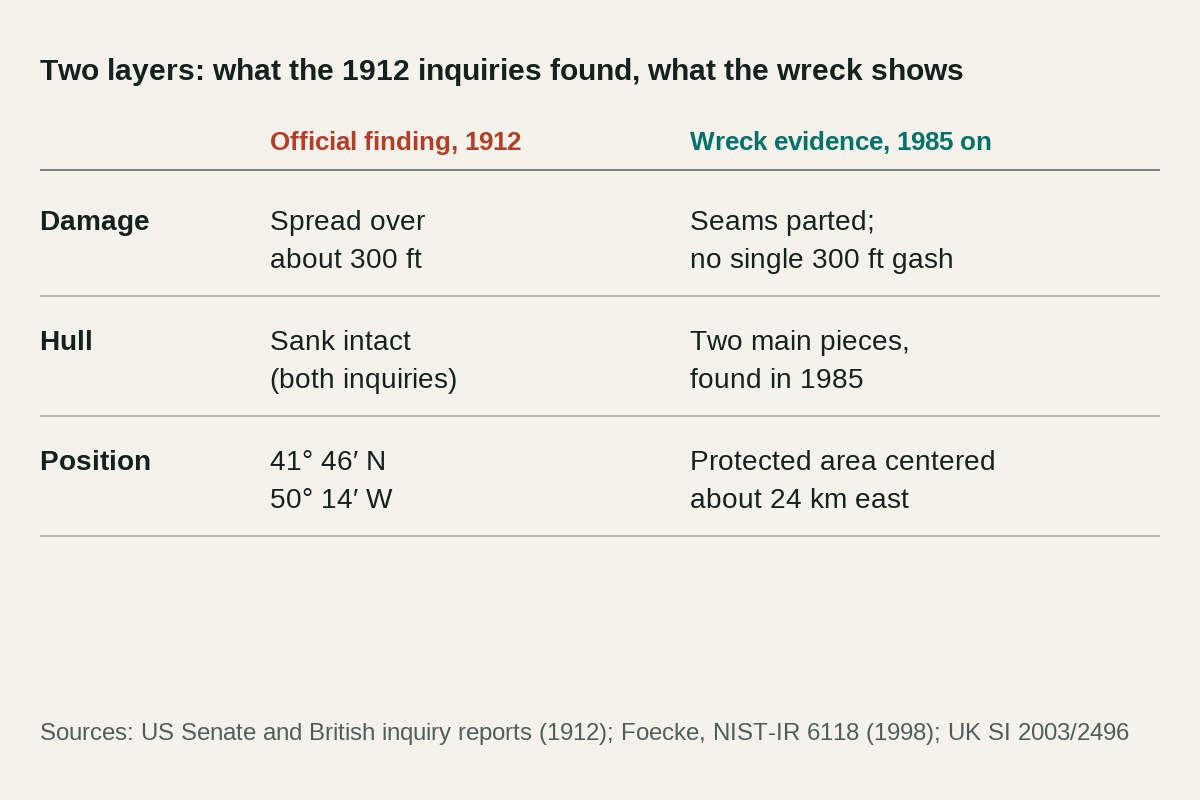
Titanic did break in two, although both official inquiries of 1912 concluded that she sank intact. The US Senate committee wrote that "there have been many conflicting statements as to whether the ship broke in two, but the preponderance of evidence is to the effect that she assumed an almost end-on position and sank intact." The British report was shorter: "The ship did not break in two."
Those findings stand as what the inquiries concluded in 1912. The wreck found in 1985 was "broken into two pieces oriented in opposite directions," Foecke's report notes. In his words, that "confirmed the scattered testimony of some passengers that she broke at the surface, but ran contrary to every account of the disaster given by surviving officers."
J. L. Michel and R. D. Ballard described the discovery expedition in a paper for the OCEANS '94 conference. A 2012 article from the Woods Hole Oceanographic Institution (WHOI) recounts that its research vessel Knorr "brought back the first grainy black-and-white images of Titanic resting on the seafloor" in 1985, using a towed camera sled called Argo.
Open full-size chart, or scroll it sideways to read every label
The two layers side by side: what the 1912 inquiries concluded, and what the wreck and later analysis show. Each row's sources are in the table's CSV.
Credit and data
"Titanic: the 1912 findings and the wreck evidence" by Ocean Life & Lore, https://oceanlifeandlore.com/wrecks/titanic/, licensed under CC BY 4.0 (https://creativecommons.org/licenses/by/4.0/).
Data: US Senate Committee on Commerce, "Titanic" Disaster, Senate Report No. 806, 1912 (https://www.titanicinquiry.org/USInq/USReport/AmInqRep01.php), US federal government work, retrieved 2026-10-15; British Wreck Commissioner's Court, Report on the Loss of the "Titanic" (s.s.), Cd. 6352, 1912 (https://www.titanicinquiry.org/BOTInq/BOTReport/botRep01.php), public domain (UK Crown copyright expired), retrieved 2026-10-15; Foecke, Metallurgy of the RMS Titanic, NIST-IR 6118, 1998 (https://nvlpubs.nist.gov/nistpubs/Legacy/IR/nistir6118.pdf), US federal government work, retrieved 2026-10-15; Protection of Wrecks (RMS Titanic) Order 2003, SI 2003/2496 (https://www.legislation.gov.uk/uksi/2003/2496/made), Open Government Licence v3.0, retrieved 2026-10-15.
Did weak rivets or brittle steel sink her?
The story goes that weak rivets, or steel that shattered in the cold, doomed the ship. Both ideas come from tests on metal recovered from the wreck, and both claim more than the tests showed.
Foecke's NIST study examined two wrought-iron hull rivets. One contained 9.3% slag on average, "more than 3 times the amount normally expected in wrought iron," which he gives as 2–3% by volume. Both had lost their inner heads. He was careful about scale, writing in 1998 that "only two rivets have been sectioned to date, out of 3,000,000."
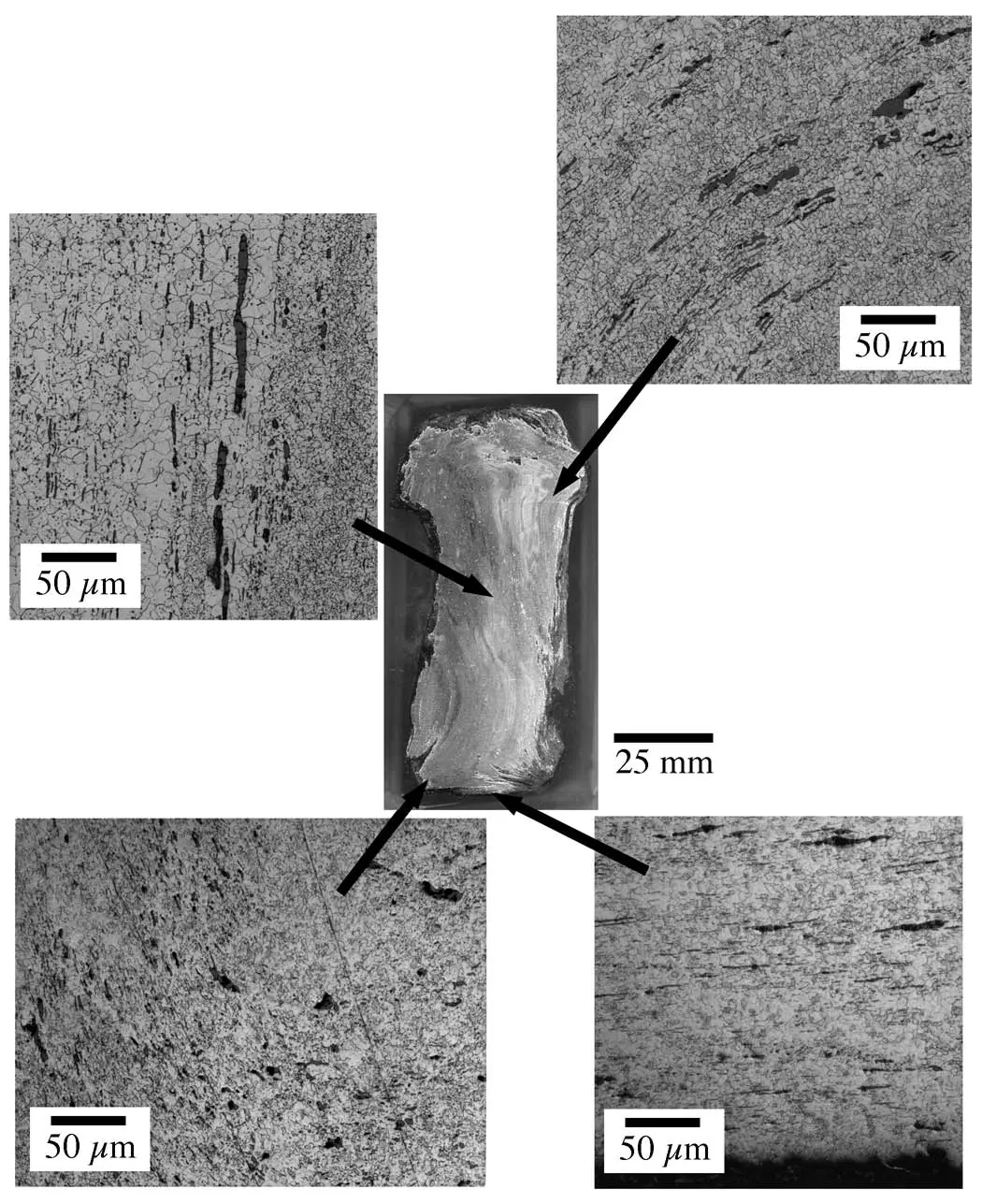
A sectioned Titanic hull rivet with micrographs of its slag streaks, from Foecke's 1998 NIST report. Scale bars mark 50 µm on the micrographs and 25 mm on the rivet.
Credit and data
"Figure 7: micrographs of slag in a Titanic hull rivet (NIST-IR 6118)" by Tim Foecke, NIST (republished courtesy of the National Institute of Standards and Technology) — https://nvlpubs.nist.gov/nistpubs/Legacy/IR/nistir6118.pdf — Public domain (US federal government work: NIST employee, NIST-IR 6118 (1998), 17 U.S.C. 105; outside the US, NIST grants a worldwide royalty-free right to reprint and make derivative works)
A 2003 study led by Jennifer Hooper, with Foecke as a co-author, compared Titanic's wrought iron with iron from buildings, bridges and ships of the same era. Its abstract reports the suggestion that the rivets "may have been an important factor in the opening of the steel plates during flooding."
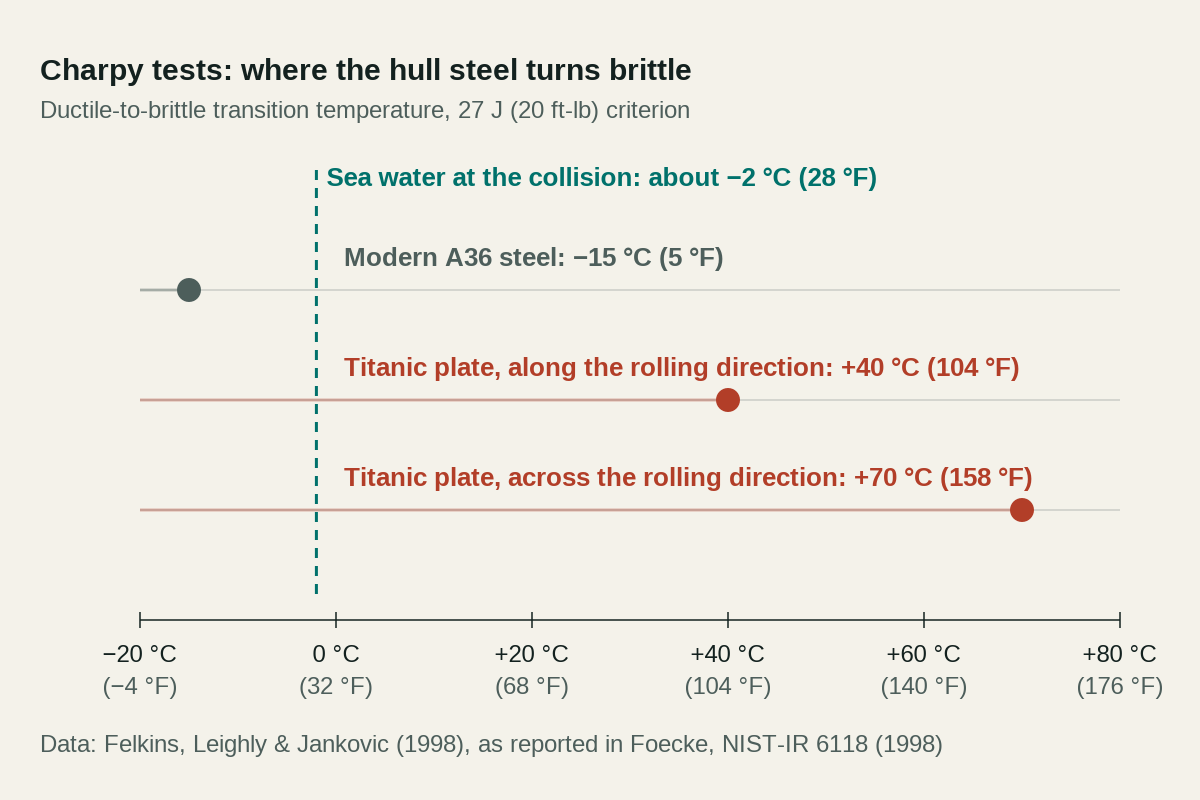
The steel story began with Charpy tests on a plate recovered in 1991, which fractured "in a 100% brittle fashion at ice brine temperatures," Foecke's report notes. A hull plate recovered in 1996 was tested by K. Felkins, H. P. Leighly and A. Jankovic, as summarized in Foecke's report. Its ductile-to-brittle transition came at +40 °C (104 °F) along its rolling direction and +70 °C (158 °F) across it, against −15 °C (5 °F) for a modern A36 steel. The water at the collision was about −2 °C (28 °F).
Open full-size chart, or scroll it sideways to read every label
Charpy tests on a Titanic hull plate put its ductile-to-brittle transition far above the −2 °C (28 °F) water at the collision. Modern A36 steel is shown for comparison.
Credit and data
"Titanic hull steel: brittle well above the water temperature" by Ocean Life & Lore, https://oceanlifeandlore.com/wrecks/titanic/, licensed under CC BY 4.0 (https://creativecommons.org/licenses/by/4.0/).
Data: Foecke, Metallurgy of the RMS Titanic, NIST-IR 6118, 1998 (https://nvlpubs.nist.gov/nistpubs/Legacy/IR/nistir6118.pdf), US federal government work, retrieved 2026-10-15.
What that meant for the sinking is disputed. Foecke judged it possible that brittle steel added to the bow damage, but "much more likely" that it was a factor in the breakup at the surface. In his opinion, "no apparent metallurgical mistakes were made," given what engineers knew in 1911. The Hooper abstract reports that tests showed the steel to be "state-of-the-art" for 1911, and that the rivets were suggested as a factor instead.
Where does the wreck lie, and who protects it?
NOAA Ocean Exploration gives the depth of the wreck as 3,800 m (12,467 ft), and its page on a 2004 survey gives the wreck site as 3,840 m (12,600 ft). That is near the bottom of what NOAA Ocean Service calls the midnight zone, from 1,000 to 4,000 m, where sunlight does not penetrate. A red shrimp in Why So Many Deep-Sea Animals Are Red was recorded off Puerto Rico in 2015 on a NOAA Ocean Exploration dive that started at 4,055 m (13,304 ft), a similar depth.
 Illustration
A weighted line let down into the dark. NOAA Ocean Exploration gives the wreck's depth as 3,800 m (12,467 ft), near the bottom of what NOAA Ocean Service calls the midnight zone.
Illustration: Ocean Life & Lore. Generated illustration — not a photograph, specimen or historical record. Reuse: CC BY 4.0 (https://creativecommons.org/licenses/by/4.0/); no rights are claimed beyond what the law grants.
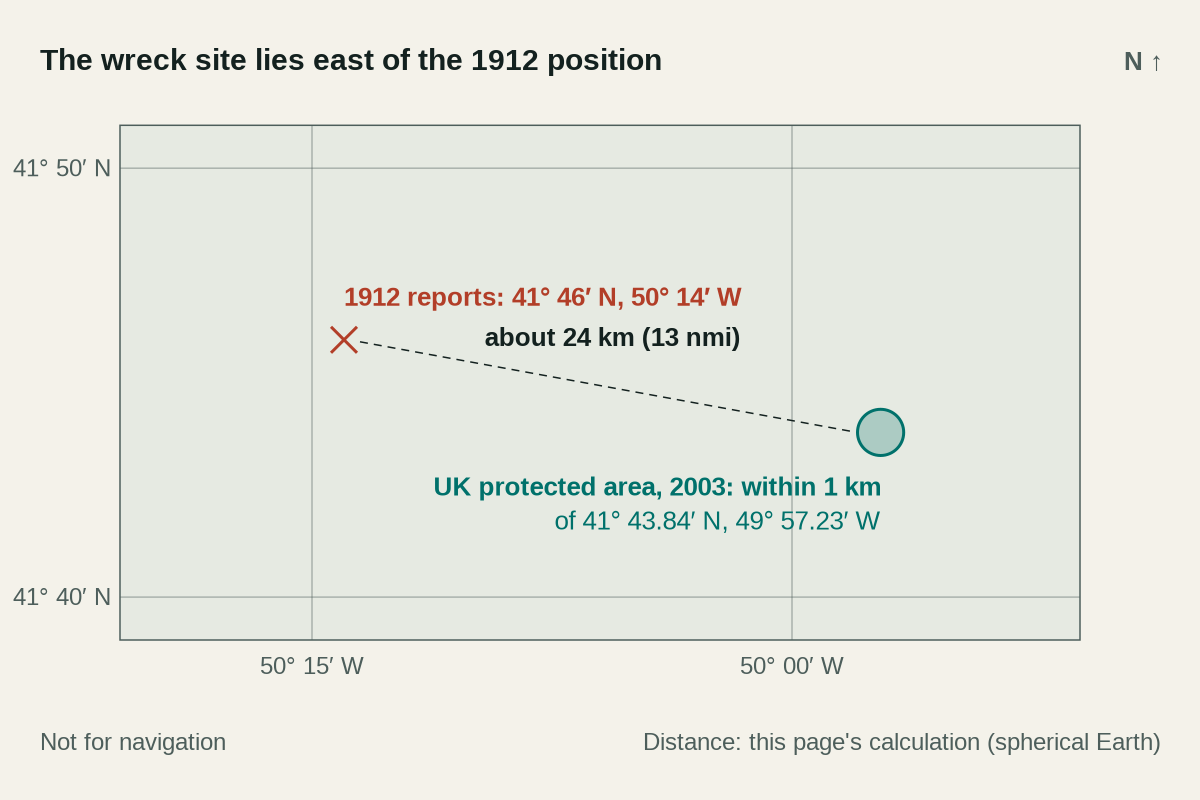
The UK's Protection of Wrecks (RMS Titanic) Order 2003 protects an area centered on 41° 43.84′ N, 49° 57.23′ W. By this page's calculation on a spherical Earth, that point lies about 24 km (13 nautical miles) east of 41° 46′ N, 50° 14′ W, the position where the 1912 reports put the sinking. For Titanic's place among other wrecks by depth, see How Deep the Famous Wrecks Lie.
Open full-size chart, or scroll it sideways to read every label
The 1912 position and the center of the UK protected area, about 24 km (13 nmi) apart by this page's calculation.
Credit and data
"Titanic: the 1912 position and the protected wreck site" by Ocean Life & Lore, https://oceanlifeandlore.com/wrecks/titanic/, licensed under CC BY 4.0 (https://creativecommons.org/licenses/by/4.0/).
Data: British Wreck Commissioner's Court, Report on the Loss of the "Titanic" (s.s.), Cd. 6352, 1912 (https://www.titanicinquiry.org/BOTInq/BOTReport/botRep01.php), public domain (UK Crown copyright expired), retrieved 2026-10-15; Protection of Wrecks (RMS Titanic) Order 2003, SI 2003/2496 (https://www.legislation.gov.uk/uksi/2003/2496/made), Open Government Licence v3.0, retrieved 2026-10-15.
Within 1 km of that point, the Order requires a license to enter the hull sections or to carry out activities aimed at artifacts outside the hull. It came into force on 18 November 2019, when the Agreement concerning the shipwrecked vessel RMS Titanic took effect for the United Kingdom. In the US, the R.M.S. Titanic Maritime Memorial Act of 1986 found that the ship "should be designated as an international maritime memorial to the men, women, and children who perished aboard her."
Foecke wrote in 1998 that "an analysis of the actual plates involved in the collision would be required" to settle the steel question, and the damaged bow lay under mud when he wrote. None of the sources checked here reports a rivet or a plate taken from the seams that actually opened. Until one is examined, the weak-rivet story cannot be sounded to the bottom.
Lore check
5 claims sounded: bends ×2sinks ×2unsounded ×1
| Claim | Verdict | Evidence |
|---|---|---|
| Titanic was advertised as unsinkable | bends | The Shipbuilder (1911): closing the watertight doors would "make the vessel practically unsinkable." US Senate report (1912): built so that any two compartments could flood. No advertisement without the qualifier in the sources checked. |
| The iceberg cut a 300-foot gash in her side | sinks | British report (1912): damage spread over about 300 ft. Wilding, British inquiry (1912): openings of about 12 sq ft, "not a continuous rip." Foecke, NIST (1998), citing the Marine Forensics Panel: parted seams, no 300 ft gash. |
| Titanic sank in one piece | sinks | Official finding: US Senate and British reports (1912), sank intact. Wreck evidence: two main pieces, found in 1985 (Foecke, NIST, 1998). |
| Weak rivets doomed her | unsounded | Foecke, NIST (1998): two rivets sectioned, one at 9.3% slag against 2–3% typical. Hooper et al. (2003) abstract reports the suggestion that rivets "may have been an important factor." Missing: rivets and plates from the seams that opened. Checked: Foecke 1998; Hooper et al. 2003 (abstract). |
| Brittle steel sank her | bends | Charpy tests (Felkins et al., 1998, via Foecke 1998): brittle well above the −2 °C sea. Foecke (1998): more likely a factor in the breakup than in the bow damage. Hooper et al. (2003): "state-of-the-art" for 1911. Disputed. |
Further down:
- Challenger Deep: about 10,935 m (35,876 ft) by NOAA's figure, nearly three times as deep as the Titanic wreck.
- Edmund Fitzgerald: a lake wreck read the same way, the official finding first and the wreck evidence beside it.
Sources
- 1US Senate, Committee on Commerce (1912). "Titanic" Disaster: Report of the Committee on Commerce, United States Senate, pursuant to S. Res. 283. 62nd Congress, 2nd Session, Senate Report No. 806. Washington: Government Printing Office. https://www.titanicinquiry.org/USInq/USReport/AmInqRep01.php Read: full text (transcription).
- 2Wreck Commissioner's Court (1912). Report on the Loss of the "Titanic" (s.s.): formal investigation before Lord Mersey, Wreck Commissioner. Command Paper Cd. 6352. London: His Majesty's Stationery Office. https://www.titanicinquiry.org/BOTInq/BOTReport/botRep01.php Read: full text (transcription).
- 3British Wreck Commissioner's Inquiry (1912). Minutes of evidence, day 19: testimony of Edward Wilding, marine architect, Harland and Wolff, questions 20361–20364, 20422–20423 and 20732. https://www.titanicinquiry.org/BOTInq/BOTInq19Wilding03.php Read: questions 20188–20748 (transcription).
- 4The Shipbuilder (1911). Vol. VI, Midsummer 1911, special number: the White Star liners "Olympic" and "Titanic", p. 26. Edited by A. G. Hood. Newcastle-on-Tyne: The Shipbuilder Press. https://archive.org/details/the_shipbuilder_special_numbers_images_201909 Read: page 26.
- 5Walker, J. B. (1912). An Unsinkable Titanic: Every Ship Its Own Lifeboat. New York: Dodd, Mead and Company (published July 1912). https://commons.wikimedia.org/wiki/File:An_unsinkable_Titanic;_every_ship_its_own_lifeboat_(IA_unsinkabletitani00walkrich).pdf Read: title page; pages 123–125, 131 and 161–162.
- 6Foecke, T. (1998). Metallurgy of the RMS Titanic. NIST-IR 6118. Gaithersburg, MD: National Institute of Standards and Technology. doi:10.6028/NIST.IR.6118 https://nvlpubs.nist.gov/nistpubs/Legacy/IR/nistir6118.pdf Read: full text.
- 7Hooper, J. J., T. Foecke, L. Graham & T. P. Weihs (2003). Metallurgical analysis of wrought iron from the RMS Titanic. Marine Technology and SNAME News 40(2): 73–81. doi:10.5957/mt1.2003.40.2.73 https://doi.org/10.5957/mt1.2003.40.2.73 Read: abstract.
- 8Michel, J. L. & R. D. Ballard (1994). The RMS Titanic 1985 discovery expedition. Proceedings of OCEANS '94, vol. 3, pp. III/132–III/137. doi:10.1109/OCEANS.1994.364185 https://doi.org/10.1109/OCEANS.1994.364185 Read: catalogue record.
- 9Lippsett, L. (2012). The Quest to Map Titanic. Oceanus, Woods Hole Oceanographic Institution, 12 April 2012. https://www.whoi.edu/oceanus/feature/the-quest-to-map-titanic/ Read: full text.
- 10NOAA Ocean Exploration. Titanic Bow (daily image; from R.M.S. Titanic Expedition 2003). https://oceanexplorer.noaa.gov/multimedia/daily-image-media-20210415/ Read: full text.
- 11NOAA Ocean Exploration. R.M.S. Titanic: June 2004 (expedition video page). https://oceanexplorer.noaa.gov/multimedia/video-playlist-best-titanic/ Read: full text.
- 12NOAA Ocean Exploration. How deep is the ocean? https://oceanexplorer.noaa.gov/ocean-fact/ocean-depth/ Read: full text.
- 13NOAA Ocean Service. How far does light travel in the ocean? https://oceanservice.noaa.gov/facts/light_travel.html Read: full text.
- 14NOAA Ocean Exploration. May 12, 2021: Shrimp (daily image, from Océano Profundo 2015: Exploring Puerto Rico’s Seamounts, Trenches, and Troughs). https://oceanexplorer.noaa.gov/multimedia/daily-image-media-20210512/ Read: full text.
- 15The Protection of Wrecks (RMS Titanic) Order 2003, SI 2003/2496 (made 29 September 2003; article 1 in force 18 November 2019). https://www.legislation.gov.uk/uksi/2003/2496/made Read: full text; commencement note.
- 16R.M.S. Titanic Maritime Memorial Act of 1986, Pub. L. 99-513, 100 Stat. 2082; 16 U.S.C. 450rr. https://www.govinfo.gov/content/pkg/USCODE-2024-title16/html/USCODE-2024-title16-chap1-subchapLXI-sec450rr.htm Read: section 450rr.
Cite this page
Ocean Life & Lore. “Titanic: No 300-Foot Gash, and She Did Not Sink in One Piece.” Ocean Life & Lore. Published 2026-10-15; last substantive revision 2026-10-15. https://oceanlifeandlore.com/wrecks/titanic/ (accessed the date you read it).
Download the data: Sounding line (CSV) CSV (source and license record) Data: NOAA Ocean Exploration, Titanic Bow (https://oceanexplorer.noaa.gov/multimedia/daily-image-media-20210415/), US federal government work, retrieved 2026-10-15; NOAA Ocean Exploration, R.M.S. Titanic: June 2004 (https://oceanexplorer.noaa.gov/multimedia/video-playlist-best-titanic/), US federal government work, retrieved 2026-10-15; NOAA Ocean Service, How far does light travel in the ocean? (https://oceanservice.noaa.gov/facts/light_travel.html), US federal government work, retrieved 2026-10-15; NOAA Ocean Exploration, How deep is the ocean? (https://oceanexplorer.noaa.gov/ocean-fact/ocean-depth/), US federal government work, retrieved 2026-10-15. · Compartments and damage (CSV) CSV (source and license record) Data: US Senate Committee on Commerce, "Titanic" Disaster, Senate Report No. 806, 1912 (https://www.titanicinquiry.org/USInq/USReport/AmInqRep01.php), US federal government work, retrieved 2026-10-15; British Wreck Commissioner's Court, Report on the Loss of the "Titanic" (s.s.), Cd. 6352, 1912 (https://www.titanicinquiry.org/BOTInq/BOTReport/botRep01.php), public domain (UK Crown copyright expired), retrieved 2026-10-15; Testimony of Edward Wilding, British Wreck Commissioner's Inquiry, day 19, 1912 (https://www.titanicinquiry.org/BOTInq/BOTInq19Wilding03.php), public domain (UK Crown copyright expired), retrieved 2026-10-15. · Two layers (CSV) CSV (source and license record) Data: US Senate Committee on Commerce, "Titanic" Disaster, Senate Report No. 806, 1912 (https://www.titanicinquiry.org/USInq/USReport/AmInqRep01.php), US federal government work, retrieved 2026-10-15; British Wreck Commissioner's Court, Report on the Loss of the "Titanic" (s.s.), Cd. 6352, 1912 (https://www.titanicinquiry.org/BOTInq/BOTReport/botRep01.php), public domain (UK Crown copyright expired), retrieved 2026-10-15; Foecke, Metallurgy of the RMS Titanic, NIST-IR 6118, 1998 (https://nvlpubs.nist.gov/nistpubs/Legacy/IR/nistir6118.pdf), US federal government work, retrieved 2026-10-15; Protection of Wrecks (RMS Titanic) Order 2003, SI 2003/2496 (https://www.legislation.gov.uk/uksi/2003/2496/made), Open Government Licence v3.0, retrieved 2026-10-15. · Steel and rivets (CSV) CSV (source and license record) Data: Foecke, Metallurgy of the RMS Titanic, NIST-IR 6118, 1998 (https://nvlpubs.nist.gov/nistpubs/Legacy/IR/nistir6118.pdf), US federal government work, retrieved 2026-10-15. · Positions (CSV) CSV (source and license record) Data: British Wreck Commissioner's Court, Report on the Loss of the "Titanic" (s.s.), Cd. 6352, 1912 (https://www.titanicinquiry.org/BOTInq/BOTReport/botRep01.php), public domain (UK Crown copyright expired), retrieved 2026-10-15; Protection of Wrecks (RMS Titanic) Order 2003, SI 2003/2496 (https://www.legislation.gov.uk/uksi/2003/2496/made), Open Government Licence v3.0, retrieved 2026-10-15.
Corrections
No corrections yet.
Every correction on the site is listed in the Corrections logbook. To report an error on this page, use Report a correction with the page URL, the sentence and your source. How claims are sounded sets out the sources, recalculations and verdict rules behind each page.
More from Ships & Wrecks
-
Comparison table
How Deep the Famous Wrecks Lie: Titanic Isn't the Deepest
Famous wrecks in the table: 70–6,895 m
-
Entry
Edmund Fitzgerald: Hatch Covers Blamed in a Split 1978 Vote
Edmund Fitzgerald wreck: 162 m