How it works
Why So Many Deep-Sea Animals Are Red, and Look Black
Seawater spends the red in sunlight within the first tens of meters, so at depth a red body works as a black one, except in the beam of a dragonfish that makes its own far-red light.
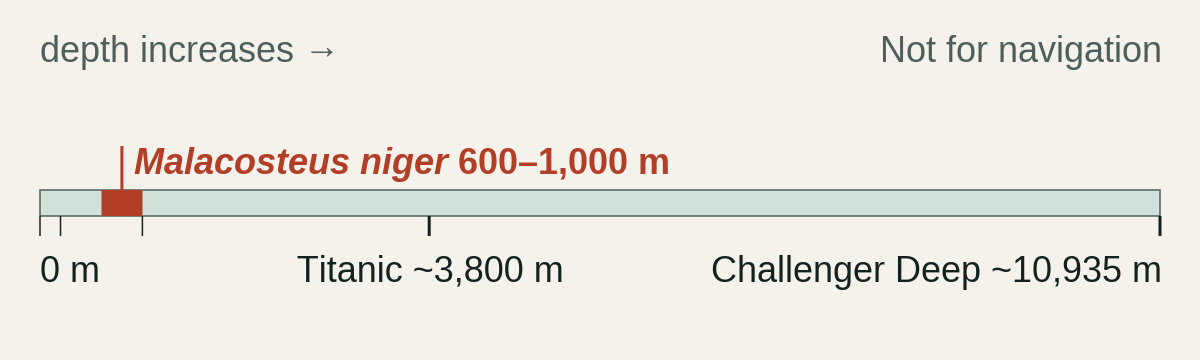
Malacosteus niger, the dragonfish this article ends with, is reported at 600–1,000 m (1,969–3,281 ft; Gastineau et al. 2023).
Credit and data
"Sounding line: where Malacosteus niger lives" by Ocean Life & Lore, https://oceanlifeandlore.com/deep/why-deep-sea-animals-are-red/, licensed under CC BY 4.0 (https://creativecommons.org/licenses/by/4.0/).
Data: Gastineau et al. 2023, ZooKeys 1157: 177–191 (https://doi.org/10.3897/zookeys.1157.97921), CC BY 4.0, retrieved 2026-10-15; NOAA Ocean Service, How far does light travel in the ocean? (https://oceanservice.noaa.gov/facts/light_travel.html), US federal government work (public domain), retrieved 2026-10-15; NOAA Ocean Exploration, Titanic Bow daily image (https://oceanexplorer.noaa.gov/multimedia/daily-image-media-20210415/), US federal government work (public domain), retrieved 2026-10-15; NOAA Ocean Exploration, How deep is the ocean? (https://oceanexplorer.noaa.gov/ocean-fact/ocean-depth/), US federal government work (public domain), retrieved 2026-10-15.
Spec card
- Common name
- Stoplight loosejaw
- Scientific name
- Malacosteus niger Ayres, 1848 (WoRMS AphiaID 127358)
- Group
- Loosejaw dragonfishes (family Stomiidae, order Stomiiformes)
- Depth range (m, ft)
- 600–1,000 m (1,969–3,281 ft); found below 600 m in Atlantic catches
- Max size
- About 15–20 cm long; no maximum stated in the cited sources
- Light strategy
- Bioluminescence: far-red light from organs below the eyes (peak about 705 nm) and blue light from organs behind the eyes (470–480 nm); black body
- Food strategy
- Prefers small prey, including the 3–5 mm calanoid copepod Chirundina streetsii
- First described
- Ayres, 1848
why-deep-sea-animals-are-red-spec.csv CSV (source and license record)
Data: Froese, R. and D. Pauly (eds.) (2026). FishBase. Malacosteus niger Ayres, 1848. Accessed through: World Register of Marine Species (https://www.marinespecies.org/aphia.php?p=taxdetails&id=127358), factual name data, WoRMS/Aphia record based on FishBase, retrieved 2026-10-15; Walter, T.C. and G. Boxshall (2026). World of Copepods Database. Chirundina streetsii Giesbrecht, 1895. Accessed through: World Register of Marine Species (https://www.marinespecies.org/aphia.php?p=taxdetails&id=104294), factual name data, WoRMS/Aphia record from the World of Copepods Database, retrieved 2026-10-15; Gastineau et al. 2023, ZooKeys 1157: 177–191 (https://doi.org/10.3897/zookeys.1157.97921), CC BY 4.0, retrieved 2026-10-15; Kenaley 2008, Journal of Fish Biology 73: 888–901 (https://doi.org/10.1111/j.1095-8649.2008.01983.x), facts from the published abstract, retrieved 2026-10-15; Widder et al. 1984, Science 225: 512–514 (https://doi.org/10.1126/science.225.4661.512), facts from the published abstract, retrieved 2026-10-15; Douglas, Mullineaux & Partridge 2000, Phil. Trans. R. Soc. B 355: 1269–1272 (https://doi.org/10.1098/rstb.2000.0681), facts from the published abstract, retrieved 2026-10-15.
TL;DR. By this page's calculation from pure-water absorption data, 1% of 650 nm red light is left at about 13.5 m, while 475 nm blue keeps 1% down to about 404 m. Deeper down, red pigment has almost nothing to reflect and looks black; the vivid reds in deep-sea photographs come from the vehicle's lamps. Three dragonfish genera, Malacosteus among them, make far-red light and are sensitive to it, though by the same calculation that light fades within a few meters.
Down this page 7 sections
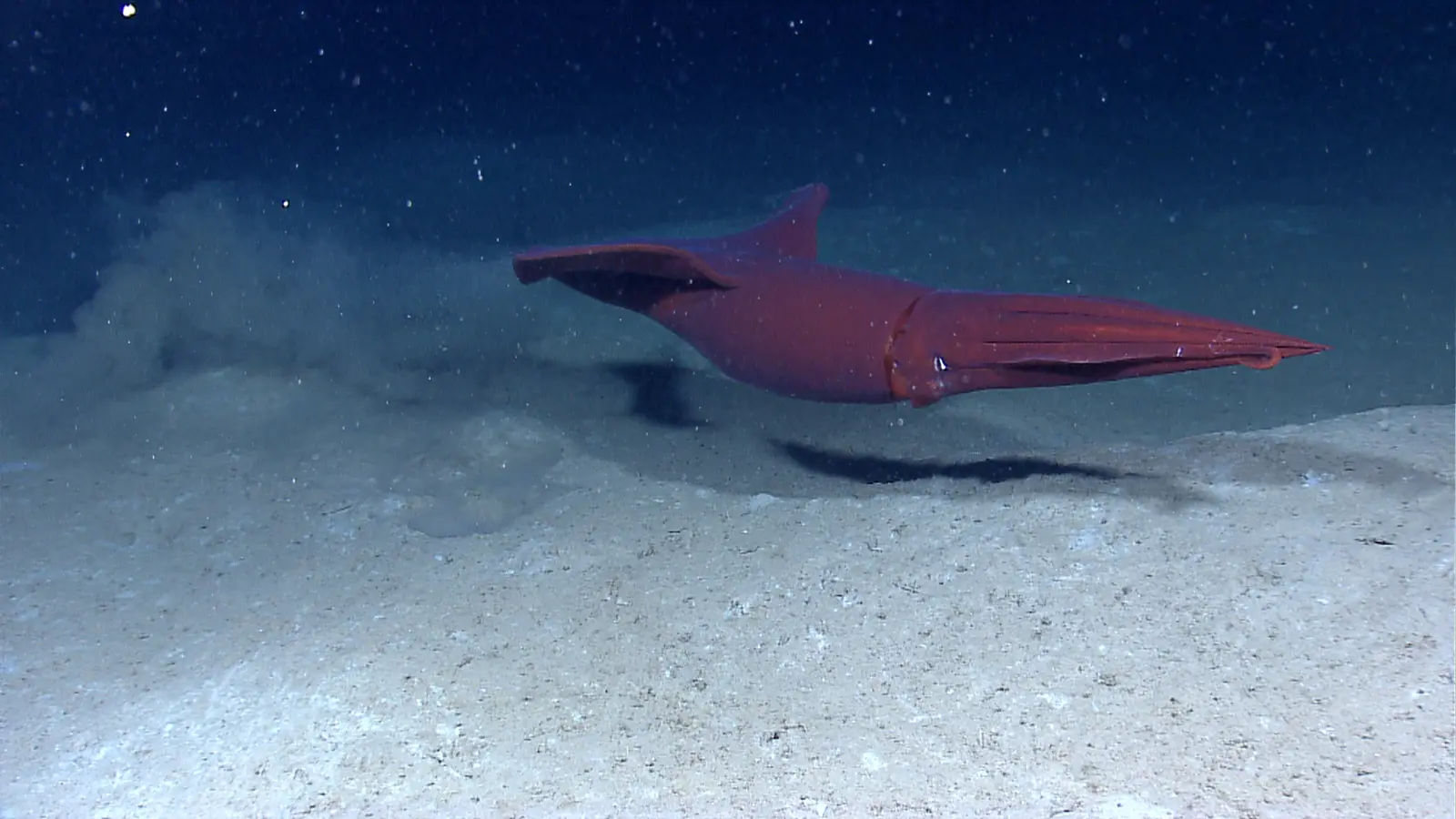
A red squid, Pholidoteuthis adami, near the Gulf of Mexico seafloor on a 2012 NOAA Okeanos Explorer expedition. Its red shows because of the ROV's white lamps.
"Expl8167 (9660934349)" by NOAA Okeanos Explorer Program, Gulf of Mexico 2012 Expedition — https://commons.wikimedia.org/wiki/File:Expl8167_(9660934349).jpg — CC BY 2.0 (https://creativecommons.org/licenses/by/2.0/)

Below about 100 m (328 ft), a red squid is, in effect, a black one. Seawater has absorbed the red. Pure water absorbs 650 nm red light about 30 times faster than 475 nm blue, by the values Pope and Fry measured in 1997. A red pigment reflects red and absorbs the other colors, so where no red light arrives it has almost nothing to send back to an eye (NOAA Ocean Exploration).
That is the usual explanation for why so many animals of the dim water between 200 and 1,000 m (656 and 3,281 ft) are red or black, a pattern NOAA Ocean Exploration describes on its fact pages. A few dragonfishes at those depths complicate it. Malacosteus niger makes far-red light of its own and has eyes that can sense it (Widder et al. 1984; Douglas et al. 1999).
How deep does red light reach in the ocean?
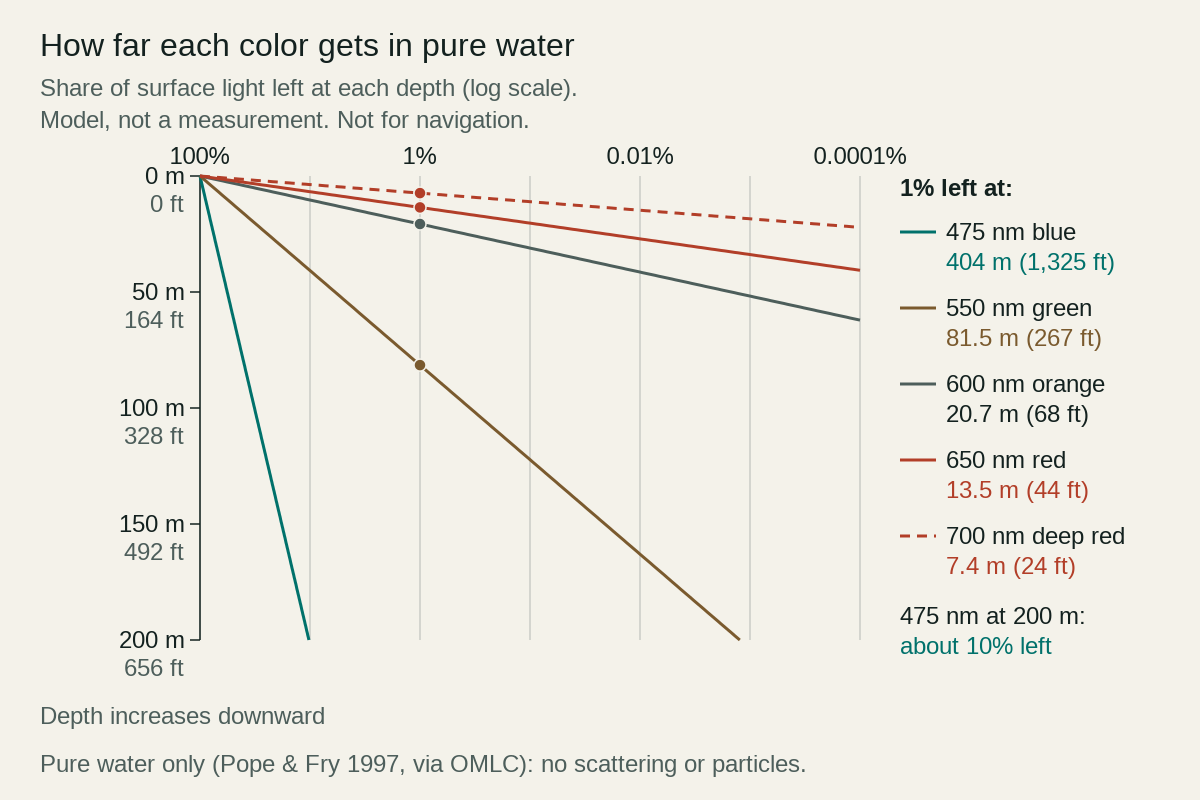
The chart below uses the simplest model of how light fades in water: every meter takes away the same share of what is left. In symbols, I = I₀ × e^(−a × z), where I₀ is the light entering the water, I is what is left at depth z, and a is the absorption coefficient for one color. Pope and Fry measured a for pure water. The table of their values hosted by OMLC runs from 380 to 727.5 nm.
Their values climb steeply toward red: 0.0114 per meter at 475 nm, 0.340 at 650 nm and 0.624 at 700 nm. By this page's calculation from Pope and Fry's values, 1% of 700 nm deep-red light is left at about 7.4 m (24 ft), 1% of 650 nm red at about 13.5 m (44 ft) and 1% of 600 nm orange at about 20.7 m (68 ft).
Green fares in between, with 1% of 550 nm light left at about 81.5 m (267 ft). Blue light at 475 nm keeps 1% down to about 404 m (1,325 ft).
At 100 m, the model leaves less than a trillionth of the 650 nm light that entered at the surface. NOAA Ocean Exploration's fact page on red animals reaches the same point in plain words: "At 100 meters, red light does not penetrate."
Open full-size chart, or scroll it sideways to read every label
Share of surface light left at each depth for five colors, calculated from Pope and Fry's 1997 pure-water absorption values, with the same share lost every meter. Model, not a measurement; values in the CSV.
Credit and data
"How far each color gets in pure water" by Ocean Life & Lore, https://oceanlifeandlore.com/deep/why-deep-sea-animals-are-red/, licensed under CC BY 4.0 (https://creativecommons.org/licenses/by/4.0/).
Data: Pope & Fry 1997, Applied Optics 36: 8710–8723, pure-water absorption values as tabulated by OMLC (https://omlc.org/spectra/water/data/pope97.txt), factual measurements, no license stated, retrieved 2026-10-15.
The model is simplified on purpose. It counts only what pure water absorbs, and it leaves out scattering, the uneven spectrum of sunlight, and the particles, plankton and dissolved matter in real seawater.
The real ocean is darker than this model. NOAA Ocean Service notes that light may be detected as far as 1,000 m down but that there is rarely any significant light beyond 200 m. The model still leaves about 10% of 475 nm light at 200 m.
Red sunlight runs out far above the depths recorded for this article's dragonfish and jellyfish. At Osprey Reef in the Coral Sea, tracked chambered nautiluses spent their days either nearly still at 160–225 m (525–738 ft) or foraging at 489–700 m (1,604–2,297 ft; Dunstan et al. 2011). Even the shallower band is far below the point where the model runs out of red.
Why does a red animal look black down there?
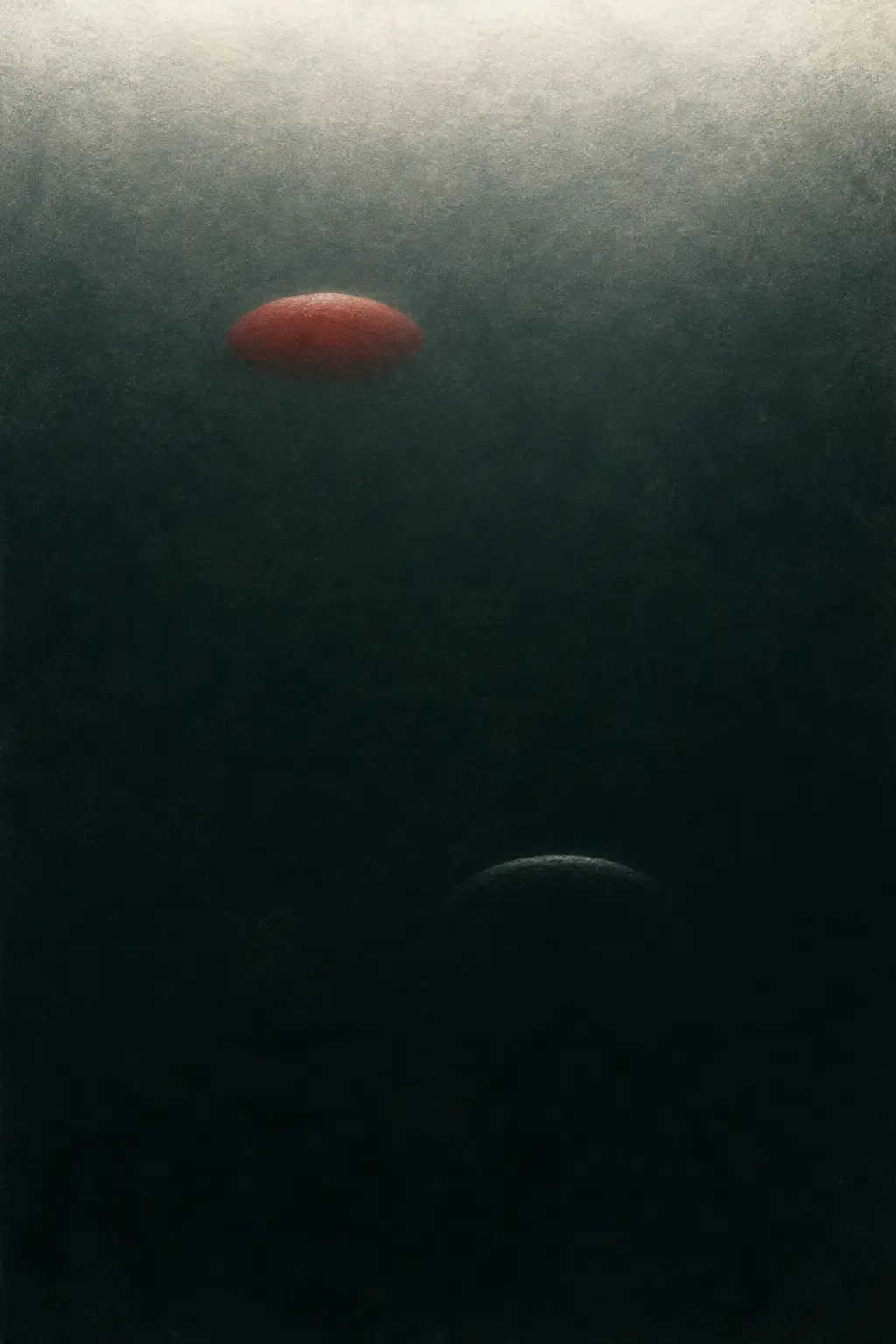
Color is the light an object sends back. When white light strikes it, some wavelengths are absorbed and the rest are reflected, and the reflected mix is the color seen (NOAA Ocean Exploration). A red pigment absorbs blue and green and reflects red, so once the red is gone, the pigment has almost nothing to reflect.
 Illustration
The same small body twice: red near the light at the top, and nearly lost in the dark lower down, where the red is gone and the pigment has almost nothing to reflect.
Illustration: Ocean Life & Lore. Generated illustration — not a photograph, specimen or historical record. Reuse: CC BY 4.0 (https://creativecommons.org/licenses/by/4.0/); no rights are claimed beyond what the law grants.
This site calls the result “the red cloak”: below the depth where seawater has used up the red, red pigment works, in effect, as black, and so as concealment. The figure of speech has limits. NOAA Ocean Exploration also describes transparent animals with red stomachs and, on the bottom, pale red or cream ones. And the cloak may fail in front of the few dragonfishes that make red light, as the last section shows.
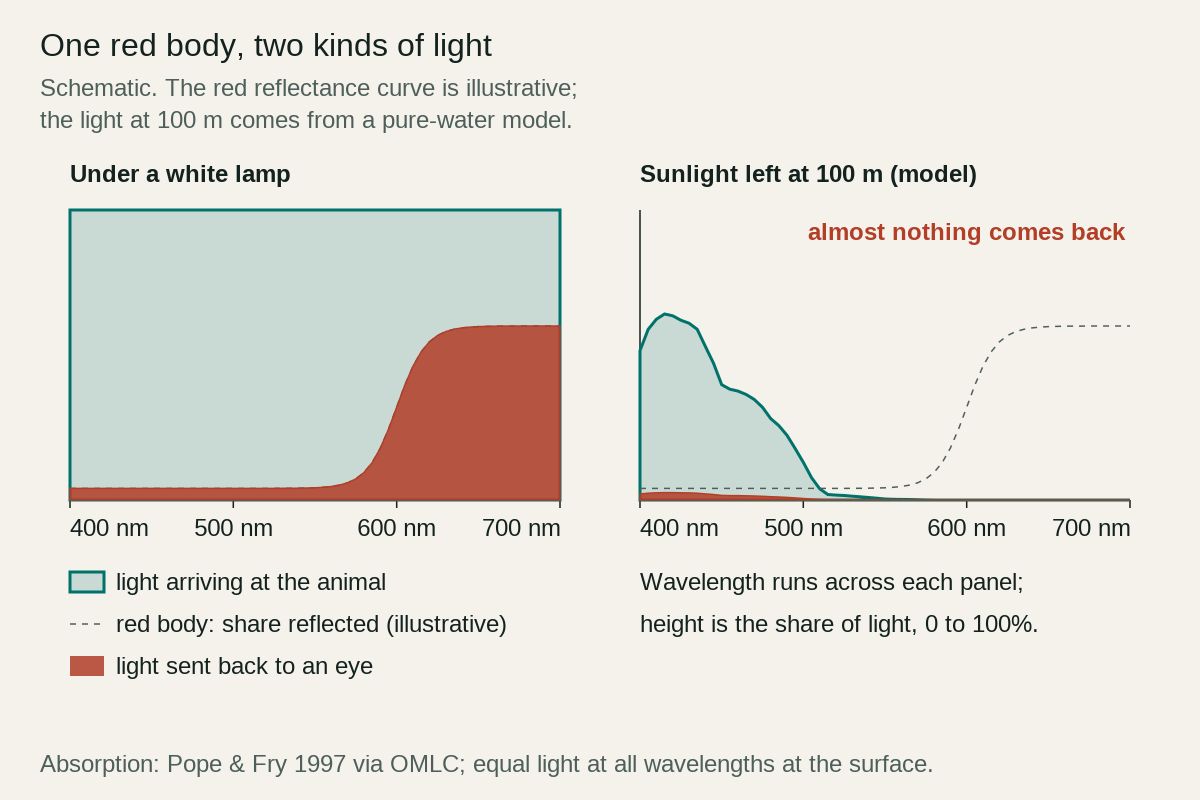
Open full-size chart, or scroll it sideways to read every label
Schematic: one red surface under a white lamp and under the sunlight left at 100 m in a pure-water model. The reflectance curve is illustrative, not measured.
Credit and data
"One red body, two kinds of light" by Ocean Life & Lore, https://oceanlifeandlore.com/deep/why-deep-sea-animals-are-red/, licensed under CC BY 4.0 (https://creativecommons.org/licenses/by/4.0/).
Data: Pope & Fry 1997, Applied Optics 36: 8710–8723, pure-water absorption values as tabulated by OMLC (https://omlc.org/spectra/water/data/pope97.txt), factual measurements, no license stated, retrieved 2026-10-15.
Under the lamp, the red body sends back a band of red. Under the light left at 100 m, which the model confines to violet, blue and blue-green, it sends back almost nothing. Red pigment is common at these depths, and NOAA Ocean Exploration gives camouflage as the most likely explanation.
A 2005 study by Johnsen measured the color of about 70 deep-sea species. The open-water species reflected far less blue-green light than would best hide them in the dim light from above, and came closer to the zero reflectance that would best hide them from a bioluminescent searchlight. Johnsen read this as a sign that, at mesopelagic depths, light made by animals matters more than sunlight for spotting them.
That light is mostly blue too. Douglas and colleagues noted in 2016 that both the sunlight left in the deep ocean and its bioluminescence are centered around 470–490 nm, and a red or black body sends back little of either.
The seafloor species in Johnsen's sample were more variable, and they were a relatively poor match for the ground they were found on. Estimates of how well deep-sea eyes pick out contrast suggest that a rough match may be enough there. Many of the crabs carried striking patterns that may break up their outlines.
Red, black or see-through: who wears what, and where?
NOAA Ocean Exploration describes a surprisingly regular pattern in the color of ocean animals by depth. Blue animals live near the surface, and slightly deeper they are blue on top and white underneath. Deeper still, animals are generally transparent but have red stomachs; below that they are red or black all over, and on the bottom almost all are pale red or cream.
The page gives no depth numbers for those bands, and it calls camouflage the most likely explanation, not a proven one. It also names the catch for animals in open water. On the seafloor, the background and the animal are lit by the same light; for an animal swimming in midwater, the light coming from the background does not change with the light around it in a simple way.
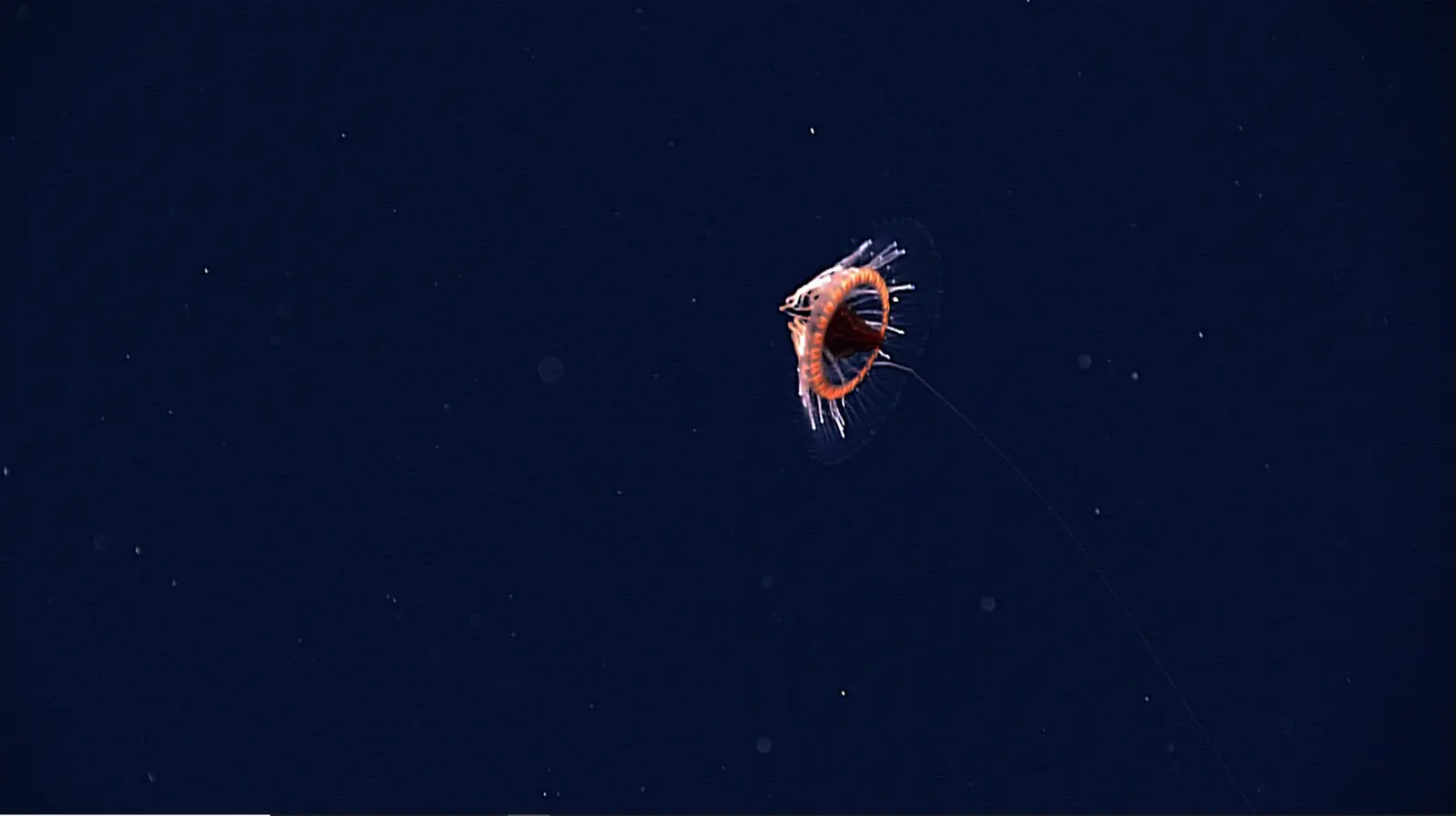
A coronate jellyfish of the genus Atolla at about 800 m (2,625 ft) off Puerto Rico on 28 April 2015, seen on a NOAA ROV dive. Its red shows under the vehicle's lamps.
Credit and data
"Coronate of the genus Atolla Puerto Rico 28 April 2015" by NOAA Office of Ocean Exploration and Research — https://commons.wikimedia.org/wiki/File:Coronate_of_the_genus_Atolla_Puerto_Rico_28_April_2015.png — Public domain (US federal government work: image by the NOAA Office of Ocean Exploration and Research, Océano Profundo 2015 expedition (Commons PD-USGov-NOAA))

Against blue-green light, red and black do the same job. NOAA Ocean Exploration notes that black animals absorb all the colors of light available and that red animals look black too, because there is no red light to reflect. Transparency is a different approach, and NOAA's pattern places it above the red-and-black layer.
Blue is the color that seldom turns up in midwater, NOAA Ocean Exploration adds. Blue light travels best in water, so a blue body would reflect the very light that is left and stand out to predators.
At about 800 m (2,625 ft) off Puerto Rico in 2015, the Atolla in the photo above shows plenty of red. But that color on camera is the lamp's.
Why do deep-sea animals look bright red in photos?
Underwater vehicles carry their own white light. That light contains the red that sunlight lost on the way down. NOAA's caption for the squid at the top of this page makes the point: blue light does not reflect off red animals, so they are much harder to see without a source of bright white light such as the lamps on the ROV Little Herc.
The red in those pictures comes down with the vehicle.
NOAA recorded the shrimp below off Puerto Rico in 2015, on the first ROV dive of its Océano Profundo expedition. That dive began at 4,055 m (13,304 ft). The starting depth is a little deeper than the wreck of the Titanic, which lies at about 3,800 m (12,467 ft), according to NOAA Ocean Exploration. Both are far below 1,000 m, where NOAA Ocean Service puts the start of the aphotic zone, in which sunlight does not penetrate.
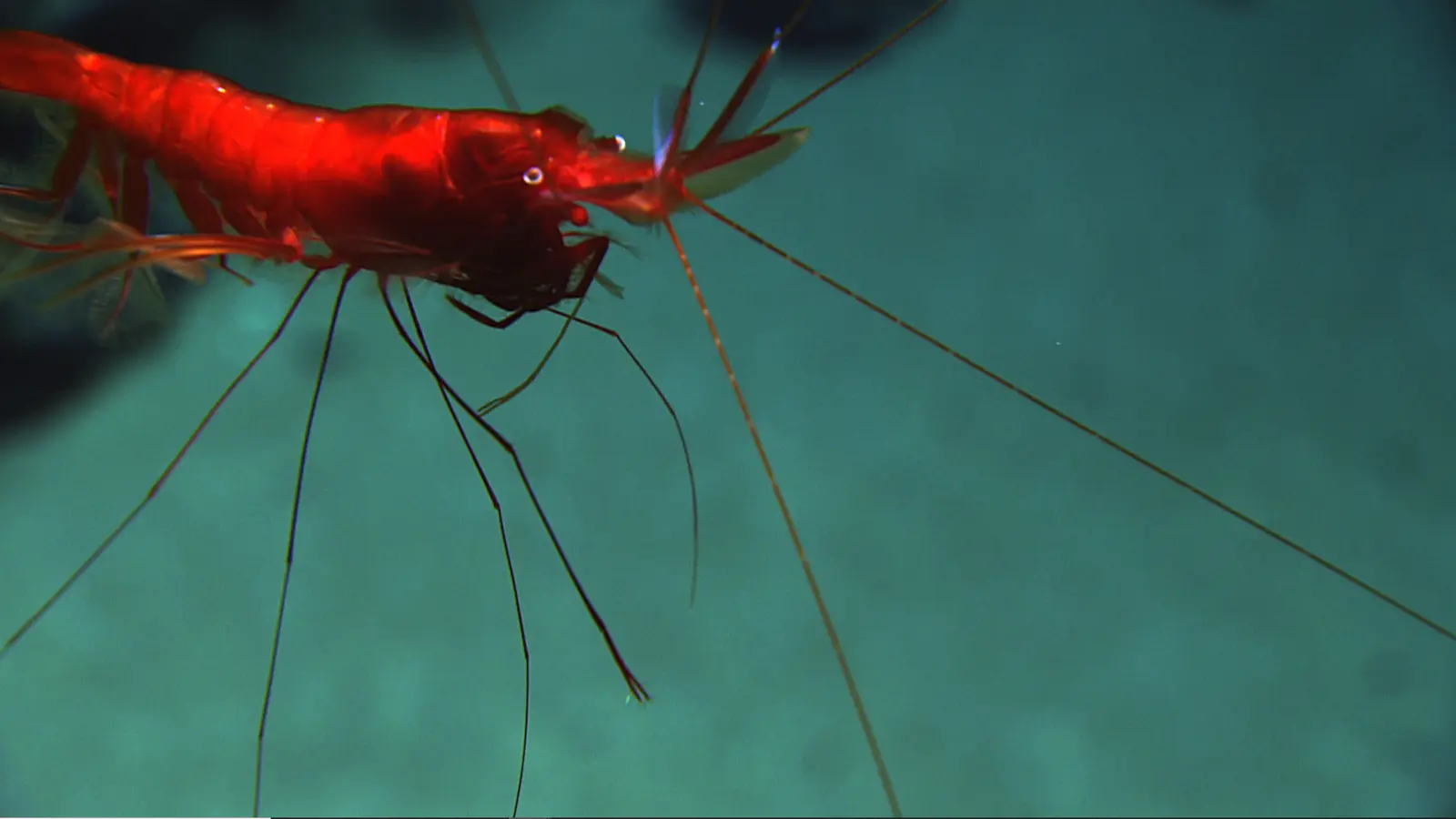
A red shrimp off Puerto Rico in 2015, lit by an ROV's lamps on a NOAA dive that began at 4,055 m (13,304 ft). NOAA's caption notes that in the dark it would appear black.
Credit and data
"Red shrimp Puerto Rico April 2015" by NOAA Office of Ocean Exploration and Research, Exploring Puerto Rico’s Seamounts, Trenches, and Troughs — https://commons.wikimedia.org/wiki/File:Red_shrimp_Puerto_Rico_April_2015.png — Public domain (US federal government work: image by the NOAA Office of Ocean Exploration and Research, Océano Profundo 2015 expedition (Commons PD-USGov-NOAA; NOAA OE page credits NOAA OER only))

Lamp-lit images are still the better record. This site puts images taken at an animal's own depth ahead of deck photos (see About Ocean Life & Lore), because a hauled-up animal can arrive damaged or deformed. Gastineau and colleagues note that Malacosteus niger, a dragonfish of 600–1,000 m (1,969–3,281 ft), is frequently damaged by fishing gear. An image from the vehicle shows the animal at its own depth and in its own shape; only the color comes from the lamp.
The fish that cheats: can anything down there see red?
Below 600 m in the Atlantic, in the catch records Kenaley analyzed in 2008, lives a black dragonfish that breaks the rule. Malacosteus niger, the stoplight loosejaw, is about 15–20 cm long and is reported at 600–1,000 m (1,969–3,281 ft), where it prefers small prey such as copepods (Gastineau et al. 2023).
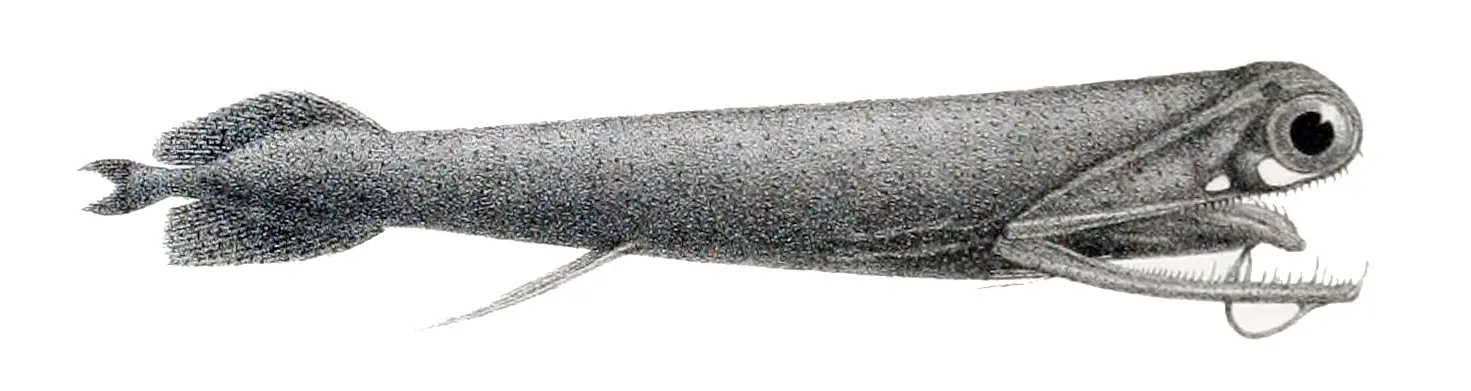
Malacosteus niger, drawn from a specimen by Robert Mintern for Günther's 1887 Challenger report as M. indicus, now a synonym. The report lists 500 fathoms, about 914 m (3,000 ft), off the Philippines.
"Malacosteus niger3" by Robert Mintern — https://commons.wikimedia.org/wiki/File:Malacosteus_niger3.jpg — Public domain (lithograph published in London in 1887; artist Robert Mintern died in 1908)

In a 1984 paper, Widder and colleagues reported measurements of its light. Photophores, or light-producing organs, below the eyes glow red into the near infrared, with a peak at about 705 nm, while organs behind the eyes give blue light peaking at 470–480 nm. Most deep-sea fishes are tuned to blue: of 195 visual pigments measured in deep-sea fishes, about 87% absorb most strongly at 468–494 nm (Douglas, Partridge and Marshall 1998).
Making red light takes a detour. Widder's team suggested that it may come from an energy transfer combined with a wavelength-selective filter. Gastineau and colleagues summarize later work: the reaction in the red organ makes blue light that is never emitted, because its energy passes to fluorescent proteins that glow red (citing Campbell and Herring 1987 and Herring and Cope 2005).
Malacosteus is one of three loosejaw dragonfish genera, with Aristostomias and Pachystomias, that make far-red light (maximum emission above 700 nm) and are sensitive to it (Douglas, Mullineaux and Partridge 2000). In their words, all other animals of the deep sea are "blind" to this part of the spectrum, which potentially gives the three genera a private waveband for lighting up prey and for signaling.
Aristostomias and Pachystomias reach the red with at least three visual pigments shifted toward longer wavelengths, absorbing most strongly near 515, 550 and 590 nm. Malacosteus lacks the most red-sensitive of these. Instead, Douglas and colleagues identified in 1999 a mixture of compounds derived from bacteriochlorophylls c and d in its retina, which acts as a photosensitizer and raises its sensitivity to long wavelengths.
A 2016 study adds that this pigment absorbs strongly near 675 nm, and that a reflective layer behind the retina, built on astaxanthin, sends red light back through the photoreceptors for a second pass. The relatives also live differently. The same paper notes that Pachystomias microdon migrates over a large depth range in search of lanternfish, while Malacosteus species generally stay below 600 m and feed largely on copepods.
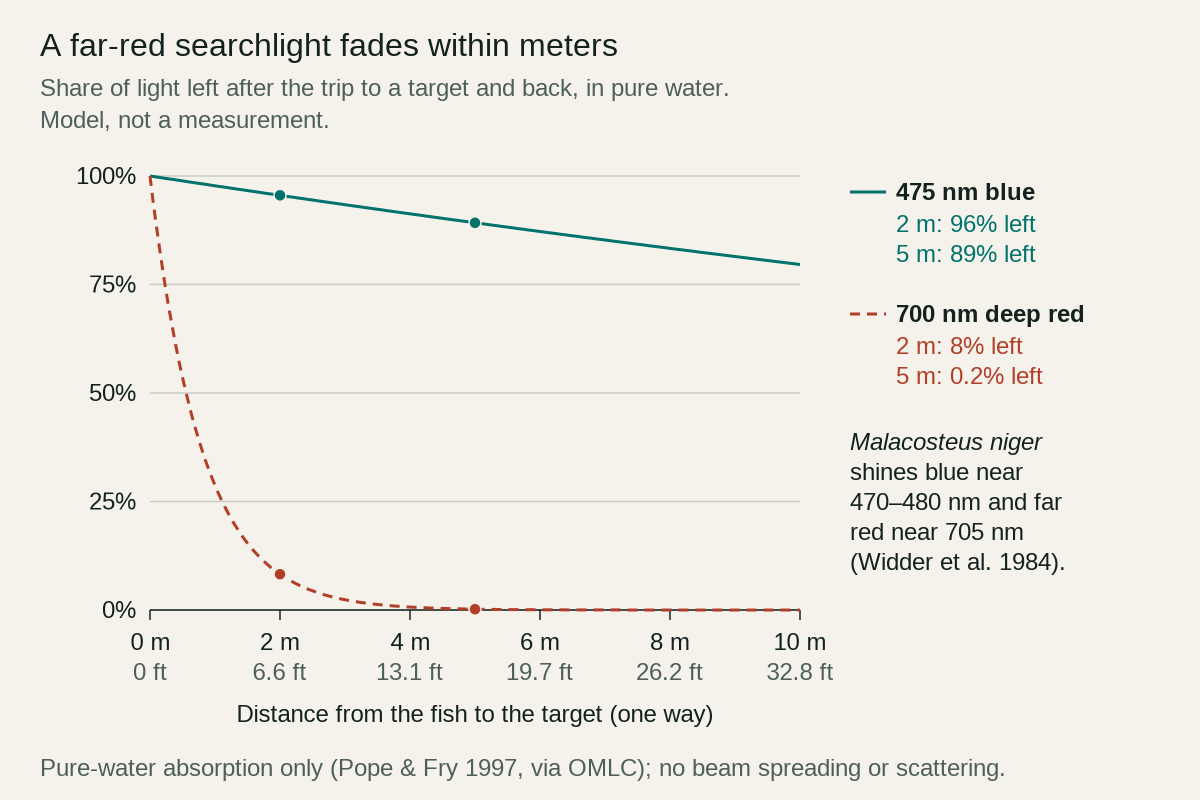
Open full-size chart, or scroll it sideways to read every label
Share of light left after the trip to a target and back through pure water, for 475 nm blue and 700 nm deep red. Model, not a measurement; the values are in the CSV download.
Credit and data
"A far-red searchlight fades within meters" by Ocean Life & Lore, https://oceanlifeandlore.com/deep/why-deep-sea-animals-are-red/, licensed under CC BY 4.0 (https://creativecommons.org/licenses/by/4.0/).
Data: Pope & Fry 1997, Applied Optics 36: 8710–8723, pure-water absorption values as tabulated by OMLC (https://omlc.org/spectra/water/data/pope97.txt), factual measurements, no license stated, retrieved 2026-10-15; Widder et al. 1984, Science 225: 512–514 (https://doi.org/10.1126/science.225.4661.512), facts from the published abstract, retrieved 2026-10-15.
The trick has a short reach. By this page's calculation from Pope and Fry's values, 700 nm light aimed at a target 2 m away comes back with about 8% of its strength, and from 5 m with about 0.2%, while 475 nm blue keeps about 89% from 5 m. The model leaves out beam spreading and scattering, and it uses the value for 700 nm; the same table gives a slightly higher 0.704 per meter at the 705 nm peak.
 Illustration
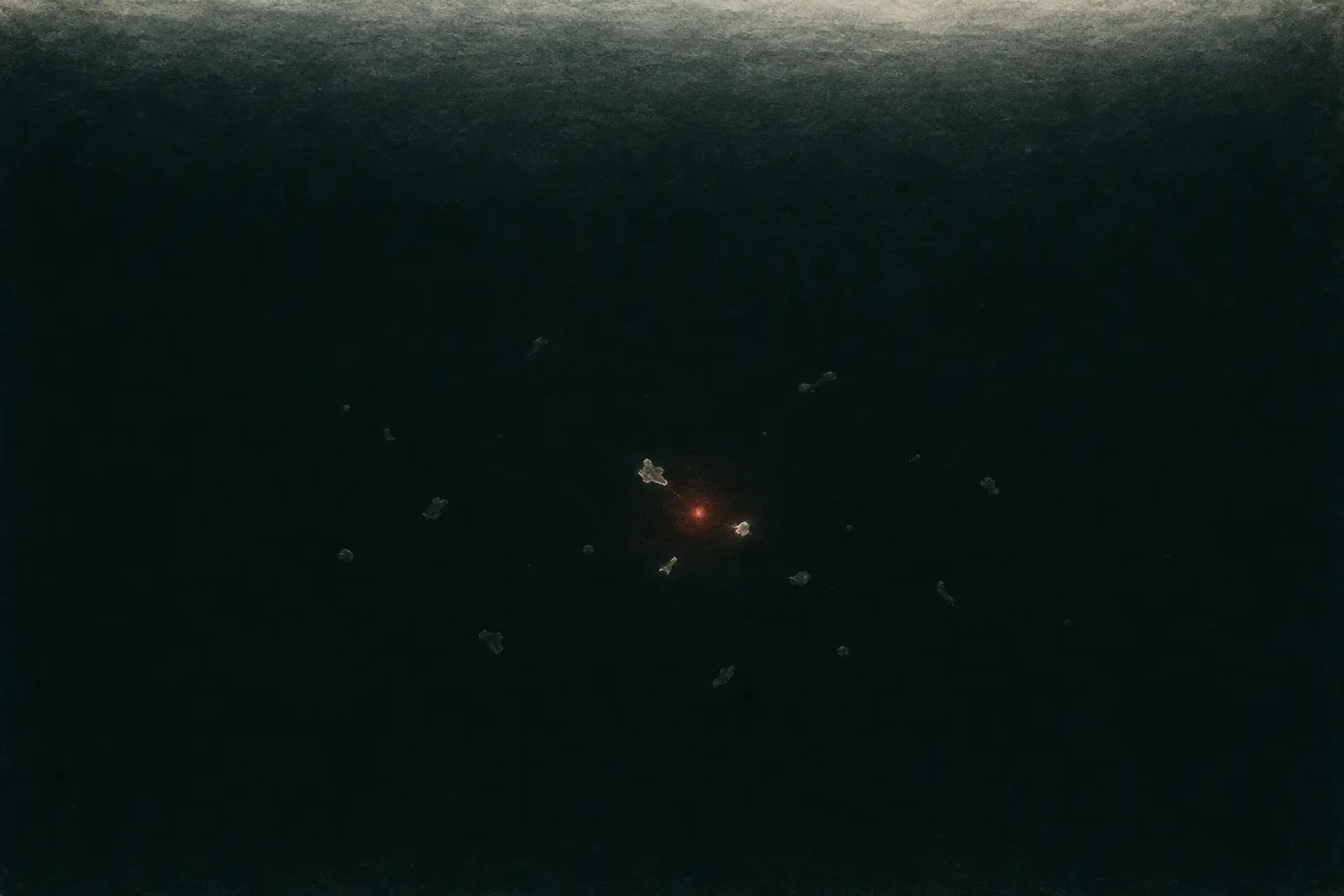
A small red light in dark water reaches only the nearest specks. In this page's pure-water model, 700 nm light aimed at a target 5 m away returns with about 0.2% of its strength.
Illustration: Ocean Life & Lore. Generated illustration — not a photograph, specimen or historical record. Reuse: CC BY 4.0 (https://creativecommons.org/licenses/by/4.0/); no rights are claimed beyond what the law grants.
The story goes that red animals are invisible in the deep. NOAA Ocean Exploration's fact pages call them "essentially invisible" and say that at depth such animals are not visible. Against the blue-green light that most deep-sea fish eyes are tuned to, the measurements above agree; in front of a loosejaw dragonfish's far-red light, the "red cloak" may not hide anything.
One link in the cheat is still unsounded. Bacteriochlorophylls c and d are made by photosynthetic bacteria, the best known being green sulfur bacteria. Douglas and colleagues concluded in 2016 that the pigment in Malacosteus most likely reaches it through its diet, which is largely copepods. None of the sources checked here traces the route from those bacteria to the retina of a fish that lives below 600 m.
Lore check
2 claims sounded: bends ×1unsounded ×1
| Claim | Verdict | Evidence |
|---|---|---|
| Red animals are invisible in the deep | bends | Stated by NOAA Ocean Exploration fact pages (2014, 2015). True under blue-green light: Johnsen 2005 found open-water species reflect very little of it. Overstated as invisible: red pigment reflects red (NOAA Ocean Exploration 2014), and Malacosteus, Aristostomias and Pachystomias make and sense far-red light, "a private waveband for illuminating prey" (Widder et al. 1984; Douglas et al. 2000). |
| Red and black animals predominate in the deep ocean | unsounded | Stated by NOAA Ocean Exploration (2014) without counts. Missing: a census of body color by depth with sample sizes. Checked: NOAA Ocean Exploration fact pages (2014, 2015); Johnsen 2005 (abstract). |
Further down:
- Challenger Deep: about 10,935 m (35,876 ft) down (NOAA Ocean Exploration), more than ten times deeper than the 1,000 m where NOAA says sunlight stops reaching.
- Vampire squid: Vampyroteuthis infernalis spends most of its life in the oxygen minimum zone, feeding on detritus from fine particles to marine aggregates (Hoving and Robison 2012).
Sources
- 1Pope, R. M., and E. S. Fry. "Absorption spectrum (380–700 nm) of pure water. II. Integrating cavity measurements." Applied Optics 36 (1997): 8710–8723. doi:10.1364/AO.36.008710. Values as tabulated by OMLC. https://omlc.org/spectra/water/data/pope97.txt Read: data table (values as tabulated by OMLC).
- 2Widder, E. A., M. I. Latz, P. J. Herring, and J. F. Case. "Far red bioluminescence from two deep-sea fishes." Science 225 (1984): 512–514. doi:10.1126/science.225.4661.512 https://doi.org/10.1126/science.225.4661.512 Read: abstract.
- 3Douglas, R. H., J. C. Partridge, K. S. Dulai, D. M. Hunt, C. W. Mullineaux, and P. H. Hynninen. "Enhanced retinal longwave sensitivity using a chlorophyll-derived photosensitiser in Malacosteus niger, a deep-sea dragon fish with far red bioluminescence." Vision Research 39 (1999): 2817–2832. doi:10.1016/S0042-6989(98)00332-0 https://doi.org/10.1016/S0042-6989(98)00332-0 Read: abstract.
- 4Douglas, R. H., C. W. Mullineaux, and J. C. Partridge. "Long-wave sensitivity in deep-sea stomiid dragonfish with far-red bioluminescence: evidence for a dietary origin of the chlorophyll-derived retinal photosensitizer of Malacosteus niger." Philosophical Transactions of the Royal Society of London B 355 (2000): 1269–1272. doi:10.1098/rstb.2000.0681 https://doi.org/10.1098/rstb.2000.0681 Read: abstract.
- 5Douglas, R. H., M. J. Genner, A. G. Hudson, J. C. Partridge, and H. J. Wagner. "Localisation and origin of the bacteriochlorophyll-derived photosensitizer in the retina of the deep-sea dragon fish Malacosteus niger." Scientific Reports 6 (2016): 39395. doi:10.1038/srep39395 https://doi.org/10.1038/srep39395 Read: full text.
- 6Douglas, R. H., J. C. Partridge, and N. J. Marshall. "The eyes of deep-sea fish. I: Lens pigmentation, tapeta and visual pigments." Progress in Retinal and Eye Research 17 (1998): 597–636. doi:10.1016/S1350-9462(98)00002-0 https://doi.org/10.1016/S1350-9462(98)00002-0 Read: abstract.
- 7Johnsen, S. "The red and the black: bioluminescence and the color of animals in the deep sea." Integrative and Comparative Biology 45 (2005): 234–246. doi:10.1093/icb/45.2.234 https://doi.org/10.1093/icb/45.2.234 Read: abstract.
- 8Kenaley, C. P. "Diel vertical migration of the loosejaw dragonfishes (Stomiiformes: Stomiidae: Malacosteinae): a new analysis for rare pelagic taxa." Journal of Fish Biology 73 (2008): 888–901. doi:10.1111/j.1095-8649.2008.01983.x https://doi.org/10.1111/j.1095-8649.2008.01983.x Read: abstract.
- 9Gastineau, R., C. Otis, B. Boyle, C. Lemieux, M. Turmel, J. St-Cyr, and M. Koken. "The mitochondrial genome of the bioluminescent fish Malacosteus niger Ayres, 1848 (Stomiidae, Actinopterygii) is large and complex, and contains an inverted-repeat structure." ZooKeys 1157 (2023): 177–191. doi:10.3897/zookeys.1157.97921 https://doi.org/10.3897/zookeys.1157.97921 Read: full text (introduction).
- 10Günther, A. Report on the Deep-Sea Fishes Collected by H.M.S. Challenger during the Years 1873–76. Report on the Scientific Results of the Voyage of H.M.S. Challenger, Zoology 22. London, 1887. Plate LIV and p. 214. https://archive.org/details/reportondeepseaf00gn Read: p. 214 and the explanation of plate LIV.
- 11Dunstan, A. J., P. D. Ward, and N. J. Marshall. "Vertical distribution and migration patterns of Nautilus pompilius." PLoS ONE 6 (2011): e16311. doi:10.1371/journal.pone.0016311 https://doi.org/10.1371/journal.pone.0016311 Read: abstract.
- 12Hoving, H. J., and B. H. Robison. "Vampire squid: detritivores in the oxygen minimum zone." Proceedings of the Royal Society B 279 (2012): 4559–4567. doi:10.1098/rspb.2012.1357 https://doi.org/10.1098/rspb.2012.1357 Read: abstract.
- 13NOAA Ocean Exploration. "Why are so many deep-sea animals red in color?" Published March 25, 2014; last updated December 18, 2020. https://oceanexplorer.noaa.gov/ocean-fact/red-color/ Read: full text.
- 14NOAA Ocean Exploration. "How does depth affect the color of marine animals?" Published May 19, 2015; last updated May 25, 2021. https://oceanexplorer.noaa.gov/ocean-fact/animal-color/ Read: full text.
- 15NOAA Ocean Service. "How far does light travel in the ocean?" Last updated September 23, 2026. https://oceanservice.noaa.gov/facts/light_travel.html Read: full text.
- 16NOAA Ocean Exploration. "How deep is the ocean?" Last updated August 21, 2024. https://oceanexplorer.noaa.gov/ocean-fact/ocean-depth/ Read: full text.
- 17NOAA Ocean Exploration. "Titanic Bow" (daily image, from R.M.S. Titanic Expedition 2003). https://oceanexplorer.noaa.gov/multimedia/daily-image-media-20210415/ Read: full text.
- 18NOAA Ocean Exploration. "May 12, 2021: Shrimp" (daily image, from Océano Profundo 2015: Exploring Puerto Rico’s Seamounts, Trenches, and Troughs). https://oceanexplorer.noaa.gov/multimedia/daily-image-media-20210512/ Read: full text.
- 19NOAA Photo Library. "expl8167" (Voyage to Inner Space – Exploring the Seas With NOAA collection; credit NOAA Okeanos Explorer Program, Gulf of Mexico 2012 Expedition), image description on Wikimedia Commons. https://commons.wikimedia.org/wiki/File:Expl8167_(9660934349).jpg Read: image description.
- 20NOAA Office of Ocean Exploration and Research. "A coronate of the genus Atolla at a depth of 800 meters (2,625 feet) near Puerto Rico" (28 April 2015), image description on Wikimedia Commons. https://commons.wikimedia.org/wiki/File:Coronate_of_the_genus_Atolla_Puerto_Rico_28_April_2015.png Read: image description.
- 21NOAA Office of Ocean Exploration and Research. "A shrimp near Puerto Rico appears red in artificial light but looks black in the deep ocean" (April 2015), image description and NOAA caption on Wikimedia Commons. https://commons.wikimedia.org/wiki/File:Red_shrimp_Puerto_Rico_April_2015.png Read: image description.
- 22WoRMS records accessed 2026-10-15: Froese, R. and D. Pauly. Editors. (2026). FishBase. Malacosteus niger Ayres, 1848 (AphiaID 127358); Aristostomias Zugmayer, 1913 (126201); Pachystomias Günther, 1887 (126216); Pachystomias microdon (Günther, 1878) (127367). Accessed through: World Register of Marine Species. MolluscaBase eds. (2026). MolluscaBase. Pholidoteuthis adami G. L. Voss, 1956 (342247); Nautilus pompilius Linnaeus, 1758 (216384); Vampyroteuthis infernalis Chun, 1903 (141887). Accessed through: World Register of Marine Species. Collins, A.G.; Morandini, A.C. (2026). World List of Scyphozoa. Atolla Haeckel, 1880 (135248). Accessed through: World Register of Marine Species. Froese, R. and D. Pauly. Editors. (2026). FishBase. Malacosteus indicus Günther, 1878 (275161; unaccepted, synonym of Malacosteus niger). Accessed through: World Register of Marine Species. Walter, T.C. and G. Boxshall (2026). World of Copepods Database. Chirundina streetsii Giesbrecht, 1895 (104294). Accessed through: World Register of Marine Species. https://www.marinespecies.org/aphia.php?p=taxdetails&id=127358 Read: species records.
Cite this page
Ocean Life & Lore. “Why So Many Deep-Sea Animals Are Red, and Look Black.” Ocean Life & Lore. Published 2026-10-15; last substantive revision 2026-10-15. https://oceanlifeandlore.com/deep/why-deep-sea-animals-are-red/ (accessed the date you read it).
Download the data: Sounding line (CSV) CSV (source and license record) Data: Gastineau et al. 2023, ZooKeys 1157: 177–191 (https://doi.org/10.3897/zookeys.1157.97921), CC BY 4.0, retrieved 2026-10-15; NOAA Ocean Service, How far does light travel in the ocean? (https://oceanservice.noaa.gov/facts/light_travel.html), US federal government work (public domain), retrieved 2026-10-15; NOAA Ocean Exploration, Titanic Bow daily image (https://oceanexplorer.noaa.gov/multimedia/daily-image-media-20210415/), US federal government work (public domain), retrieved 2026-10-15; NOAA Ocean Exploration, How deep is the ocean? (https://oceanexplorer.noaa.gov/ocean-fact/ocean-depth/), US federal government work (public domain), retrieved 2026-10-15. · Light left by depth (CSV) CSV (source and license record) Data: Pope & Fry 1997, Applied Optics 36: 8710–8723, pure-water absorption values as tabulated by OMLC (https://omlc.org/spectra/water/data/pope97.txt), factual measurements, no license stated, retrieved 2026-10-15. · Far-red round trip (CSV) CSV (source and license record) Data: Pope & Fry 1997, Applied Optics 36: 8710–8723, pure-water absorption values as tabulated by OMLC (https://omlc.org/spectra/water/data/pope97.txt), factual measurements, no license stated, retrieved 2026-10-15.
Corrections
No corrections yet.
Every correction on the site is listed in the Corrections logbook. To report an error on this page, use Report a correction with the page URL, the sentence and your source. How claims are sounded sets out the sources, recalculations and verdict rules behind each page.
More from Deep Sea
-
How it works
Challenger Deep: The Deepest Spot Has No Single Agreed Depth
Challenger Deep: 10,935 m
-
Entry
Vampire Squid: It Drinks No Blood and Eats Marine Snow
Vampyroteuthis infernalis: 600–3,300 m