Lore check
Nautilus Shell: Not a Golden Spiral, as Measured in 1838
A golden spiral widens 6.85 times per turn; measured nautilus shells widen about 3 times. The evidence runs from one shell in 1838 to 80 at the Smithsonian.
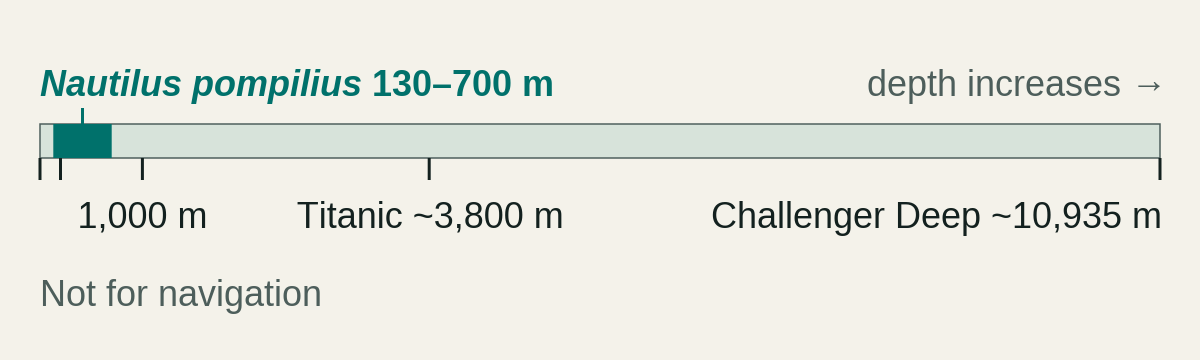
Sounding line: Nautilus pompilius tracked at 130–700 m (427–2,297 ft) at Osprey Reef, Coral Sea (Dunstan et al. 2011), shown against the full depth of the ocean.
Credit and data
"Sounding line: where Nautilus pompilius lives" by Ocean Life & Lore, https://oceanlifeandlore.com/shells/nautilus-golden-ratio/, licensed under CC BY 4.0 (https://creativecommons.org/licenses/by/4.0/).
Data: Dunstan, Ward & Marshall 2011, Vertical distribution and migration patterns of Nautilus pompilius, PLoS ONE 6(2): e16311 (https://doi.org/10.1371/journal.pone.0016311), CC BY, retrieved 2026-10-15; NOAA Ocean Service, How far does light travel in the ocean? (https://oceanservice.noaa.gov/facts/light_travel.html), public domain (US federal government work), retrieved 2026-10-15; NOAA Ocean Exploration, How deep is the ocean? (https://oceanexplorer.noaa.gov/ocean-fact/ocean-depth/), public domain (US federal government work), retrieved 2026-10-15; NOAA Ocean Exploration, Titanic Bow, daily image from the R.M.S. Titanic Expedition 2003 (https://oceanexplorer.noaa.gov/multimedia/daily-image-media-20210415/), public domain (US federal government work), retrieved 2026-10-15.
Spec card
- Common name
- Chambered nautilus
- Scientific name
- Nautilus pompilius Linnaeus, 1758 (WoRMS AphiaID 216384)
- Class
- Cephalopoda
- Coiling
- planispiral
- Raup W, D, T
- W ≈ 2.975 (published value for the genus Nautilus, small sample); D n/a; T n/a
- Size range
- adult shell about 150–200 mm across; hatchling shell about 1 inch
- Depth range
- 130–700 m (427–2,297 ft) tracked at Osprey Reef, Coral Sea; shell implosion at about 800 m (2,625 ft)
nautilus-golden-ratio-spec.csv CSV (source and license record)
Data: MolluscaBase eds. (2026), MolluscaBase, Nautilus pompilius Linnaeus, 1758, accessed through World Register of Marine Species (https://www.marinespecies.org/aphia.php?p=taxdetails&id=216384), CC BY 4.0, retrieved 2026-10-15.
TL;DR. A nautilus shell is a logarithmic spiral, but it widens about 2.9 times per turn (the mean of 46 Smithsonian shells), less than half the 6.85 of a golden spiral. The widest-opening shell reported in these sources is still about 12% short of 1.618. The golden-nautilus claim sinks; the newer "4:3" fix only bends.
Down this page 8 sections
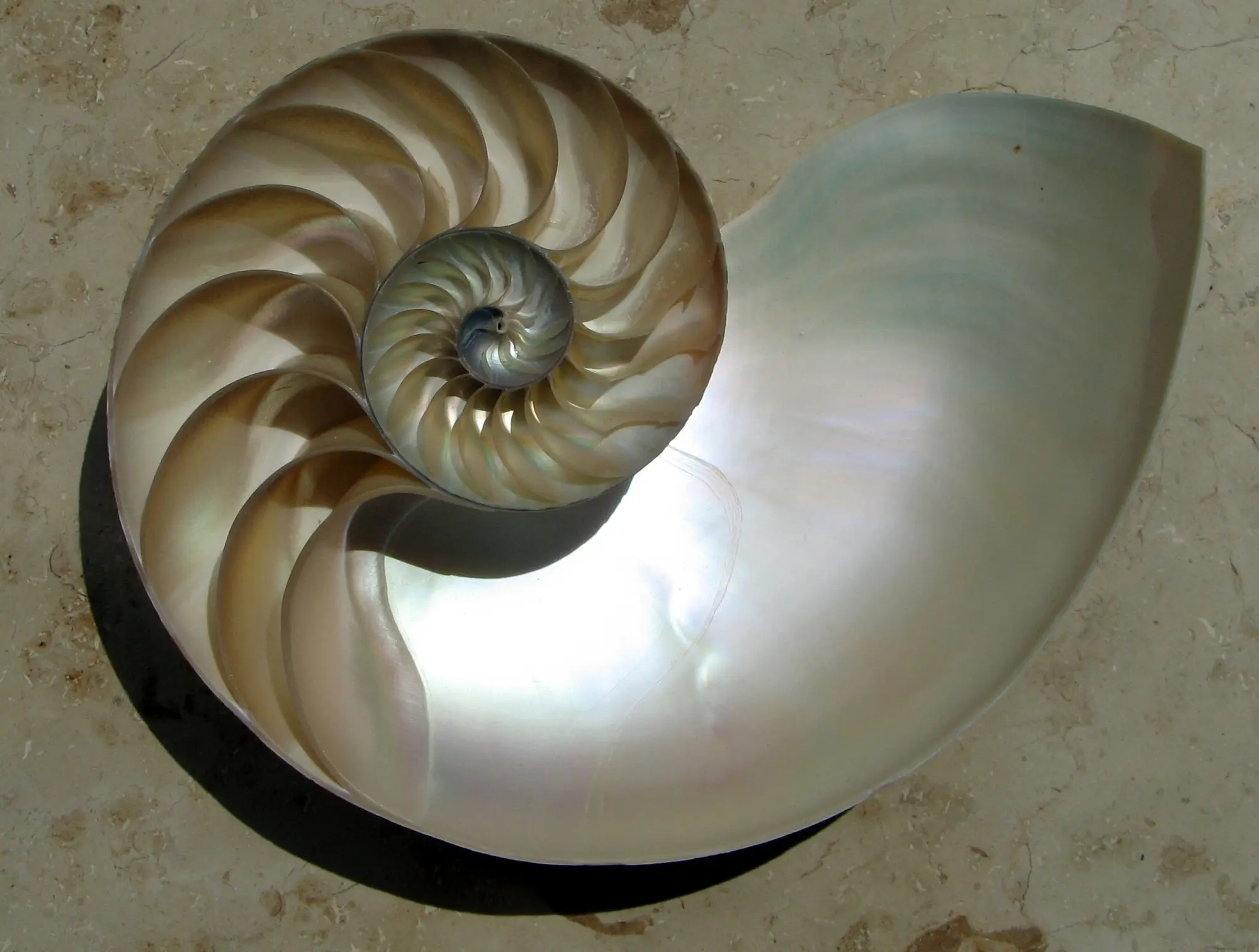
A nautilus shell cut in half. Curved walls called septa close off the older chambers, which wind outward in a logarithmic spiral to the last and largest chamber.
"NautilusCutawayLogarithmicSpiral" by Chris 73 / Wikimedia Commons — https://commons.wikimedia.org/wiki/File:NautilusCutawayLogarithmicSpiral.jpg — CC BY-SA 3.0 (https://creativecommons.org/licenses/by-sa/3.0/)

A chambered nautilus, tracked 130 to 700 meters down off Australia, does not grow a golden spiral. Its shell belongs to the same family of curves, the logarithmic spirals, but it opens far more slowly than the golden version it is usually compared with. A golden spiral becomes 6.85 times wider with every full turn, while measured nautilus shells become about 3 times wider, a figure recorded as early as 1838 and confirmed in Christopher Bartlett's 2019 study of 80 museum shells.
Most of that depth range lies in what NOAA calls the twilight zone, between 200 and 1,000 meters (656 and 3,281 ft), where light fades quickly and photosynthesis is no longer possible. At Osprey Reef in the Coral Sea, the tracked animals spent their days either resting near 160–225 m (525–738 ft) or foraging at 489–700 m (1,604–2,297 ft).
The Edmund Fitzgerald wreck lies near that resting depth: about 162 m (530 ft), in Lake Superior (NTSB 1978). What that light budget does to animal color is the subject of Why So Many Deep-Sea Animals Are Red.
Is the nautilus shell a golden spiral?
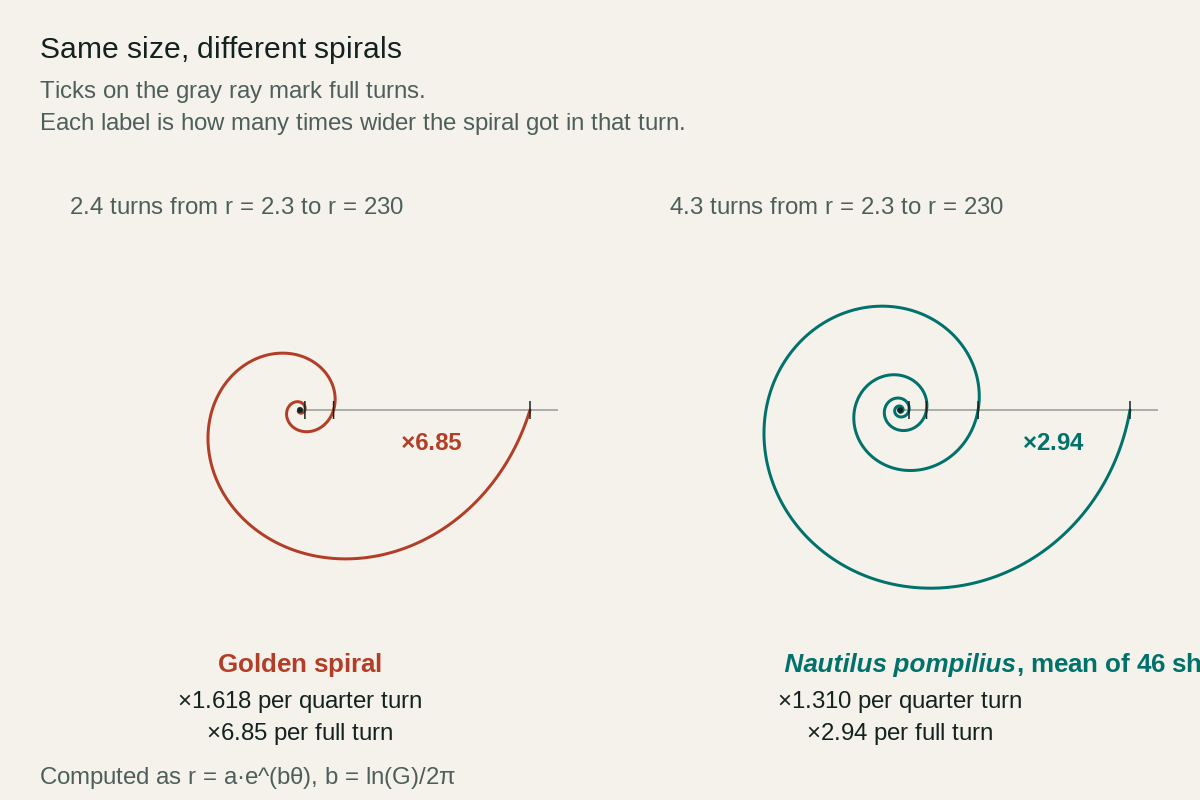
The golden ratio, written φ, equals (1 + √5)/2, or about 1.618, and a golden spiral is the logarithmic spiral that grows by exactly that factor every quarter turn. Because four quarter turns make a full turn, the spiral grows by φ⁴, about 6.85, each time it comes around. Sharp and Bartlett both note that this is the curve traditionally compared with the shell of the nautilus, an Indo-Pacific animal of the twilight zone, and it is usually drawn inside a golden rectangle.
Every logarithmic spiral also keeps a constant angle between the line from its center and the curve itself. John Sharp gives this angle as about 72.97° for the golden spiral, while D'Arcy Thompson, writing in 1917, put the nautilus at about 80°. Sharp adds that a small change in the angle produces a large change in the growth factor, so a gap of about 7 degrees matters. After comparing the two curves, he put the problem bluntly: "There just are not enough turns with the Golden Section spiral."
Open full-size chart, or scroll it sideways to read every label
To grow 100-fold, a spiral at the nautilus average (×2.94 per turn) needs about 4.3 turns; a golden spiral needs about 2.4. Computed from r = a·e^(bθ), b = ln(G)/2π.
Credit and data
"Same size, different spirals" by Ocean Life & Lore, https://oceanlifeandlore.com/shells/nautilus-golden-ratio/, licensed under CC BY 4.0 (https://creativecommons.org/licenses/by/4.0/).
Data: Bartlett 2019, Nautilus Spirals and the Meta-Golden Ratio Chi, Nexus Network Journal 21: 641–656 (https://doi.org/10.1007/s00004-018-0419-3), published values cited as facts, retrieved 2026-10-07.
How do you measure a nautilus spiral?
The sources here use two methods to put a number on the shell of an animal that lives a few hundred meters down. The radius method needs a shell cut through its middle, or a careful photograph of one, while the rectangle method also works on a whole shell.
In the radius method, you find the pole that the spiral winds around, draw a straight line outward, and compare the gaps between successive turns along that line. The Reverend Moseley did exactly this in 1838, reporting, in Thompson's quotation, that "the distance of any two of its whorls measured upon a radius vector is one-third that of the two next whorls measured upon the same radius vector." A gap that triples on every turn means the whole spiral triples on every turn.
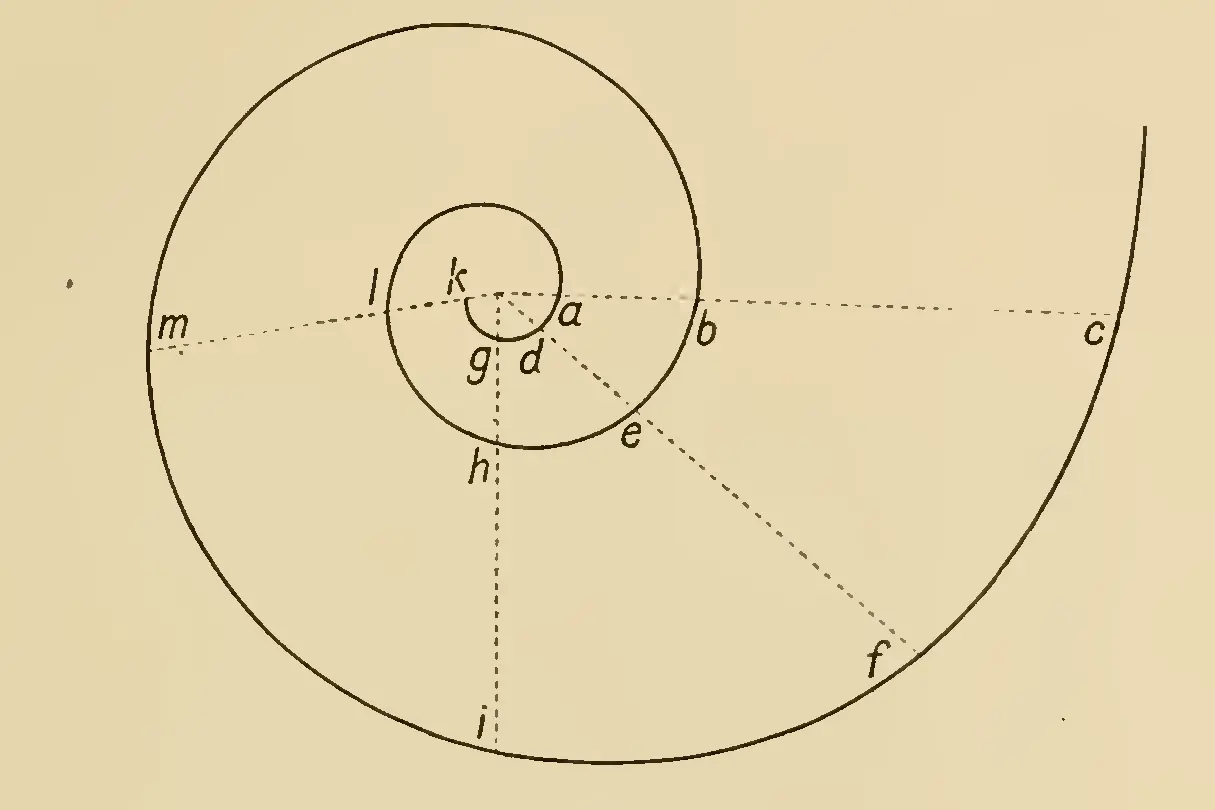
D'Arcy Thompson's 1917 diagram of the Nautilus spiral, after Moseley. On each dashed line from the pole, ab is one-third of bc, de of ef, gh of hi and kl of lm.
Credit and data
"On growth and form (IA ongrowthform1917thom)" by D'Arcy Wentworth Thompson, after H. Moseley — https://commons.wikimedia.org/wiki/File:On_growth_and_form_(IA_ongrowthform1917thom).pdf — Public domain (US: published 1917; EU: author D'Arcy W. Thompson died 1948, diagram after H. Moseley, died 1872); modified: cropped to Fig. 262, book page 519
For the rectangle method, you set the shell in a frame so that the spiral touches all four sides, then divide the long side by the short side. Clement Falbo reported rectangle ratios in his 2005 paper, and Christopher Bartlett clamped each shell into a measuring easel for his 2019 study.
One line of geometry links the two methods. For any logarithmic spiral, the four points where it touches such a rectangle lie a quarter turn apart, so the rectangle's ratio equals the growth per quarter turn. The growth per full turn is that ratio raised to the fourth power. A ratio of 1.310, for example, means 1.310⁴, or about 2.94 per turn, which is the same conversion Bartlett uses.
Neither method is clean. Sharp lists three problems: the cut may miss the true middle plane, the thick shell wall blurs where you should measure, and the pole itself is hard to locate.
What ratio does a real nautilus shell have?
Every nautilus measurement cited here falls between about ×2.4 and ×4.2 per turn, most of them close to ×3, and none comes near the golden spiral's 6.85. Those measurements run from Moseley's single shell in 1838 to Bartlett's 80 Smithsonian shells in 2019. The chart below converts each reported value to the same per-turn scale.
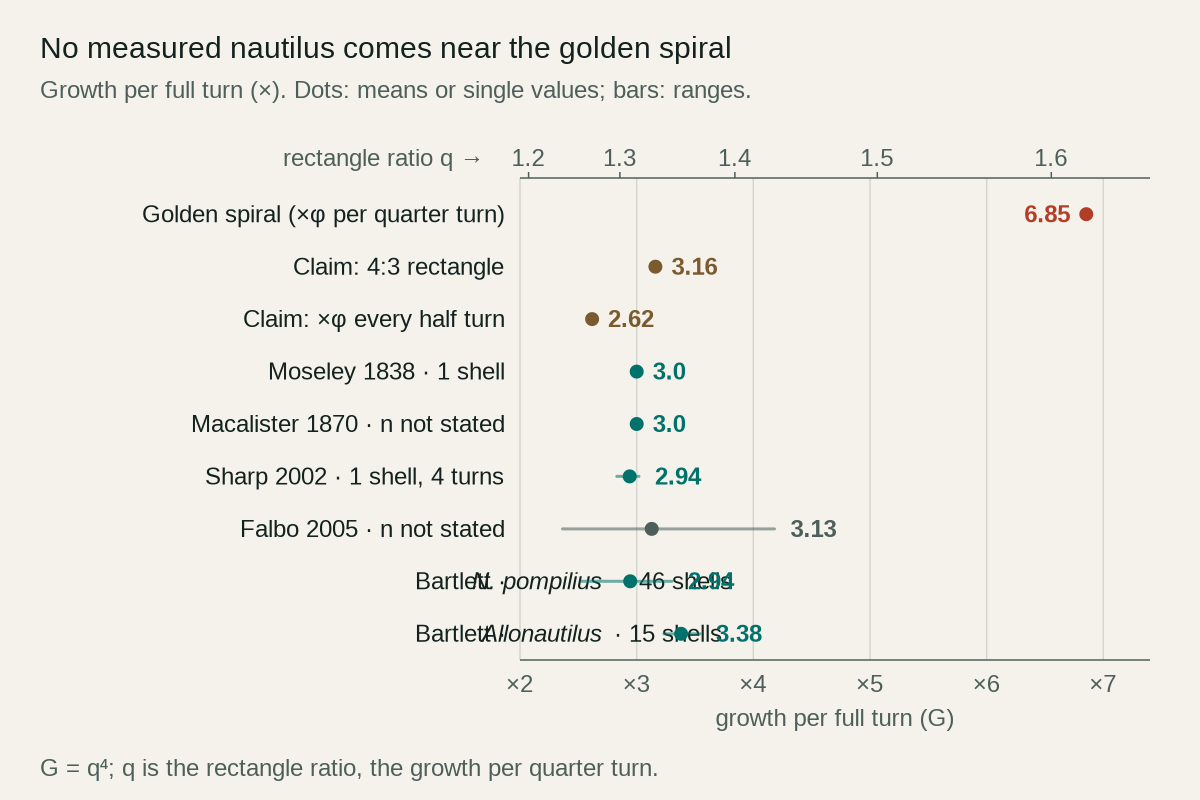
Open full-size chart, or scroll it sideways to read every label
Growth per full turn, by source; bars are reported ranges. Per-turn growth = (rectangle ratio)⁴.
Credit and data
"No measured nautilus comes near the golden spiral" by Ocean Life & Lore, https://oceanlifeandlore.com/shells/nautilus-golden-ratio/, licensed under CC BY 4.0 (https://creativecommons.org/licenses/by/4.0/).
Data: Thompson 1917, On Growth and Form, ch. XI, quoting Moseley 1838 and Macalister 1870 (https://commons.wikimedia.org/wiki/File:On_growth_and_form_(IA_ongrowthform1917thom).pdf), public domain, retrieved 2026-10-15; Sharp 2002, Spirals and the Golden Section, Part 4, Nexus Network Journal 4(1), archived copy (https://web.archive.org/web/20051228080110/http://www.nexusjournal.com/Sharp_v4n1-pt04.html), published values cited as facts, retrieved 2026-10-15; Bartlett 2019, Nautilus Spirals and the Meta-Golden Ratio Chi, Nexus Network Journal 21: 641–656 (https://doi.org/10.1007/s00004-018-0419-3), published values cited as facts, retrieved 2026-10-07.
- Moseley, 1838, one shell (quoted by Thompson 1917): ×3 per turn.
- Macalister, 1870 (reprinted by Thompson): 3.00.
- Sharp, 2002, one shell, four turns: 2.95, 3.02, 2.83 and 2.97, averaging 2.94.
- Falbo, 2005, sample size not stated (as quoted by Bartlett 2019): rectangle ratios of 1.24 to 1.43, averaging about 1.33 (×3.13 per turn).
- Bartlett, 2019, 46 Nautilus pompilius shells at the Smithsonian: ratios of 1.261 to 1.348, mean 1.310, standard deviation 0.018, or ×2.53 to ×3.30 per turn.
Bartlett spent two full days measuring 80 shells at the National Museum of Natural History. The 65 shells across five Nautilus species shared the same range and the same 1.310 mean, and the remaining 15 belonged to a separate genus discussed below.
The highest ratio in any of these measurements is Falbo's 1.43, still about 12% short of 1.618.
Growth over a lifetime shows the gap another way. Bartlett describes a hatchling shell about one inch across and an adult shell of about 150–200 mm. At ×2.94 per turn, the animal needs roughly 1.6 to 1.9 turns to grow up, whereas a golden spiral would cover the same growth in about one turn. Treat this as a rough model, since Bartlett notes that growth is irregular very early and very late in life.
Why is a nautilus shell a logarithmic spiral at all?
A nautilus, which at Osprey Reef stays between 130 and 700 m (427 and 2,297 ft), adds the chambers of its shell one after another as it grows. Bartlett notes that each chamber is sealed by a wall of mother-of-pearl called a septum. Because each new section is a slightly larger copy of the previous one, the shell keeps its shape as it grows, which makes the curve logarithmic without fixing its growth rate.
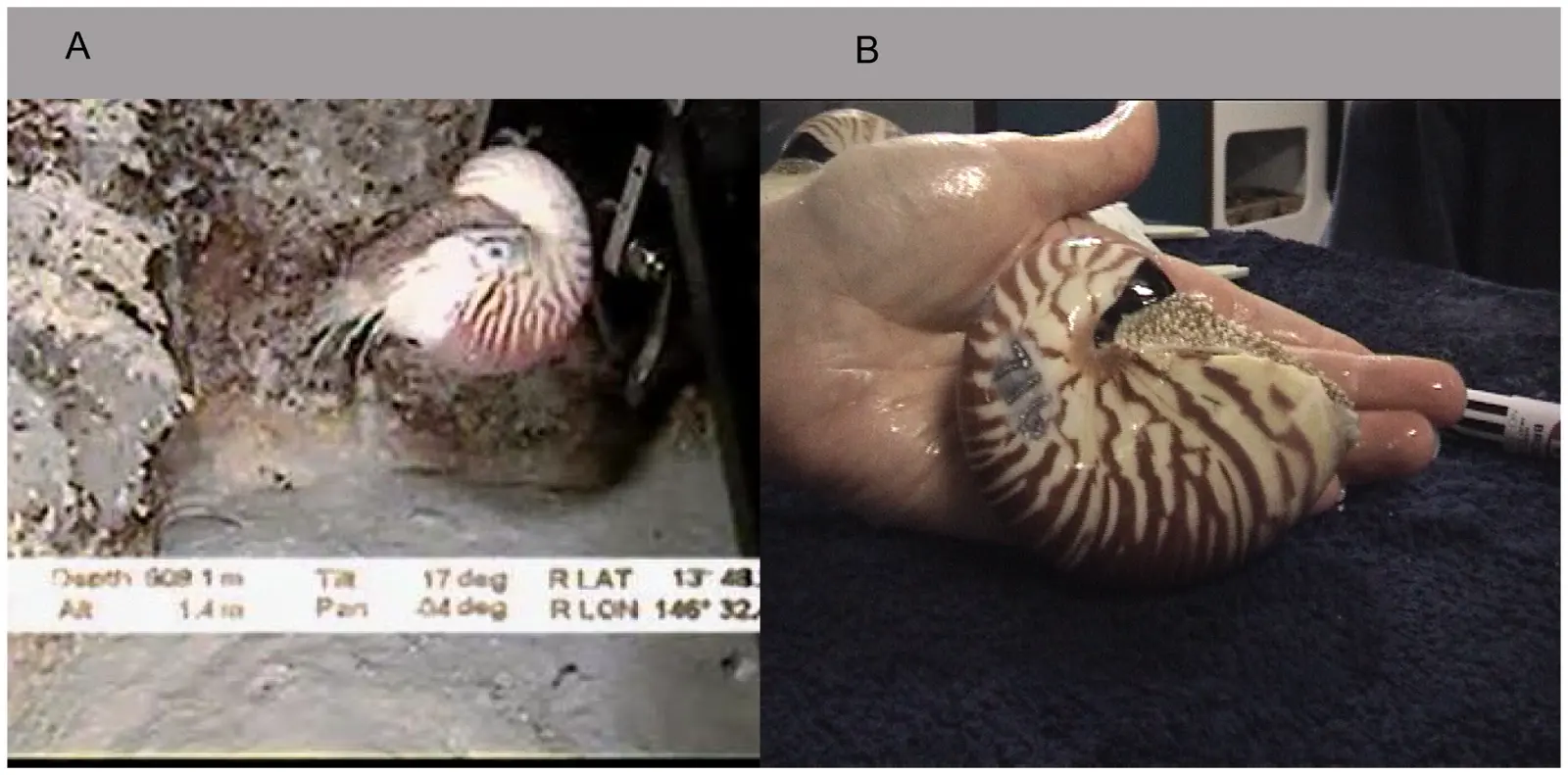
Juvenile Nautilus pompilius at Osprey Reef: about 70 mm long and filmed by a remotely operated vehicle foraging at 608.1 m (left); an 89.5 mm juvenile caught by trap from 330 m (right).
"Juvenile Nautilus pompilius" by A. J. Dunstan, P. D. Ward and N. J. Marshall, PLoS ONE 6(2): e16312 (2011) — https://commons.wikimedia.org/wiki/File:Juvenile_Nautilus_pompilius.png — CC BY 2.5 (https://creativecommons.org/licenses/by/2.5/)

From the center outward, those septa form what this site calls "the growth diary," an ordered record from the hatchling's first chambers to the last. It is a diary with smudges. Amane Tajika and colleagues, who reconstructed 30 Nautilus pompilius shells with CT scans, note that injuries can change the spacing of septa, and that in adult shells only the last chamber, or none, shrinks in volume. The sources checked here do not report Nautilus dissolving its own inner walls, a habit documented in some gastropods, including cone snails.
The chambers also settle a related claim. In the shell Bartlett illustrates, the distance from the pole to each new chamber wall grows by about 7% per chamber, and he puts the growth in chamber volume at about 24%. Neither figure is anywhere near the 61.8% that a golden step would require.
Where did the golden nautilus story come from?
The story goes that the nautilus is nature's own golden spiral. In his 2019 study, Bartlett found the claim in blogs, on a museum's social media page (calling the nautilus "a natural example of Fibonacci's sequence"), in a geometry guide and in books by well-known authors. He singles out Dan Brown's 2003 novel The Da Vinci Code, which he says "famously popularized" the myth.
Sharp traced the faulty reasoning in 2002: nautilus shells are logarithmic spirals, the golden ratio can be used to draw a logarithmic spiral, and therefore, people conclude, the nautilus must be golden. The second step is true, yet the conclusion does not follow, because the same construction works for any growth rate.
Even careful writers repeated it. The mathematician Keith Devlin wrote in 2007 that his own 2004 column debunking golden-ratio myths had let one slip through: "I claimed there that you can find the golden ratio in the growth of the Nautilus shell. Not so."
Sharp had a stranger experience. After he wrote a magazine article that explained why the nautilus is not a golden spiral, the designer put a nautilus on the cover anyway, and the next issue carried an apology and retraction. Who first put the golden nautilus into print remains unsounded, since none of the sources checked here identifies an earliest version.
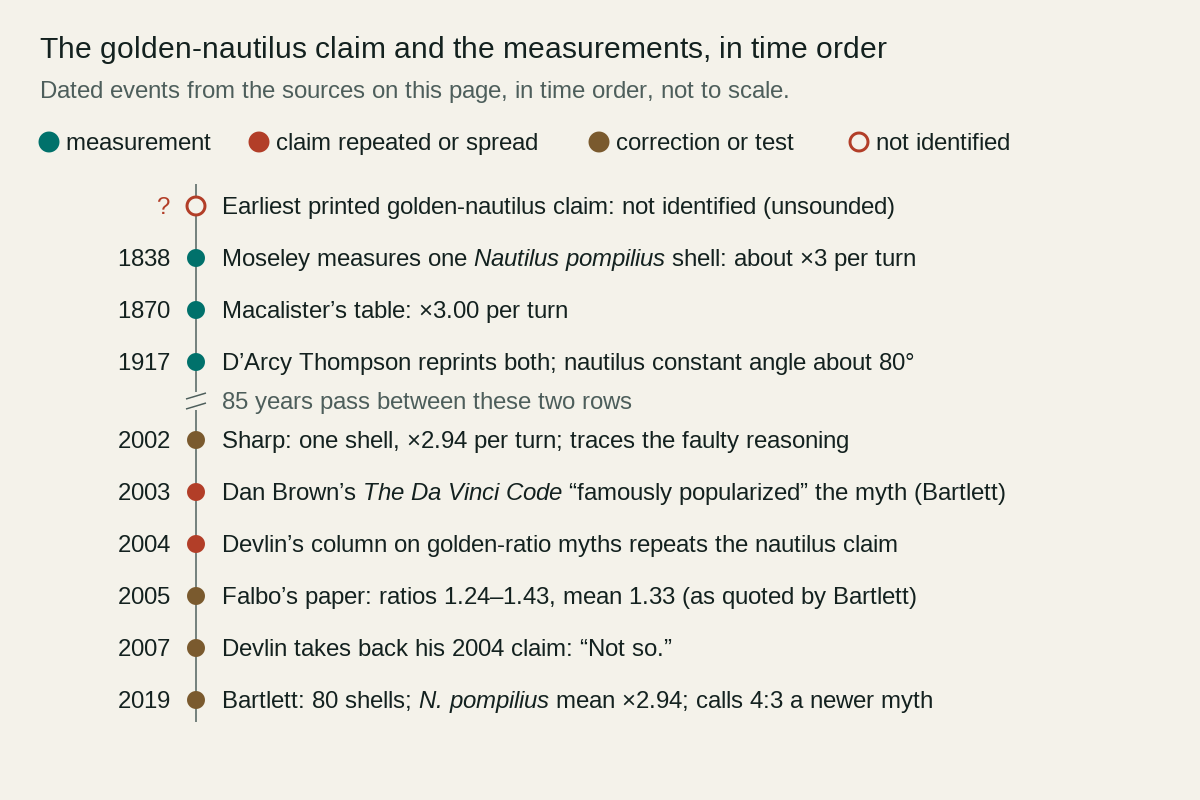
Open full-size chart, or scroll it sideways to read every label
Each row is a dated event from the sources on this page, in time order but not to scale. The first printed golden-nautilus claim has not been identified.
Credit and data
"The golden-nautilus claim and the measurements, in time order" by Ocean Life & Lore, https://oceanlifeandlore.com/shells/nautilus-golden-ratio/, licensed under CC BY 4.0 (https://creativecommons.org/licenses/by/4.0/).
Data: Thompson 1917, On Growth and Form, ch. XI, quoting Moseley 1838 and Macalister 1870 (https://commons.wikimedia.org/wiki/File:On_growth_and_form_(IA_ongrowthform1917thom).pdf), public domain, retrieved 2026-10-15; Sharp 2002, Spirals and the Golden Section, Part 4, Nexus Network Journal 4(1), archived copy (https://web.archive.org/web/20051228080110/http://www.nexusjournal.com/Sharp_v4n1-pt04.html), dates cited as facts, retrieved 2026-10-15; Devlin 2007, The Myth That Will Not Go Away, Devlin’s Angle, Mathematical Association of America, archived copy (https://web.archive.org/web/20201112034625/https://www.maa.org/external_archive/devlin/devlin_05_07.html), dates cited as facts, retrieved 2026-10-07; Bartlett 2019, Nautilus Spirals and the Meta-Golden Ratio Chi, Nexus Network Journal 21: 641–656 (https://doi.org/10.1007/s00004-018-0419-3), dates and values cited as facts, retrieved 2026-10-07.
Is the nautilus 4:3 instead, or φ every half turn?
Two newer numbers have moved in to replace φ. The first is 4:3, which spread partly through citations of Falbo's 1.33 average. Bartlett calls it a newer myth and notes that Falbo's study "provided no details of species, methods, or sample size." In Bartlett's larger sample, the Nautilus pompilius mean is 1.310, so 1.333 sits above it.
The second is the idea that the shell grows by φ every half turn rather than every quarter turn, which Bartlett traces to a single shell. It implies a rectangle ratio of √φ, about 1.272, just inside Bartlett's range but well below his 1.310 mean. Sharp anticipated this kind of move, noting that anyone can define a "golden" spiral with a chosen power of φ and land close to a real shell, an approach he called "quite contrived."
Bartlett also found that his 15 crusty nautiluses, Allonautilus scrobiculatus, a separate genus whose depth range the sources used here do not give, averaged 1.356. He matched that figure to a "meta-golden" constant called chi, about 1.35567, but one study of 15 shells is a thin base, so the idea stays unsounded until someone measures a second set.
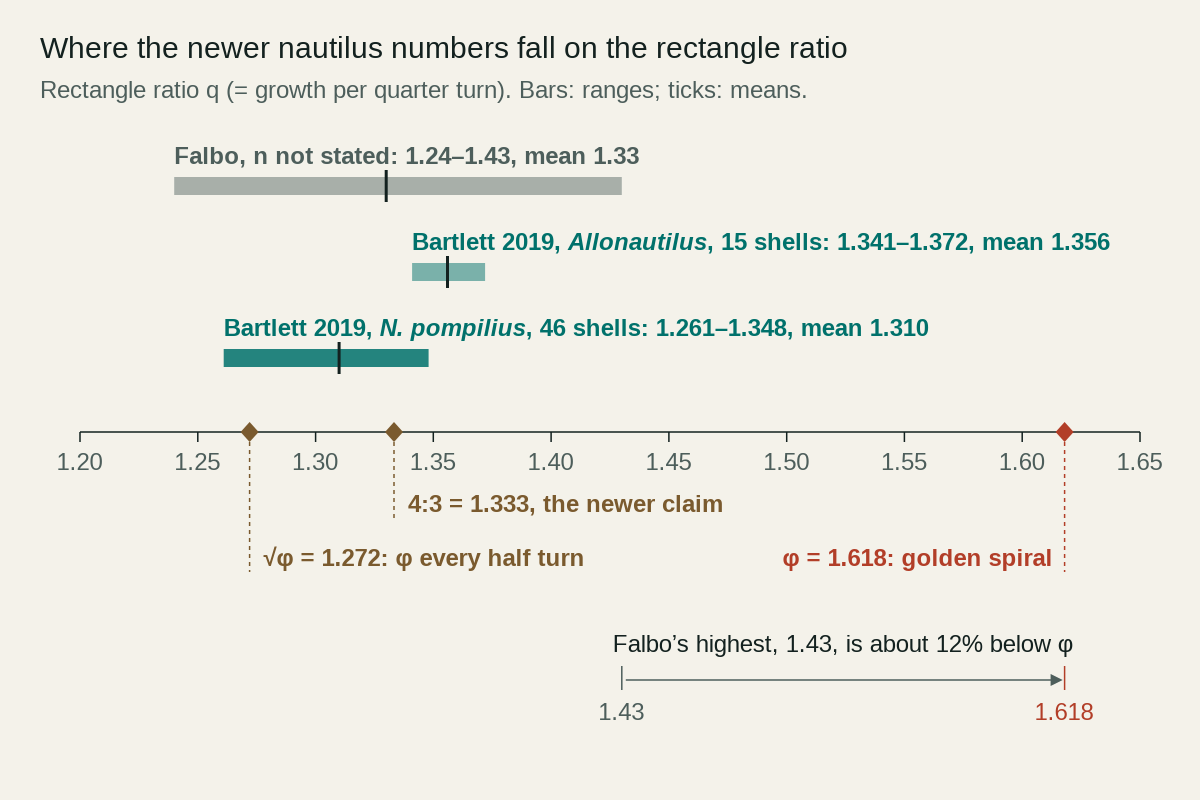
Open full-size chart, or scroll it sideways to read every label
Rectangle ratio for each measured sample and each proposed constant, from the growth-factor table on this page. Bars are reported ranges; ticks mark means.
Credit and data
"Where the newer nautilus numbers fall on the rectangle ratio" by Ocean Life & Lore, https://oceanlifeandlore.com/shells/nautilus-golden-ratio/, licensed under CC BY 4.0 (https://creativecommons.org/licenses/by/4.0/).
Data: Bartlett 2019, Nautilus Spirals and the Meta-Golden Ratio Chi, Nexus Network Journal 21: 641–656 (https://doi.org/10.1007/s00004-018-0419-3), published values cited as facts, retrieved 2026-10-07.
Sound it yourself. On any clear photo of a nautilus shell cut in half, find the pole and draw one straight line outward, then mark where the outer wall crosses that line three times in a row. If the outer gap is about three times the inner one, the shell matches the measured record, while a golden spiral would give about 6.85. Nobody in these sources has yet repeated Bartlett's crusty-nautilus measurement on a second, independent set of shells.
Lore check
7 claims sounded: holds ×1bends ×2sinks ×2unsounded ×2
| Claim | Verdict | Evidence |
|---|---|---|
| The nautilus shell is a logarithmic spiral | holds | Moseley 1838 (via Thompson); Sharp 2002; Bartlett 2019. Not perfect: in adult shells the last chamber can be smaller (Bartlett 2019; Tajika et al. 2015). |
| The nautilus shell is a golden spiral (×1.618 per quarter turn) | sinks | Highest ratios reported: 1.372 (Bartlett 2019, 80 shells), 1.43 (Falbo 2005, as quoted by Bartlett). Sharp 2002: ×2.94 per turn. |
| Each new chamber is golden-proportioned to the last (listed in Wikipedia's golden ratio article) | sinks | Bartlett 2019: about 7% per chamber in distance from the pole, about 24% in volume. |
| The nautilus is a 4:3 spiral | bends | Right ballpark, wrong constant: Bartlett's 46 Nautilus pompilius average 1.310. |
| The nautilus grows by φ every half turn | bends | Implies 1.272: inside Bartlett's range (1.261–1.348), below his mean. Based on one shell. |
| The crusty nautilus is a "meta-golden" chi spiral | unsounded | One study, 15 shells (Bartlett 2019). Missing: an independent sample. Checked: the sources below only. |
| Where the golden-nautilus story first appeared | unsounded | Sharp 2002, Devlin 2007 and Bartlett 2019 name no first printed source. |
Further down:
- Why So Many Deep-Sea Animals Are Red: by the nautilus's daytime resting depth, red sunlight is already gone, and a red animal looks black.
- Ming the clam: where a nautilus keeps its record in chambers, the clam Arctica islandica lays down annual growth increments, and one shell first aged at 405 to 410 years turned out to be 507.
Sources
- 1Bartlett, Christopher. "Nautilus Spirals and the Meta-Golden Ratio Chi." Nexus Network Journal 21 (2019): 641–656. Published online 12 December 2018. https://doi.org/10.1007/s00004-018-0419-3 Read: full text.
- 2Sharp, John. "Spirals and the Golden Section," Part 4: The Myth of the Nautilus Shell. Nexus Network Journal 4, no. 1 (Winter 2002). https://web.archive.org/web/20051228080110/http://www.nexusjournal.com/Sharp_v4n1-pt04.html Read: archived copy of 2005-12-28.
- 3Devlin, Keith. "The Myth That Will Not Go Away." Devlin's Angle, Mathematical Association of America, May 2007. https://web.archive.org/web/20201112034625/https://www.maa.org/external_archive/devlin/devlin_05_07.html Read: archived copy of 2020-11-12.
- 4Thompson, D'Arcy Wentworth. On Growth and Form. Cambridge University Press, 1917. Chapter XI, quoting Moseley, H., "On the Geometrical Forms of Turbinated and Discoid Shells," Phil. Trans. (1838): 351–370 (doi:10.1098/rstl.1838.0018), and a table from Macalister (1870). https://commons.wikimedia.org/wiki/File:On_growth_and_form_(IA_ongrowthform1917thom).pdf Read: pages 514–515, 518–519 and 554–557 of a scan of the 1917 edition.
- 5Dunstan, A. J., P. D. Ward, and N. J. Marshall. "Vertical Distribution and Migration Patterns of Nautilus pompilius." PLoS ONE 6, no. 2 (2011): e16311. https://doi.org/10.1371/journal.pone.0016311 Read: full text.
- 6Tajika, A., N. Morimoto, R. Wani, C. Naglik, and C. Klug. "Intraspecific variation of phragmocone chamber volumes throughout ontogeny in the modern nautilid Nautilus and the Jurassic ammonite Normannites." PeerJ 3 (2015): e1306. https://doi.org/10.7717/peerj.1306 Read: full text.
- 7WoRMS Editorial Board (2026). World Register of Marine Species. Nautilus pompilius Linnaeus, 1758, AphiaID 216384; Allonautilus scrobiculatus ([Lightfoot], 1786), AphiaID 342269; Arctica islandica (Linnaeus, 1767), AphiaID 138802. Available from https://www.marinespecies.org at VLIZ. Accessed 2026-10-15. doi:10.14284/170 https://www.marinespecies.org/aphia.php?p=taxdetails&id=216384 Read: catalogue record.
- 8NOAA Ocean Service. "How far does light travel in the ocean?" https://oceanservice.noaa.gov/facts/light_travel.html Read: full text.
- 9NOAA Ocean Exploration. "How deep is the ocean?" https://oceanexplorer.noaa.gov/ocean-fact/ocean-depth/ Read: full text.
- 10NOAA Ocean Exploration. "Titanic Bow." Daily image from the R.M.S. Titanic Expedition 2003. https://oceanexplorer.noaa.gov/multimedia/daily-image-media-20210415/ Read: full text.
- 11Wikipedia contributors. "Golden ratio" (section "Disputed observations"; used only to locate where the per-chamber claim is listed). Accessed 2026-10-15. https://en.wikipedia.org/wiki/Golden_ratio Read: full text.
- 12Crossref metadata record for Falbo (2005), doi:10.1080/07468342.2005.11922119 (bibliographic details only). https://api.crossref.org/works/10.1080/07468342.2005.11922119 Read: catalogue record.
- 13OpenAlex record for Bartlett (2019), confirming free-to-read access on the publisher site. https://api.openalex.org/works/doi:10.1007/s00004-018-0419-3 Read: catalogue record.
- 14Europe PMC record for Tajika et al. (2015), license CC BY. https://www.ebi.ac.uk/europepmc/webservices/rest/search?query=DOI:10.7717/peerj.1306&format=json&resultType=core Read: catalogue record.
- 15Kohn, A. J., E. R. Myers, and V. R. Meenakshi. "Interior Remodeling of the Shell by a Gastropod Mollusc." Proceedings of the National Academy of Sciences of the United States of America 76, no. 7 (1979): 3406–3410. https://doi.org/10.1073/pnas.76.7.3406 Read: abstract.
- 16Vermeij, G. J., and T. J. Thomson. "Uniqueness and Predictability in Evolution and the History of Mollusks." Proceedings of the National Academy of Sciences of the United States of America 123, no. 9 (2026): e2520986123. https://doi.org/10.1073/pnas.2520986123 Read: full text.
- 17NOAA Ocean Exploration. "Why are so many deep-sea animals red in color?" https://oceanexplorer.noaa.gov/facts/red-color.html Read: full text.
- 18National Transportation Safety Board. Marine Accident Report: SS Edmund Fitzgerald Sinking in Lake Superior on November 10, 1975. NTSB-MAR-78-3. Adopted May 4, 1978. https://www.ntsb.gov/investigations/AccidentReports/Reports/MAR7803.pdf Read: pages 5 and 12.
- 19Dunstan, A. J., P. D. Ward, and N. J. Marshall. "Nautilus pompilius Life History and Demographics at the Osprey Reef Seamount, Coral Sea, Australia." PLoS ONE 6, no. 2 (2011): e16312. https://doi.org/10.1371/journal.pone.0016312 Read: abstract, figure 5 and its caption.
- 20Butler, P. G., A. D. Wanamaker, J. D. Scourse, C. A. Richardson, and D. J. Reynolds. "Variability of Marine Climate on the North Icelandic Shelf in a 1357-Year Proxy Archive Based on Growth Increments in the Bivalve Arctica islandica." Palaeogeography, Palaeoclimatology, Palaeoecology 373 (2013): 141–151. https://www.ncei.noaa.gov/access/paleo-search/study/14609 Read: abstract.
- 21Bangor University. "Clam found to be over 500 years old." News release, 14 November 2013. https://www.bangor.ac.uk/news/archive/clam-found-to-be-over-500-years-old-16781 Read: full text.
Cite this page
Ocean Life & Lore. “Nautilus Shell: Not a Golden Spiral, as Measured in 1838.” Ocean Life & Lore. Published 2026-10-15; last substantive revision 2026-10-15. https://oceanlifeandlore.com/shells/nautilus-golden-ratio/ (accessed the date you read it).
Download the data: Growth factors (CSV) CSV (source and license record) Data: Thompson 1917, On Growth and Form, ch. XI, quoting Moseley 1838 and Macalister 1870 (https://commons.wikimedia.org/wiki/File:On_growth_and_form_(IA_ongrowthform1917thom).pdf), public domain, retrieved 2026-10-15; Sharp 2002, Spirals and the Golden Section, Part 4, Nexus Network Journal 4(1), archived copy (https://web.archive.org/web/20051228080110/http://www.nexusjournal.com/Sharp_v4n1-pt04.html), published values cited as facts, retrieved 2026-10-15; Bartlett 2019, Nautilus Spirals and the Meta-Golden Ratio Chi, Nexus Network Journal 21: 641–656 (https://doi.org/10.1007/s00004-018-0419-3), published values cited as facts, retrieved 2026-10-07. · Sounding line (CSV) CSV (source and license record) Data: Dunstan, Ward & Marshall 2011, Vertical distribution and migration patterns of Nautilus pompilius, PLoS ONE 6(2): e16311 (https://doi.org/10.1371/journal.pone.0016311), CC BY, retrieved 2026-10-15; NOAA Ocean Service, How far does light travel in the ocean? (https://oceanservice.noaa.gov/facts/light_travel.html), public domain (US federal government work), retrieved 2026-10-15; NOAA Ocean Exploration, How deep is the ocean? (https://oceanexplorer.noaa.gov/ocean-fact/ocean-depth/), public domain (US federal government work), retrieved 2026-10-15; NOAA Ocean Exploration, Titanic Bow, daily image from the R.M.S. Titanic Expedition 2003 (https://oceanexplorer.noaa.gov/multimedia/daily-image-media-20210415/), public domain (US federal government work), retrieved 2026-10-15.
Corrections
No corrections yet.
Every correction on the site is listed in the Corrections logbook. To report an error on this page, use Report a correction with the page URL, the sentence and your source. How claims are sounded sets out the sources, recalculations and verdict rules behind each page.
More from Shells
-
How it works
Ming the Clam: Counted at 405 Years, Recounted at 507
Ming (Arctica islandica): 81–83 m
-
Entry
Geography Cone: The Snail That Hunts Fish With Insulin
Conus geographus: 0–20 m