Entry
Geography Cone: The Snail That Hunts Fish With Insulin
The cone snail that nets fish with insulin is also behind most recorded stings of people, but its cigarette nickname does not match the cases.
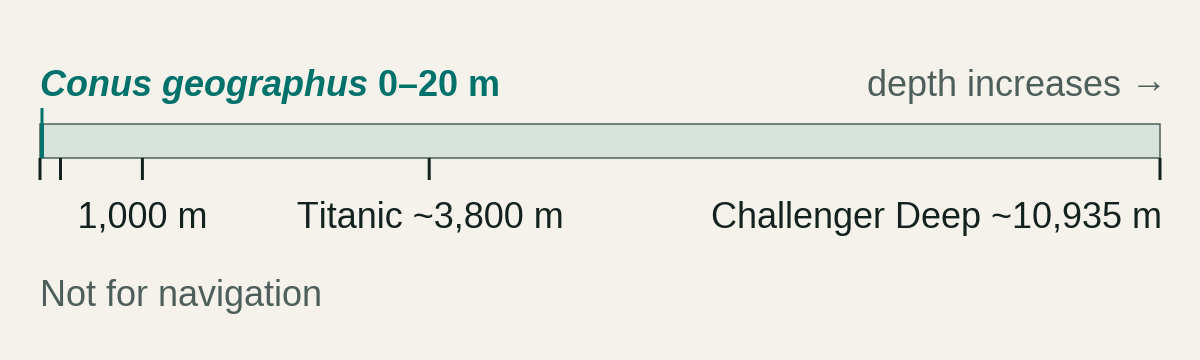
Sounding line: Conus geographus lives from the intertidal zone to about 20 m (66 ft), mainly on Indo-West Pacific coral reefs (Kohn 2018; Peters et al. 2013), shown against the full depth of the ocean.
Credit and data
"Sounding line: where Conus geographus lives" by Ocean Life & Lore, https://oceanlifeandlore.com/shells/geography-cone/, licensed under CC BY 4.0 (https://creativecommons.org/licenses/by/4.0/).
Data: Kohn 2018, Conus Envenomation of Humans: In Fact and Fiction, Toxins 11(1): 10 (https://doi.org/10.3390/toxins11010010), CC BY 4.0, retrieved 2026-10-15; Peters et al. 2013, PLoS ONE 8(12): e83353, figure 1 caption (https://doi.org/10.1371/journal.pone.0083353), CC BY, retrieved 2026-10-15; NOAA Ocean Service, How far does light travel in the ocean? (https://oceanservice.noaa.gov/facts/light_travel.html), public domain (US federal government work), retrieved 2026-10-15; NOAA Ocean Exploration, How deep is the ocean? (https://oceanexplorer.noaa.gov/ocean-fact/ocean-depth/), public domain (US federal government work), retrieved 2026-10-15; NOAA Ocean Exploration, Titanic Bow, daily image from the R.M.S. Titanic Expedition 2003 (https://oceanexplorer.noaa.gov/multimedia/daily-image-media-20210415/), public domain (US federal government work), retrieved 2026-10-15.
Spec card
- Common name
- Geography cone (also geographer cone, geographic cone)
- Scientific name
- Conus geographus Linnaeus, 1758 (WoRMS AphiaID 215499)
- Class
- Gastropoda
- Coiling
- dextral (as shown in the specimen photograph on this page)
- Raup W, D, T
- n/a
- Size range
- shell length 65–165 mm; largest recorded 166 mm
- Depth range
- intertidal to about 20 m (0–66 ft), mainly on coral reefs in the Indo-West Pacific
geography-cone-spec.csv CSV (source and license record)
Data: MolluscaBase eds. (2026), MolluscaBase, Conus geographus Linnaeus, 1758, accessed through World Register of Marine Species (https://www.marinespecies.org/aphia.php?p=taxdetails&id=215499), CC BY 4.0, retrieved 2026-10-15; Peters et al. 2013, PLoS ONE 8(12): e83353, figure 1 caption (https://doi.org/10.1371/journal.pone.0083353), CC BY, retrieved 2026-10-15; Kohn 2018, Toxins 11(1): 10 (https://doi.org/10.3390/toxins11010010), CC BY 4.0, retrieved 2026-10-15.
TL;DR. Conus geographus is one of only two cone snails known to hunt fish like a net: venom released into the water lowers their blood sugar, and a widened false mouth closes over them. It caused 57% of 141 recorded cone snail stings of humans and probably every recorded death. Yet a man stung on the Great Barrier Reef in 1935 died about five hours later.
Down this page 7 sections
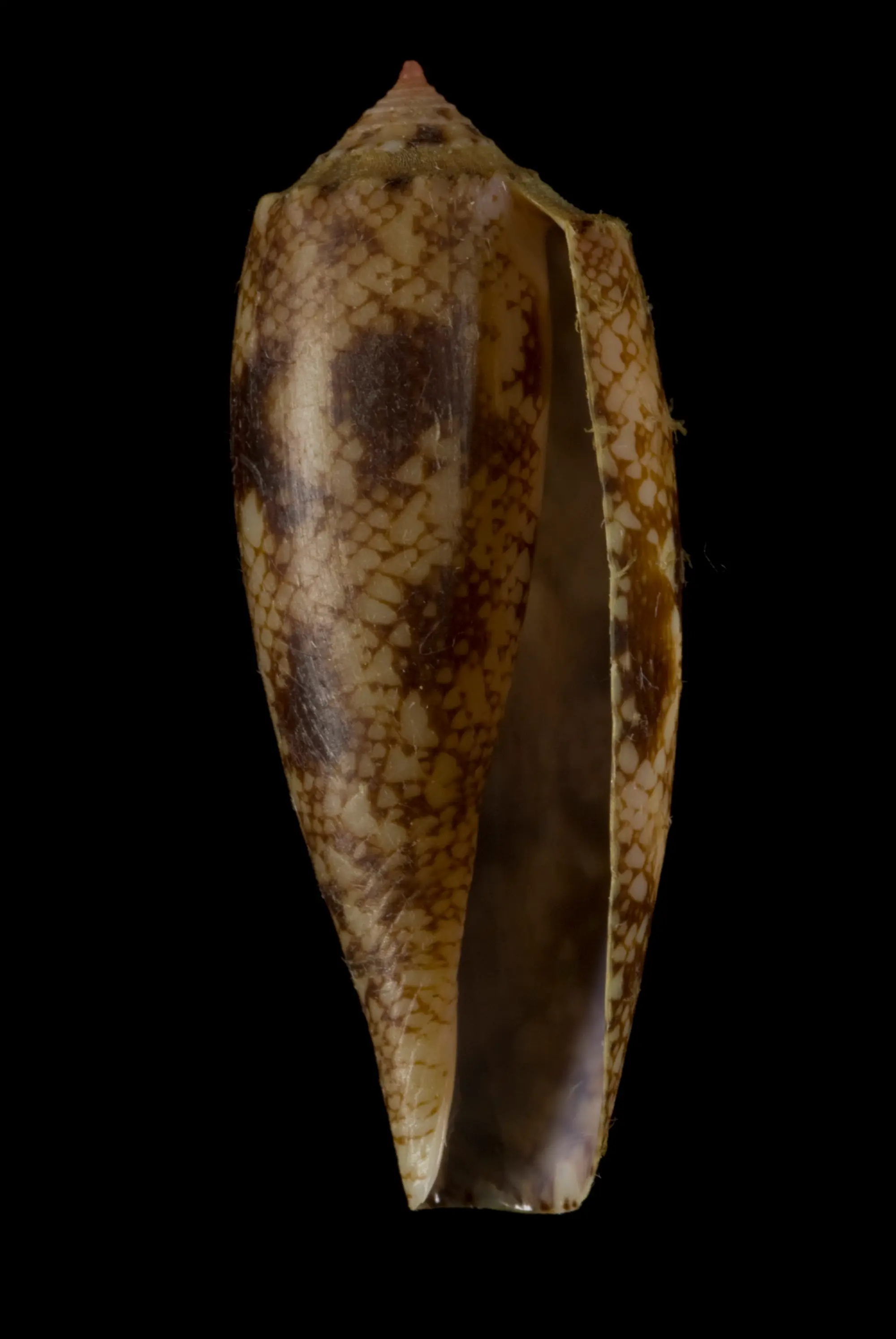
A Conus geographus shell in the mollusk collection of the Muséum national d'Histoire naturelle, Paris, photographed from the side of its long, narrow opening.
"Conus geographus (MNHN-IM-2013-11448)" by Lardeur A. / MNHN - Museum national d'Histoire naturelle — https://commons.wikimedia.org/wiki/File:Conus_geographus_(MNHN-IM-2013-11448).jpeg — CC BY 4.0 (https://creativecommons.org/licenses/by/4.0/)

The geography cone, a reef snail found from the tide line to about 20 m, catches fish partly with insulin. Safavi-Hemami and colleagues reported in 2015 that its venom carries a specialized insulin that sends fish into hypoglycemic shock, a dangerous drop in blood sugar. The same snail, Conus geographus, is the cone snail most dangerous to people. Alan Kohn's 2018 review of 141 recorded human stings attributes 57% of them to it and calls it "quite likely" that it caused all the deaths.
Kohn places the species in the Indo-West Pacific, mainly on coral reefs from the intertidal zone to about 20 m (66 ft). That whole depth band would fit 190 times into the 3,800 m (12,467 ft) at which the Titanic wreck lies, by this page's calculation from the NOAA Ocean Exploration figure.
A 2013 conservation assessment by Peters and colleagues gives the same depth range and shell lengths of 65–165 mm, and Kohn puts the largest recorded shell at 166 mm, citing a 1995 manual. Its common name comes from the map-like markings on its shell, according to a 2002 feature by the US National Institute of General Medical Sciences (NIGMS).
How does a cone snail catch fish?
Most cone snails hunt with a harpoon-like tooth. In Kohn's description, a cone snail extends its proboscis, a tubular feeding organ, toward the prey and pumps venom through a hollow tooth that works like a hypodermic needle. In fish-hunting species the barbed tooth also holds the fish, like a harpoon, until it is paralyzed and can be swallowed whole.
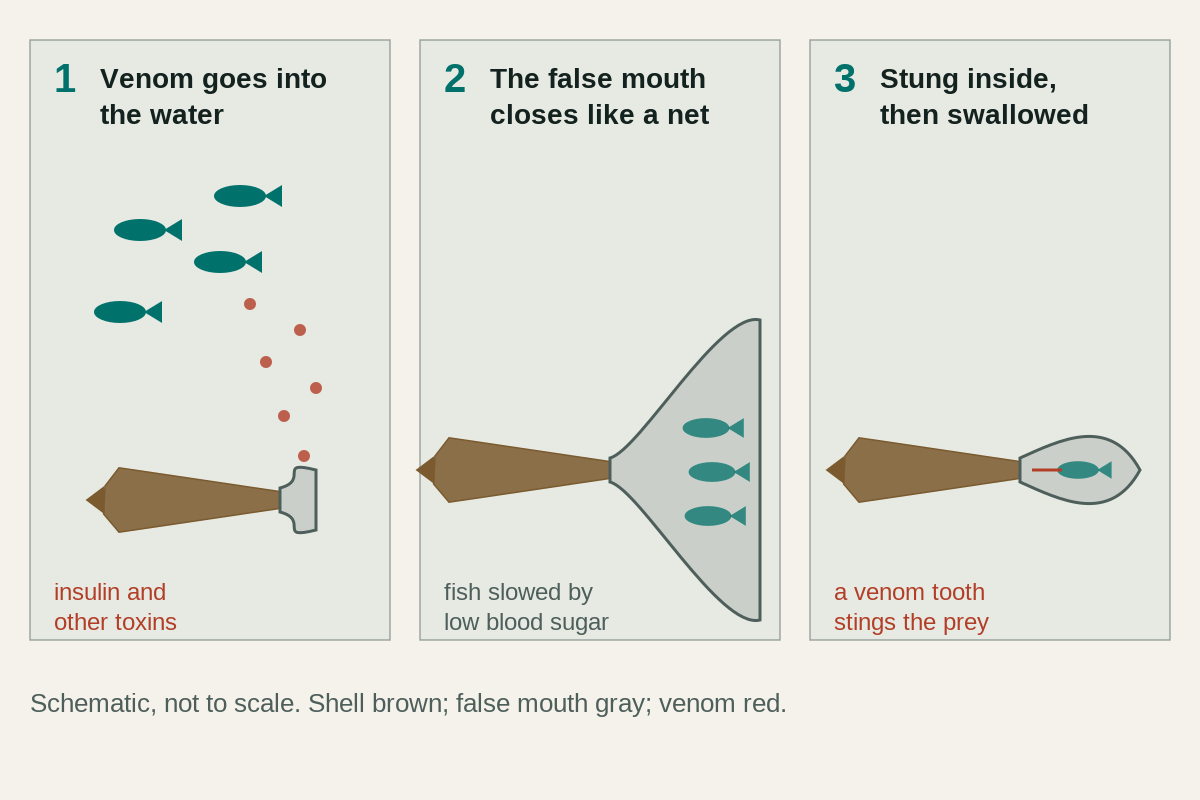
C. geographus has a second method, which researchers call net-feeding. John Healy of the Queensland Museum summarized it in 2022: the snail widens the sheath around its proboscis into a broad trumpet, in effect a false mouth, as it closes in on a fish, then releases a squirt of venom that partly stuns the prey. Once the fish is enclosed, it is stung and eaten. A 2024 study by Yeung and colleagues names the geography cone as one of only two cone snail species known to hunt this way.
Healy adds that the species feeds mostly at night and spends the day on or under rocks, coral slabs or rubble. Its depth band overlaps that of the clownfish Amphiprion ocellaris, which Madduppa and colleagues describe in 2014 on outer reef slopes and in sheltered lagoons to a maximum depth of 15 m (49 ft).
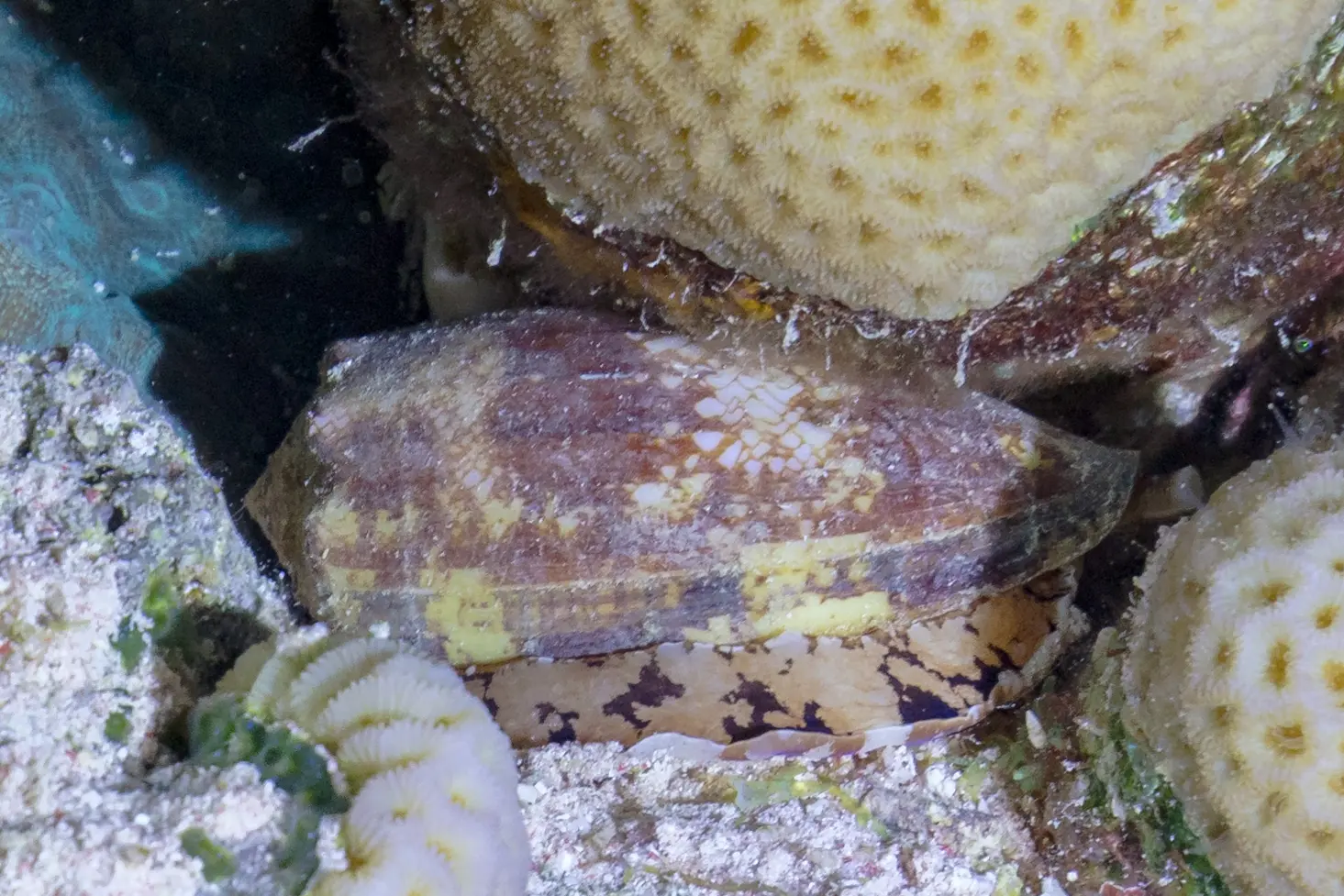
A Conus geographus under coral in the Red Sea off Egypt, photographed underwater in 2023.
"Caracol de mar (Conus geographus), mar Rojo, Egipto, 2023-04-16, DD 51" by Diego Delso, delso.photo — https://commons.wikimedia.org/wiki/File:Caracol_de_mar_(Conus_geographus),_mar_Rojo,_Egipto,_2023-04-16,_DD_51.jpg — CC BY-SA 4.0 (https://creativecommons.org/licenses/by-sa/4.0/)

Why is there insulin in its venom?
Safavi-Hemami and colleagues found in 2015 that two fish-hunting cone snails, including C. geographus, make specialized insulins as major parts of their venom. These insulins look much more like fish insulin than like the snails' own hormone. Injected into fish, the venom insulin caused hypoglycemic shock.
The insulin appears to be part of the nirvana cabal, the authors write: a mix of toxins released into the water that disorients schools of small fish and makes them easier to engulf with the snail's distended false mouth, which works as a net. In 2024 Yeung and colleagues described a second ingredient from the geography cone: a toxin that mimics the hormone somatostatin and blocks the release of glucagon, the hormone that would push a fish's blood sugar back up.
Open full-size chart, or scroll it sideways to read every label
Schematic, not to scale, of net-feeding as described by Safavi-Hemami and colleagues (2015), Healy (2022) and Yeung and colleagues (2024).
"How a geography cone nets fish (schematic)" by Ocean Life & Lore, https://oceanlifeandlore.com/shells/geography-cone/, licensed under CC BY 4.0 (https://creativecommons.org/licenses/by/4.0/).
Cone snail venom has also produced a medicine, though not from this species. As of Kohn's 2018 review, one venom peptide from another fish-hunting cone snail had met all US Food and Drug Administration requirements; made synthetically, it has been sold as the painkiller ziconotide, or Prialt, since 2004.
How dangerous is a cone snail sting?
Kohn, who by 2018 had kept a database of cone snail stings for 62 years, counted at least 141 human cases reported between about 1670 and 2017, 36 of them fatal. The table in the same review, plotted below, sums to 35 deaths and 106 survivors, so both totals are given here.
More than half of all recorded stings, 57%, came from C. geographus. Kohn calls it "quite likely" that the species caused every death, though the snail's identity is still uncertain in about 8 cases.
The story goes that the snail-eating textile cone, Conus textile, recorded from the intertidal zone to 50 m (164 ft) by Peters and colleagues (2013), has also killed people. Kohn writes that it was accused in print of a number of deaths, especially before 1900, but he knows of none that has been verified.
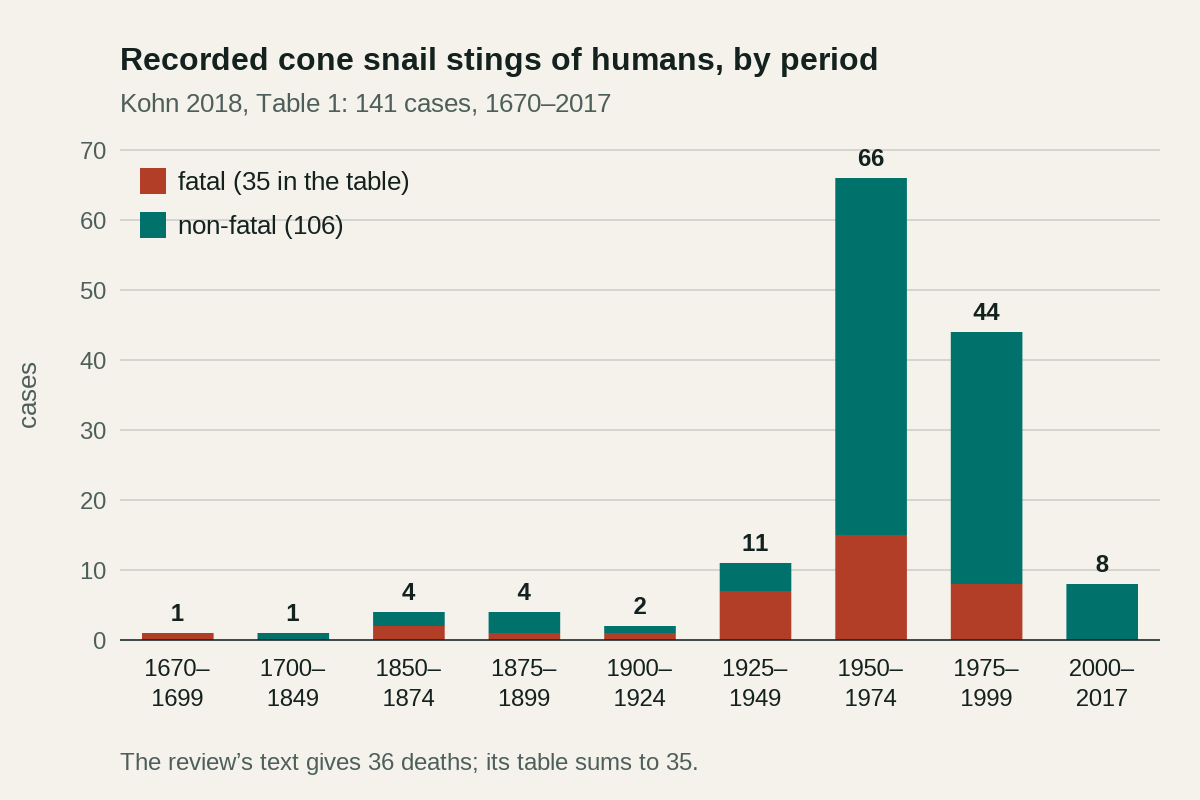
Open full-size chart, or scroll it sideways to read every label
Recorded cone snail stings of humans by period, from Kohn's 2018 table. The table totals 35 deaths; the review's text gives 36.
Credit and data
"Recorded cone snail stings of humans, 1670–2017" by Ocean Life & Lore, https://oceanlifeandlore.com/shells/geography-cone/, licensed under CC BY 4.0 (https://creativecommons.org/licenses/by/4.0/).
Data: Kohn 2018, Conus Envenomation of Humans: In Fact and Fiction, Toxins 11(1): 10, Table 1 (https://doi.org/10.3390/toxins11010010), CC BY 4.0, retrieved 2026-10-15.
The share of stings that killed fell over time. In Kohn's Table 1 the cumulative fatality rate stays between 40% and 100% through 1925–1949, then falls to 30% by 1974 and 25% by 2017. His text gives the early range as 42–100%. He suggests the main reasons are better access to medical treatment and more reporting of mild stings from remote tropical areas.
Size and age matter. The 8 geography cones that killed people and whose shells were measured were 80–135 mm long, against 50–125 mm for those whose stings were not fatal. Kohn's 2016 review adds that children died from these stings more often than adults, and that larger snails killed more often regardless of the victim's age.
In 2014 Dutertre and colleagues found that the venom a geography cone injects in self-defense is packed with paralytic toxins that block receptors where nerves signal muscles, which fits its lethal effects on people, while its hunting venom holds prey-specific toxins mostly inactive at human targets.
As of 2022, Healy writes, no antivenom made for cone snail stings had been developed. A sting from a live cone snail calls for medical help at once.
Is the "cigarette snail" story true?
The story goes that a geography cone sting leaves just enough time to smoke one cigarette. The 2002 NIGMS feature says the species "used to be called the ‘cigarette snail’" for that reason, and in the same paragraph says one sting kills an adult "within hours."
One fatal case on record took hours. On 25 June 1935 a fishing party gathered shells at low water on the reef at Hayman Island, on the Great Barrier Reef. A 27-year-old man in the party was stung in the palm while handling a live geography cone. Do not pick up or handle a live cone snail: it stings in self-defense, and Healy notes that an empty shell would have spared him.
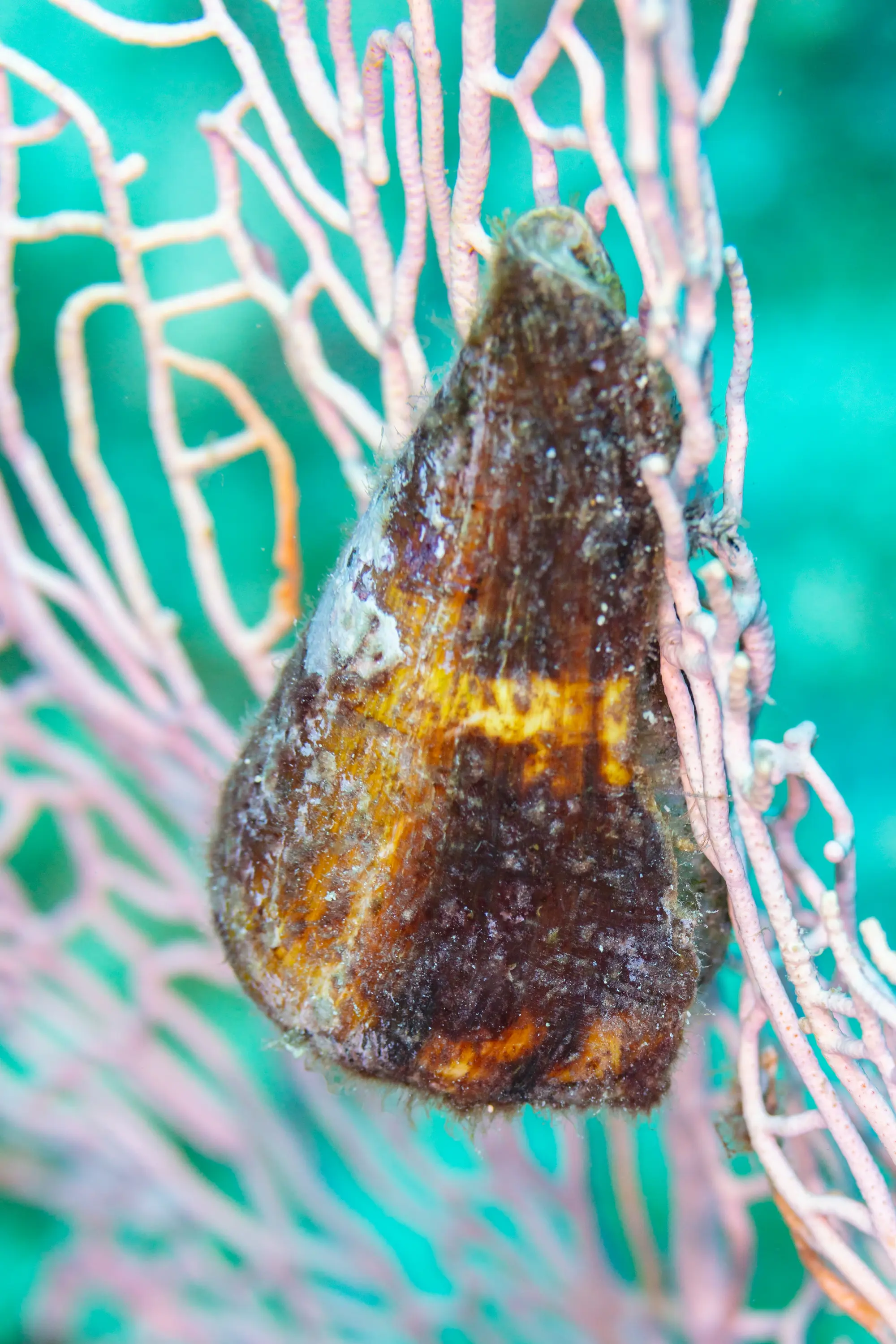
A Conus geographus on a sea fan off Madagascar, photographed underwater in 2025.
Credit and data
"Caracol de mar (Conus geographus), Nosy Antanimora, Madagascar, 2025-09-15, DD 24" by Diego Delso, delso.photo — https://commons.wikimedia.org/wiki/File:Caracol_de_mar_(Conus_geographus),_Nosy_Antanimora,_Madagascar,_2025-09-15,_DD_24.jpg — CC BY-SA 4.0 (https://creativecommons.org/licenses/by-sa/4.0/)

According to a letter by the doctor who met the party ashore, the man's lips went numb about 20 minutes after the sting, his sight then began to fail, and he died about five hours after he was stung. The skipper's account, published by Cleland in 1942, puts death at about four and a half hours. Healy, who reexamined the case in 2022, calls it Australia's first and, to that date, only medically confirmed cone snail fatality.
Not every case runs that slowly. Healy, citing Kohn's 2016 review, writes that reactions to geography cone stings range from mild pain and prolonged dizziness in some adults to sharp pain and "almost instant death, particularly in infants." The danger in the nickname is real. No single countdown fits the recorded cases.
Why does a cone snail dissolve its own shell?
A cone snail rebuilds its shell from the inside as it grows. Kohn, Myers and Meenakshi reported in 1979 that as a Conus shell grows, dissolution inside it thins the walls of the next-to-last whorl, one turn of the coil, from several millimeters to less than 50 µm. New shell is added inside the spire. By their account, the result is a thick last whorl and spire that resist crushing predators, plus far more living space inside.
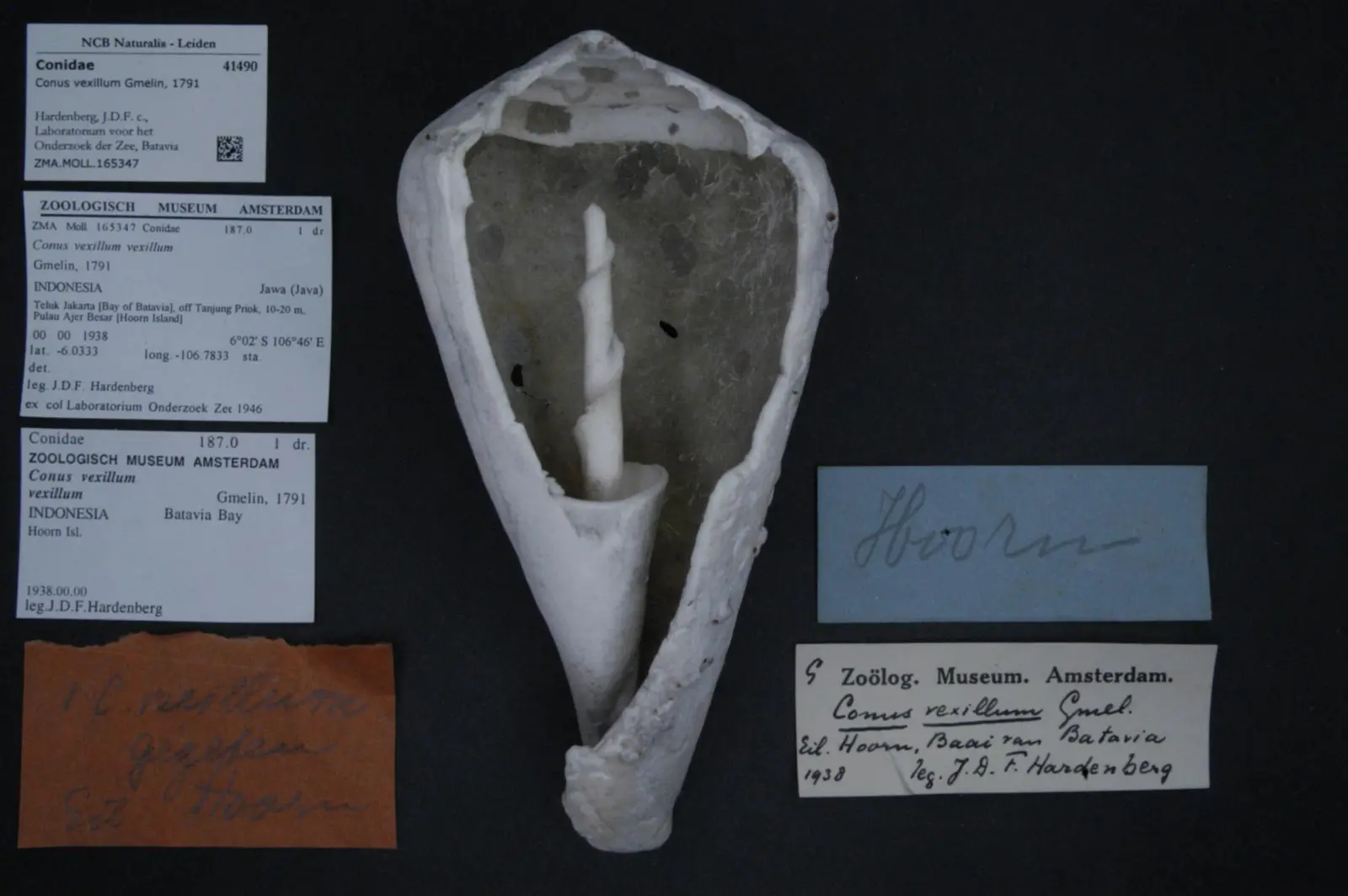
A broken shell of another cone snail, Conus vexillum, collected in 1938 from 10–20 m (33–66 ft) depth and now at Naturalis, Leiden. Inside, a slender central column rises through an open space.
Credit and data
"Naturalis Biodiversity Center - ZMA.MOLL.165347 - Conus vexillum Gmelin, 1791 - Conidae - Mollusc shell" by Naturalis Biodiversity Center — https://commons.wikimedia.org/wiki/File:Naturalis_Biodiversity_Center_-_ZMA.MOLL.165347_-_Conus_vexillum_Gmelin,_1791_-_Conidae_-_Mollusc_shell.jpeg — CC0 1.0 (https://creativecommons.org/publicdomain/zero/1.0/)

That makes a cone shell an incomplete version of what this site calls "the growth diary": in effect, a diary with pages torn out and rewritten. The 1979 abstract covers Conus in general without naming the species examined, so the sources checked here do not show how far C. geographus thins its inner walls. The chambered nautilus, 130–700 m (427–2,297 ft) down at Osprey Reef in the Coral Sea (Dunstan and colleagues, 2011), is the contrast: the sources checked for it report no such dissolving.
The geography cone's shell is thin as well. Dutertre and colleagues noted in 2014 that C. geographus has one of the most fragile shells among cone snails, and they suggested that weak shell protection may have evolved together with a strong defensive venom. Healy adds that the shell is often thin, and solid usually only in large, old adults.
One measurement is still missing from the record. None of the sources checked here reports how thin the inner walls of a C. geographus shell become, even though Dutertre and colleagues describe it as one of the most fragile cone snail shells.
Lore check
3 claims sounded: holds ×1bends ×1unsounded ×1
| Claim | Verdict | Evidence |
|---|---|---|
| Cigarette snail: a geography cone sting leaves time for one cigarette | bends | Story source: NIGMS 2002, which says the species "used to be called" the cigarette snail. Deaths are real: 36 among at least 141 recorded stings (Kohn 2018). In the 1935 Hayman Island case, death came about 4.5 to 5 hours after the sting (Healy 2022). Reactions range from mild to almost instant death in infants (Healy 2022, citing Kohn 2016). |
| A cone snail sting can kill a person | holds | Kohn 2018: 36 deaths among at least 141 recorded stings, about 1670 to 2017, probably all from C. geographus. Healy 2022: the 1935 Hayman Island death. |
| Textile cone stings have killed people | unsounded | Kohn 2018: accused in print, especially before 1900, but none verified. Missing: a confirmed fatal case with the snail identified. Checked: Kohn 2016 abstract, Kohn 2018, Healy 2022. |
Further down:
- Chambered nautilus: 130–700 m down at Osprey Reef, a shell long held up as a golden spiral, put against the measurements.
- Ming the clam: where a cone snail's shell loses pages, the ocean quahog Arctica islandica lays down a band a year, counted on a shell taken alive at about 80 m (262 ft) off north Iceland in 2006.
Sources
- 1Safavi-Hemami, H., J. Gajewiak, S. Karanth, S. D. Robinson, B. Ueberheide, A. D. Douglass, et al. "Specialized insulin is used for chemical warfare by fish-hunting cone snails." Proceedings of the National Academy of Sciences of the United States of America 112, no. 6 (2015): 1743–1748. https://doi.org/10.1073/pnas.1423857112 Read: abstract.
- 2Yeung, H. Y., I. B. L. Ramiro, D. B. Andersen, T. L. Koch, A. Hamilton, W. E. Bjørn-Yoshimoto, et al. "Fish-hunting cone snail disrupts prey's glucose homeostasis with weaponized mimetics of somatostatin and insulin." Nature Communications 15 (2024): 6408. https://doi.org/10.1038/s41467-024-50470-2 Read: full text.
- 3Dutertre, S., A.-H. Jin, I. Vetter, B. Hamilton, K. Sunagar, V. Lavergne, et al. "Evolution of separate predation- and defence-evoked venoms in carnivorous cone snails." Nature Communications 5 (2014): 3521. https://doi.org/10.1038/ncomms4521 Read: full text.
- 4Kohn, A. J., E. R. Myers, and V. R. Meenakshi. "Interior Remodeling of the Shell by a Gastropod Mollusc." Proceedings of the National Academy of Sciences of the United States of America 76, no. 7 (1979): 3406–3410. https://doi.org/10.1073/pnas.76.7.3406 Read: abstract.
- 5Healy, J. M. "A return to Hayman Island: revisiting Australia's only recorded cone snail fatality after 85 years." Memoirs of the Queensland Museum – Nature 63 (2022): 41–83. https://doi.org/10.17082/j.2204-1478.63.2021.2020-09 Read: full text.
- 6Peters, H., B. C. O'Leary, J. P. Hawkins, K. E. Carpenter, and C. M. Roberts. "Conus: first comprehensive conservation red list assessment of a marine gastropod mollusc genus." PLoS ONE 8, no. 12 (2013): e83353. https://doi.org/10.1371/journal.pone.0083353 Read: figure 1 caption.
- 7Madduppa, H. H., J. Timm, and M. Kochzius. "Interspecific, spatial and temporal variability of self-recruitment in anemonefishes." PLoS ONE 9, no. 2 (2014): e90648. https://doi.org/10.1371/journal.pone.0090648 Read: full text.
- 8Dunstan, A. J., P. D. Ward, and N. J. Marshall. "Vertical distribution and migration patterns of Nautilus pompilius." PLoS ONE 6, no. 2 (2011): e16311. https://doi.org/10.1371/journal.pone.0016311 Read: abstract.
- 9Wanamaker, A. D., Jr., J. Heinemeier, J. D. Scourse, C. A. Richardson, P. G. Butler, J. Eiríksson, and K. L. Knudsen. "Very long-lived mollusks confirm 17th century AD tephra-based radiocarbon reservoir ages for North Icelandic shelf waters." Radiocarbon 50, no. 3 (2008): 399–412. https://hdl.handle.net/10150/654085 Read: abstract.
- 10Kohn, Alan J. "Conus Envenomation of Humans: In Fact and Fiction." Toxins 11, no. 1 (2018): 10. https://doi.org/10.3390/toxins11010010 Read: full text.
- 11Kohn, Alan J. "Human injuries and fatalities due to venomous marine snails of the family Conidae." International Journal of Clinical Pharmacology and Therapeutics 54, no. 7 (2016): 524–538. https://doi.org/10.5414/CP202630 Read: abstract.
- 12MolluscaBase eds. (2026). MolluscaBase. Conus geographus Linnaeus, 1758. Accessed through: World Register of Marine Species at: https://www.marinespecies.org/aphia.php?p=taxdetails&id=215499 on 2026-10-15 Read: catalogue record.
- 13Naturalis Biodiversity Center. Specimen ZMA.MOLL.165347, Conus vexillum Gmelin, 1791 (shell, collected 1938). File description on Wikimedia Commons. https://commons.wikimedia.org/wiki/File:Naturalis_Biodiversity_Center_-_ZMA.MOLL.165347_-_Conus_vexillum_Gmelin,_1791_-_Conidae_-_Mollusc_shell.jpeg Read: catalogue record.
- 14NOAA Ocean Exploration. "Titanic Bow." Daily image from the R.M.S. Titanic Expedition 2003. https://oceanexplorer.noaa.gov/multimedia/daily-image-media-20210415/ Read: full text.
- 15NOAA Ocean Exploration. "How deep is the ocean?" https://oceanexplorer.noaa.gov/ocean-fact/ocean-depth/ Read: full text.
- 16NOAA Ocean Service. "How far does light travel in the ocean?" https://oceanservice.noaa.gov/facts/light_travel.html Read: full text.
- 17Machalek, Alisa Zapp. "Secrets of the Killer Snails." Findings, National Institute of General Medical Sciences, September 2002. https://web.archive.org/web/20171107113530/https://publications.nigms.nih.gov/findings/sept02/snails.html Read: archived copy of 2017-11-07.
Cite this page
Ocean Life & Lore. “Geography Cone: The Snail That Hunts Fish With Insulin.” Ocean Life & Lore. Published 2026-10-15; last substantive revision 2026-10-15. https://oceanlifeandlore.com/shells/geography-cone/ (accessed the date you read it).
Download the data: Sounding line (CSV) CSV (source and license record) Data: Kohn 2018, Conus Envenomation of Humans: In Fact and Fiction, Toxins 11(1): 10 (https://doi.org/10.3390/toxins11010010), CC BY 4.0, retrieved 2026-10-15; Peters et al. 2013, PLoS ONE 8(12): e83353, figure 1 caption (https://doi.org/10.1371/journal.pone.0083353), CC BY, retrieved 2026-10-15; NOAA Ocean Service, How far does light travel in the ocean? (https://oceanservice.noaa.gov/facts/light_travel.html), public domain (US federal government work), retrieved 2026-10-15; NOAA Ocean Exploration, How deep is the ocean? (https://oceanexplorer.noaa.gov/ocean-fact/ocean-depth/), public domain (US federal government work), retrieved 2026-10-15; NOAA Ocean Exploration, Titanic Bow, daily image from the R.M.S. Titanic Expedition 2003 (https://oceanexplorer.noaa.gov/multimedia/daily-image-media-20210415/), public domain (US federal government work), retrieved 2026-10-15. · Recorded stings by period (CSV) CSV (source and license record) Data: Kohn 2018, Conus Envenomation of Humans: In Fact and Fiction, Toxins 11(1): 10, Table 1 (https://doi.org/10.3390/toxins11010010), CC BY 4.0, retrieved 2026-10-15.
Corrections
No corrections yet.
Every correction on the site is listed in the Corrections logbook. To report an error on this page, use Report a correction with the page URL, the sentence and your source. How claims are sounded sets out the sources, recalculations and verdict rules behind each page.
More from Shells
-
Lore check
Nautilus Shell: Not a Golden Spiral, as Measured in 1838
Nautilus pompilius: 130–700 m
-
How it works
Ming the Clam: Counted at 405 Years, Recounted at 507
Ming (Arctica islandica): 81–83 m