Entry
Clownfish: The Largest in Each Anemone Is the Female
Every female clownfish began life as a male, and the anemone's sting is held off by a coat of mucus, not by immunity.
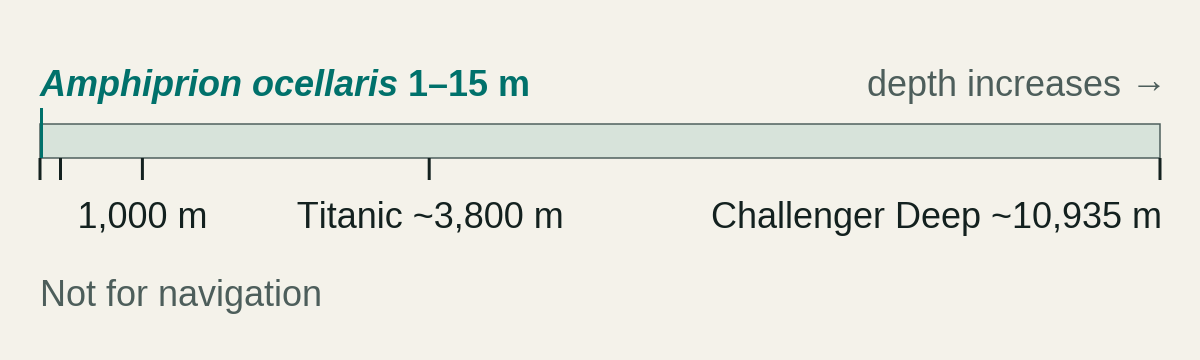
Sounding line: Amphiprion ocellaris lives 1–15 m (3–49 ft) deep in the wild (Bray 2021), a sliver at the surface end of the ocean's full depth.
Credit and data
"Sounding line: where the clownfish lives" by Ocean Life & Lore, https://oceanlifeandlore.com/aquarium/clownfish/, licensed under CC BY 4.0 (https://creativecommons.org/licenses/by/4.0/).
Data: Bray, D. J. 2021, Amphiprion ocellaris in Fishes of Australia, Museums Victoria (https://fishesofaustralia.net.au/home/species/1275), CC BY 3.0 AU, retrieved 2026-10-15; NOAA Ocean Service, How far does light travel in the ocean? (https://oceanservice.noaa.gov/facts/light_travel.html), public domain (US federal government work), retrieved 2026-10-15; NOAA Ocean Exploration, Titanic Bow, daily image from the R.M.S. Titanic Expedition 2003 (https://oceanexplorer.noaa.gov/multimedia/daily-image-media-20210415/), public domain (US federal government work), retrieved 2026-10-15; NOAA Ocean Exploration, How deep is the ocean? (https://oceanexplorer.noaa.gov/ocean-fact/ocean-depth/), public domain (US federal government work), retrieved 2026-10-15.
Spec card
- Common name
- Clownfish; false clown anemonefish; western clown anemonefish
- Scientific name
- Amphiprion ocellaris Cuvier, 1830 (WoRMS AphiaID 278400)
- Origin (wild range)
- Andaman and Nicobar Islands, Indo-Malayan Archipelago, Philippines, northwestern Australia, and the coast of Southeast Asia north to the Ryukyu Islands
- Adult size
- Maximum length about 90 mm (Fautin & Allen 1992); maximum 9.5 cm total length (Bray 2021)
- Temperature range (°C, °F)
- 26–28 °C (79–82 °F) in one lab colony (Parker et al. 2024); no wild range in the sources used
- pH range
- 8.0–8.4 in the same lab colony (Parker et al. 2024)
- Hardness range (dGH)
- n/a (marine fish)
- Source
- Fautin & Allen 1992; Bray 2021 (Fishes of Australia); Parker et al. 2024; WoRMS
- Data checked
- 2026-10-15
clownfish-spec.csv CSV (source and license record)
Data: Froese, R. and D. Pauly (eds) 2026, FishBase: Amphiprion ocellaris Cuvier, 1830, accessed through World Register of Marine Species (https://www.marinespecies.org/aphia.php?p=taxdetails&id=278400), factual name data, retrieved 2026-10-15; Bray, D. J. 2021, Amphiprion ocellaris in Fishes of Australia, Museums Victoria (https://fishesofaustralia.net.au/home/species/1275), CC BY 3.0 AU, retrieved 2026-10-15; Parker et al. 2024, Adult sex change leads to extensive forebrain reorganization in clownfish, Biology of Sex Differences 15: 58 (https://doi.org/10.1186/s13293-024-00632-0), CC BY 4.0, retrieved 2026-10-15.
TL;DR. In each anemone, the largest Amphiprion ocellaris is the breeding female and her mate is next in size; if she disappears, he changes sex. Clownfish are not immune to their hosts: in a 2025 test, 1 of 30 larvae survived anemone tentacles before metamorphosis, and adults rely on their mucus. A 2017 trade study found little sign of a rush to buy wild clownfish in the 1.5 years after Finding Nemo.
Down this page 7 sections
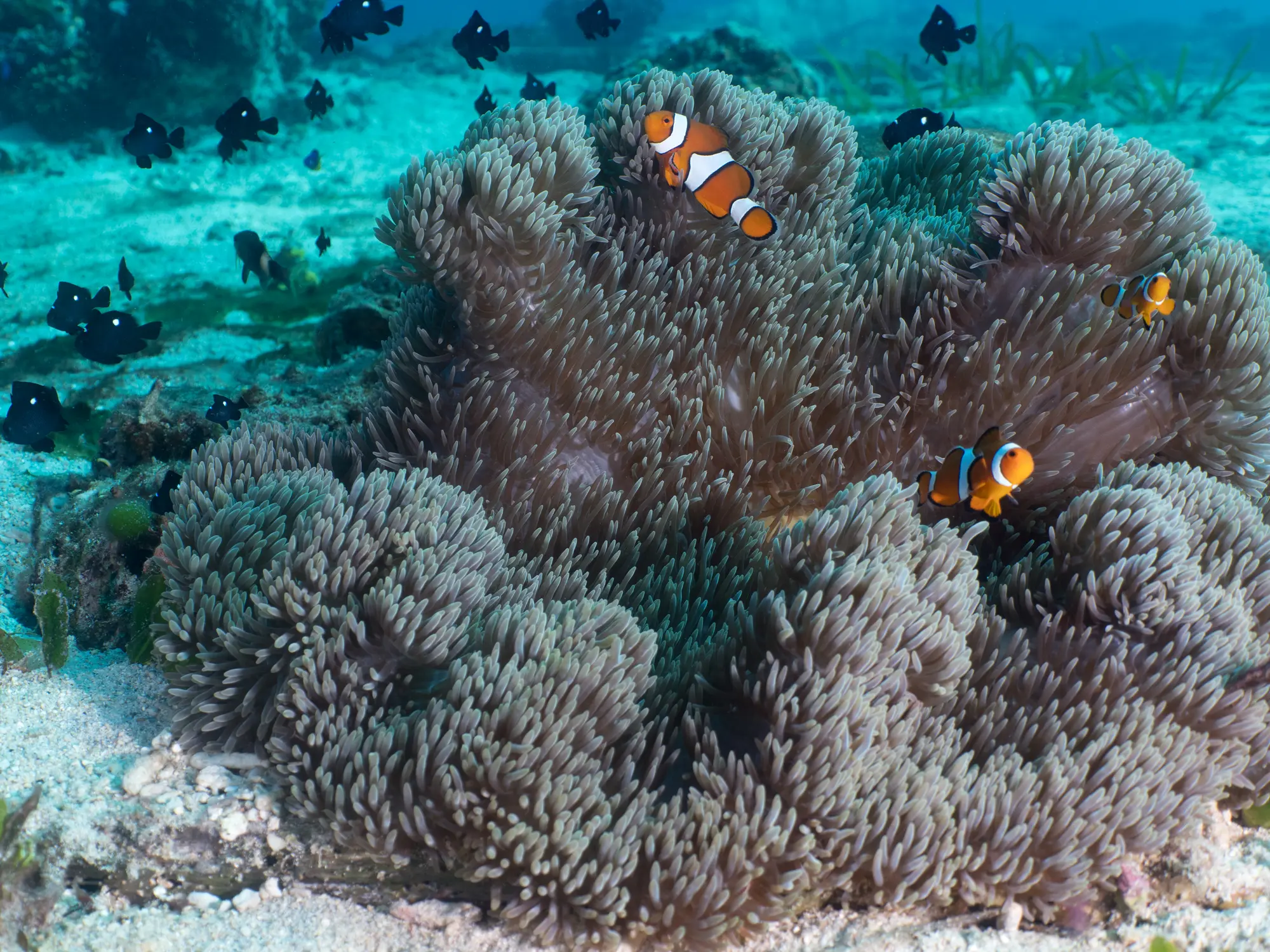
Three Amphiprion ocellaris in a sea anemone at Rao, west of Morotai, Indonesia, in 2019. The dark fish around them are threespot dascyllus, Dascyllus trimaculatus.
Credit and data
"Ocellaris clownfish (Amphiprion ocellaris) and Threespot dascyllus (Dascyllus trimaculatus) (48272091521)" by Rickard Zerpe — https://commons.wikimedia.org/wiki/File:Ocellaris_clownfish_(Amphiprion_ocellaris)_and_Threespot_dascyllus_(Dascyllus_trimaculatus)_(48272091521).jpg — CC BY 2.0 (https://creativecommons.org/licenses/by/2.0/)

In every group of Amphiprion ocellaris, the biggest fish is the female, and she began life as a male. If she disappears, her partner changes sex and the largest of the smaller fish matures into the new breeding male, according to a 2023 review by Marcela Herrera, Timothy Ravasi and Vincent Laudet.
The clownfish of Finding Nemo, Amphiprion ocellaris, is a small orange reef fish of the eastern Indian Ocean and western Pacific, found 1 to 15 m (3 to 49 ft) deep inside one of three kinds of sea anemone. It is spared their stings because of its mucus coat, not because it is immune, and how that coat works is still disputed.
Where do clownfish live in the wild?
Daphne Fautin and Gerald Allen's field guide to anemonefishes, published by the Western Australian Museum in 1992, places A. ocellaris from the Andaman and Nicobar Islands through the Indo-Malayan Archipelago and the Philippines to northwestern Australia, and along the coast of Southeast Asia north to the Ryukyu Islands. The guide names three hosts: the magnificent sea anemone, now Radianthus magnifica in WoRMS; the gigantic sea anemone, Stichodactyla gigantea; and Mertens' sea anemone, S. mertensii.
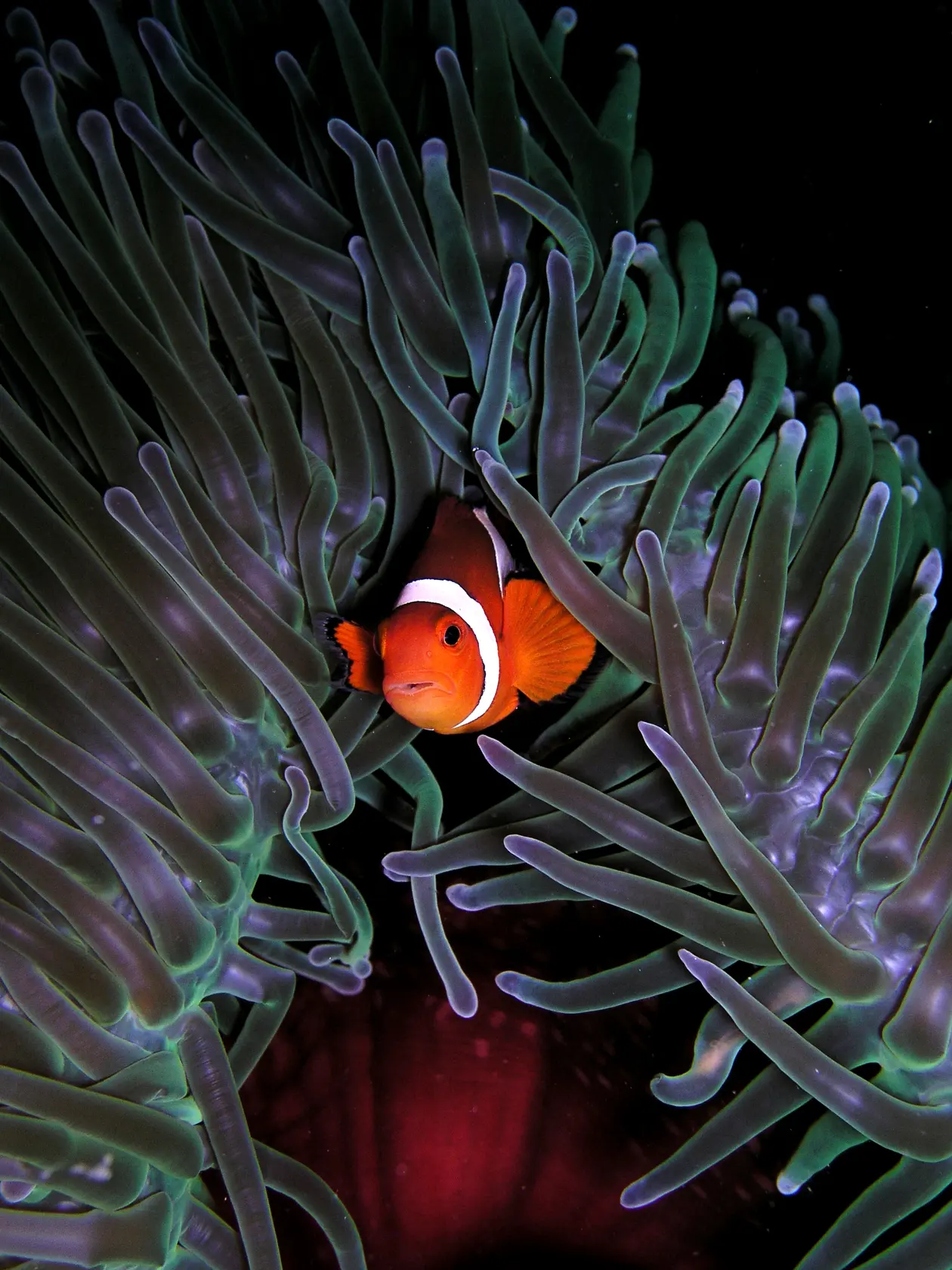
Amphiprion ocellaris in a magnificent sea anemone, Radianthus magnifica (filed under its older name, Heteractis magnifica), off Cristo Rei, East Timor, in 2004.
"Amphiprion ocellaris (Clown anemonefish) in Heteractis magnifica (Sea anemone)" by Nick Hobgood — https://commons.wikimedia.org/wiki/File:Amphiprion_ocellaris_(Clown_anemonefish)_in_Heteractis_magnifica_(Sea_anemone).jpg — CC BY-SA 3.0 (https://creativecommons.org/licenses/by-sa/3.0/)

D. J. Bray's 2021 species account in Fishes of Australia, hosted by Museums Victoria, gives a depth range of 1 to 15 m (3 to 49 ft). By this page's calculation, the Titanic wreck, which NOAA Ocean Exploration puts at 3,800 m (12,467 ft), lies about 250 times deeper than the 15 m end of that range.
The hosts are shallow-water animals too. The 10 anemones that house anemonefishes carry single-celled algae called zooxanthellae, which need sunlight, so Fautin and Allen place them no deeper than about 50 m (164 ft), generally in clear water.
 Illustration
Sea anemones on top of a rock in bright, shallow water. The anemones that house anemonefishes carry algae that need sunlight, so Fautin and Allen place them no deeper than about 50 m (164 ft).
Illustration: Ocean Life & Lore. Generated illustration — not a photograph, specimen or historical record. Reuse: CC BY 4.0 (https://creativecommons.org/licenses/by/4.0/); no rights are claimed beyond what the law grants.
WoRMS, the World Register of Marine Species, lists A. ocellaris as a marine fish only. It lists the betta, Betta splendens, as freshwater only.
Why doesn't the anemone sting the clownfish?
Sea anemones sting with nematocysts, microscopic capsules that shoot out a fine thread, many of them loaded with toxin. Fautin and Allen note that the 10 host anemones carry typical nematocysts, and that an unprotected anemonefish can be killed by its host's sting.
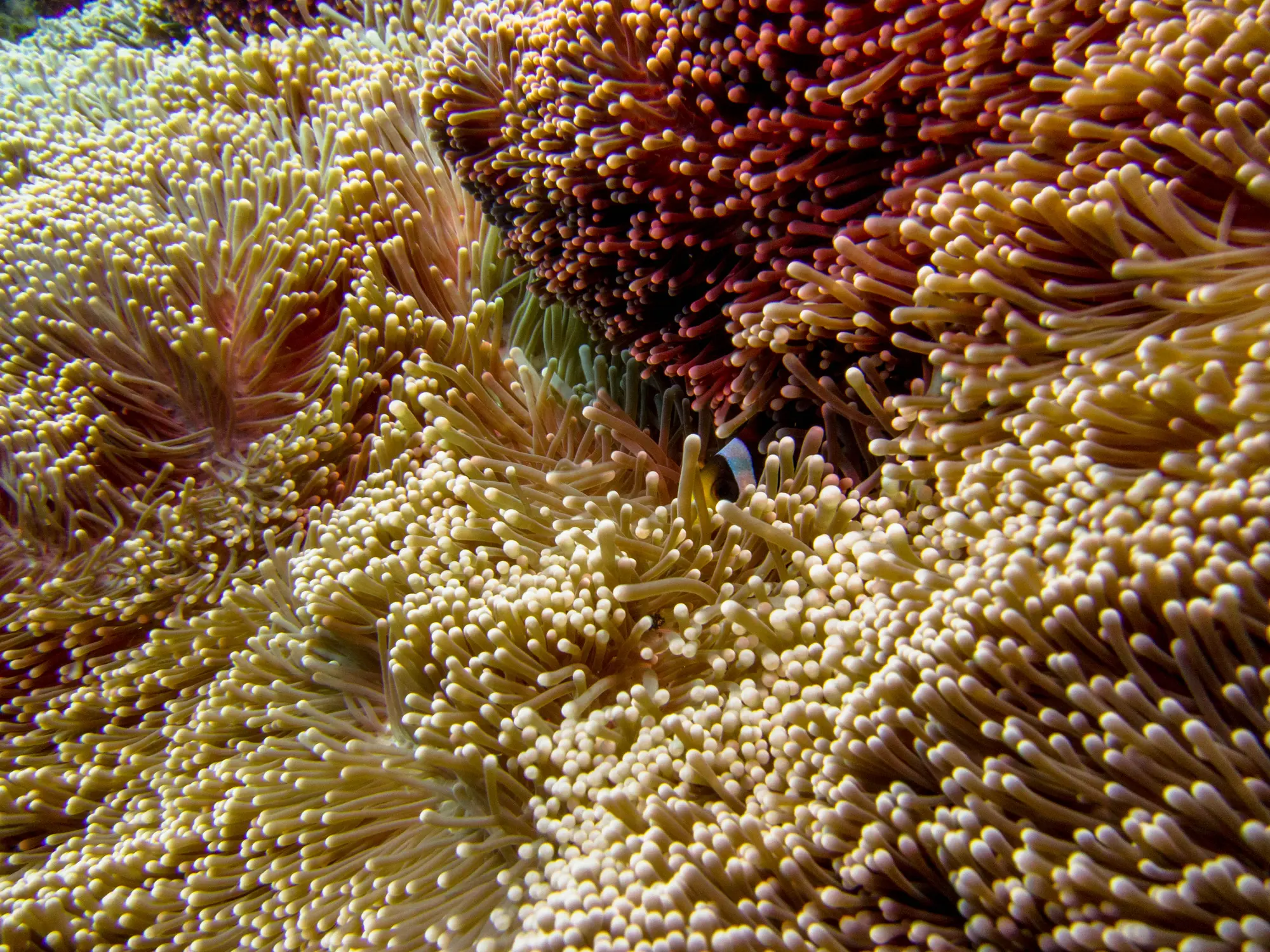
Tentacles of a gigantic sea anemone, Stichodactyla gigantea, off Saint-Paul, Réunion, in 2015. The 2025 larval sting trials described below used this species.
"Stichodactyla gigantea, Reunión" by Ryan McMinds — https://commons.wikimedia.org/wiki/File:Stichodactyla_gigantea,_Reuni%C3%B3n.jpg — CC BY 2.0 (https://creativecommons.org/licenses/by/2.0/)

The story goes that clownfish are immune to the sting. Fautin and Allen, who say this is "sometimes stated," answer that "the fish are not immune to being stung." A clownfish kept from its anemone for more than a few days or weeks appears to be stung when it returns, they write, and needs minutes to hours of what they call acclimation before it can dive right in.
Fautin and Allen report in their 1992 guide that experiments by Davenport and Norris placed the clownfish's protection in its mucus coat. The guide gives two explanations for that mucus: the fish smears itself with the anemone's own mucus, becoming "a fish in anemone's clothing," or its own mucus lacks the chemical cues that make nematocysts fire.
A 2025 study led by Natacha Roux tested a version of the second idea with sialic acid, one of the sugars that bind to receptors on anemone tentacles and help set off stings. Anemonefish mucus held less of it than that of damselfishes living without anemones, and four giant anemones showed none above the detection limit in their own mucus.
The same team placed A. ocellaris larvae, one at a time, in contact with the tentacles of Stichodactyla gigantea. None of the 20 larvae at the first two stages survived; at stage 4, when metamorphosis begins, 5 of 10 did, and at stages 6 and 7 all did, while the larvae's sialic acid fell (Roux et al. 2025).
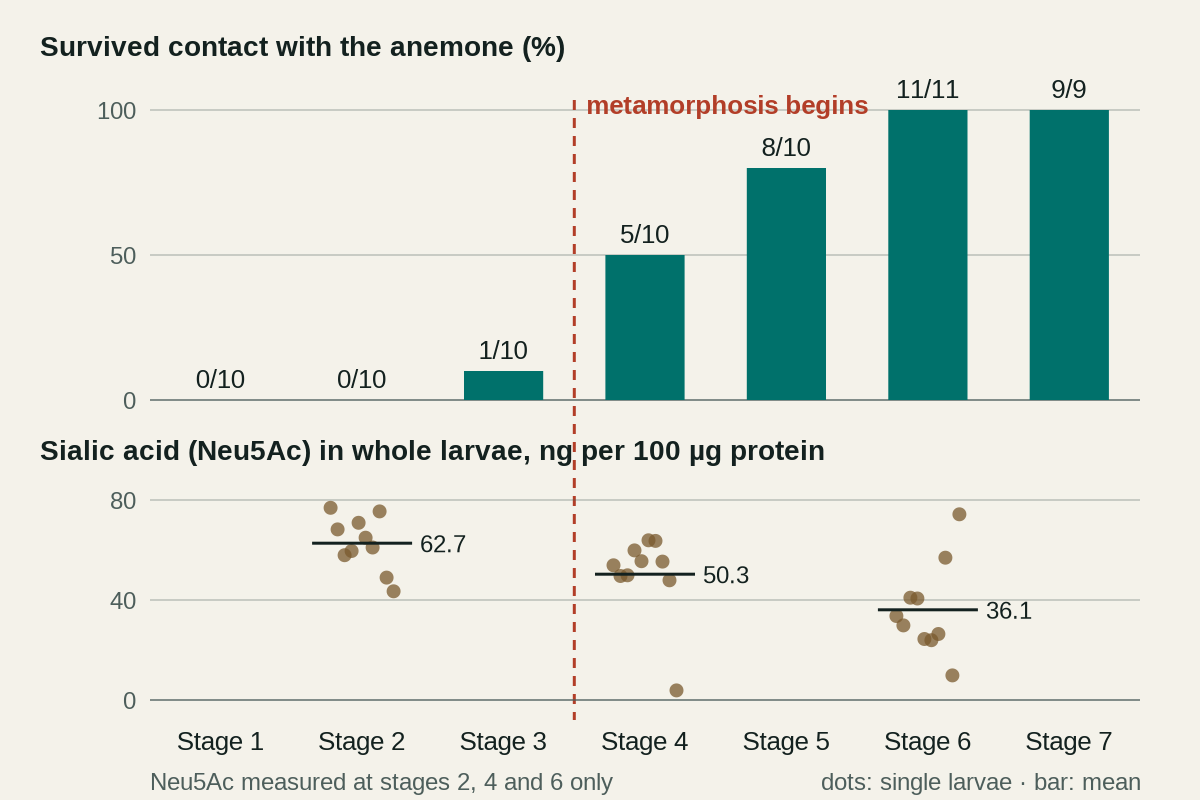
Open full-size chart, or scroll it sideways to read every label
Survival of Amphiprion ocellaris larvae placed against Stichodactyla gigantea tentacles, by developmental stage, and the sialic acid (Neu5Ac) in whole larvae. Stage means computed by this page.
Credit and data
"Clownfish larval survival on anemone tentacles rises at metamorphosis" by Ocean Life & Lore, https://oceanlifeandlore.com/aquarium/clownfish/, licensed under CC BY 4.0 (https://creativecommons.org/licenses/by/4.0/).
Data: Roux et al. 2025, Anemonefish use sialic acid metabolism as Trojan horse to avoid giant sea anemone stinging, BMC Biology 23: 39, Additional file 6, Table S3 (https://doi.org/10.1186/s12915-025-02144-8), CC BY 4.0, retrieved 2026-10-15.
That explanation is disputed. Also in 2025, Sara Heim and colleagues found 13–16 µM of total sialic acid in the mucus of two anemone-dwelling fishes, the clownfish Amphiprion akindynos and young Dascyllus trimaculatus, against 21–30 µM in two damselfishes living without anemones. A simple lack of these sugars, they concluded, does not explain why the fish are spared.
Do clownfish really change sex?
Yes, and only from male to female. All anemonefishes are protandrous hermaphrodites, meaning each fish starts out male and can later turn female (Herrera et al. 2023).
Every female clownfish was once a male.
A 2024 study of A. ocellaris brains by Coltan Parker and colleagues puts it outright: all female anemonefishes "were once males that changed sex to female after ascending to social dominance." A group in one anemone is typically an adult breeding pair plus several smaller, immature fish ranked by size, Herrera and colleagues write. For A. ocellaris, Bray's account adds that the female is the largest fish and her partner the second largest.
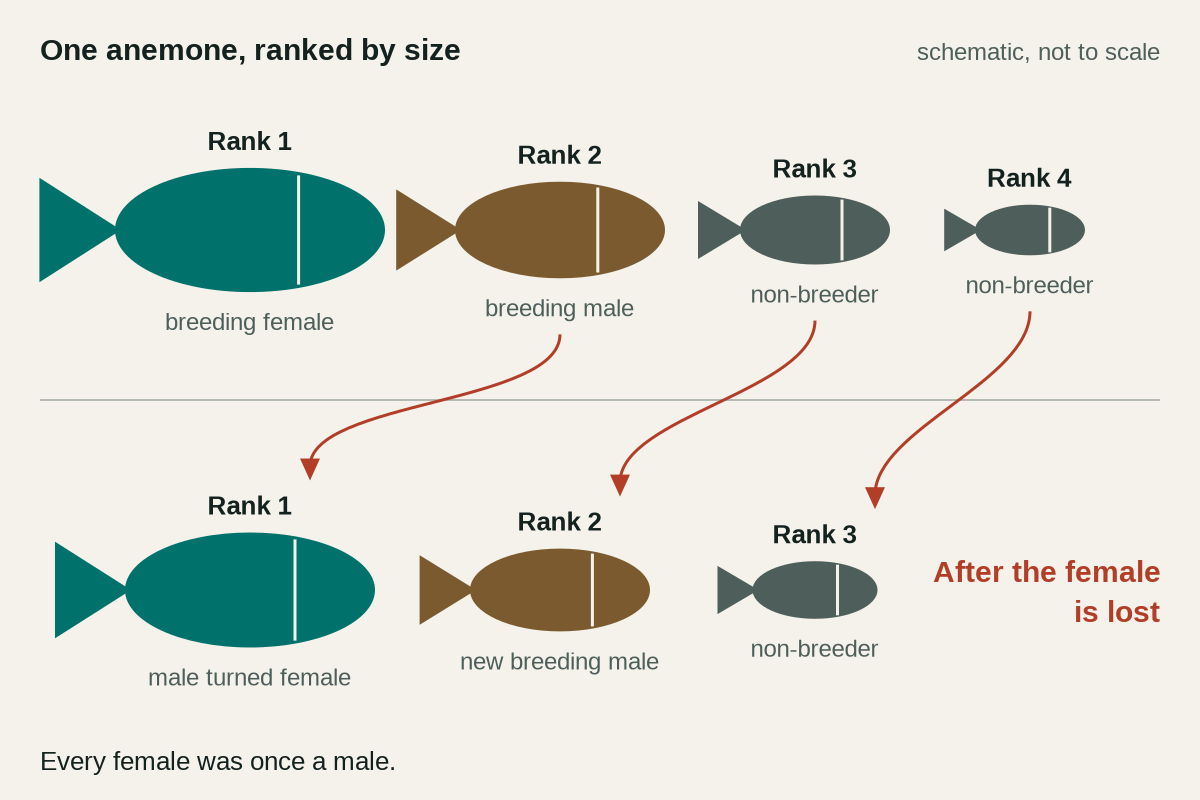
Open full-size chart, or scroll it sideways to read every label
Schematic of one anemone's size queue, not to scale. When the breeding female is lost, her male becomes female and the largest non-breeder becomes the breeding male (Herrera et al. 2023; Bray 2021).
Credit and data
"Who moves up when the female clownfish is lost" by Ocean Life & Lore, https://oceanlifeandlore.com/aquarium/clownfish/, licensed under CC BY 4.0 (https://creativecommons.org/licenses/by/4.0/).
Data: Herrera, Ravasi & Laudet 2023, Anemonefishes: A model system for evolutionary genomics, F1000Research 12: 204 (https://doi.org/10.12688/f1000research.130752.2), CC BY 4.0, retrieved 2026-10-15; Bray, D. J. 2021, Amphiprion ocellaris in Fishes of Australia, Museums Victoria (https://fishesofaustralia.net.au/home/species/1275), CC BY 3.0 AU, retrieved 2026-10-15.
How fast the change happens is still an active research question, the 2023 review notes. In anemonefishes, gene activity in the brain shifts within days to weeks of the female's removal, while complete change in the gonads takes much longer, sometimes several years. In one lab colony, the larger fish in each pair of young male A. ocellaris changed sex within 6 months to a year of pairing (Parker et al. 2024).
The story goes that Marlin, the widowed father in Finding Nemo, would in real life have become female. A University of Exeter news release in 2017 put it as "Marlin would have become Marlene." The studies above describe exactly that switch.
Wild groups may not be families at all. Anemonefish larvae drift into the open ocean right after hatching (Roux et al. 2025). A genetic survey of 203 groups of the close relative Amphiprion percula in Kimbe Bay, Papua New Guinea, sampled in 2019, found the fish within each group effectively unrelated (Rueger et al. 2025).
Did Finding Nemo empty the reefs of clownfish?
The story goes that Finding Nemo, released in 2003, sent fans straight out to buy wild-caught clownfish. Thane Militz and Simon Foale examined the idea, which they call the Nemo Effect, for the two species behind the film's hero, A. ocellaris and A. percula.
Their 2017 paper in Fish and Fisheries reports that import and export figures show little evidence of fans buying wild-caught fish in the 1.5 years after the film's release. That finding comes from the paper's abstract, which reports no result for later years.
The trade itself is large. In European Union import records for 2014 to 2021, Monica Biondo and colleagues counted 1,768,631 A. ocellaris, 10.0% of the marine aquarium fish identified to species and the second most imported species. Yearly imports peaked at 370,199 in 2015 and were 120,680 in 2021, about two-thirds lower by this page's calculation. For the wild population, the same paper reports that the IUCN Red List last assessed A. ocellaris in 2021 as "least concern," with its population trend unknown.
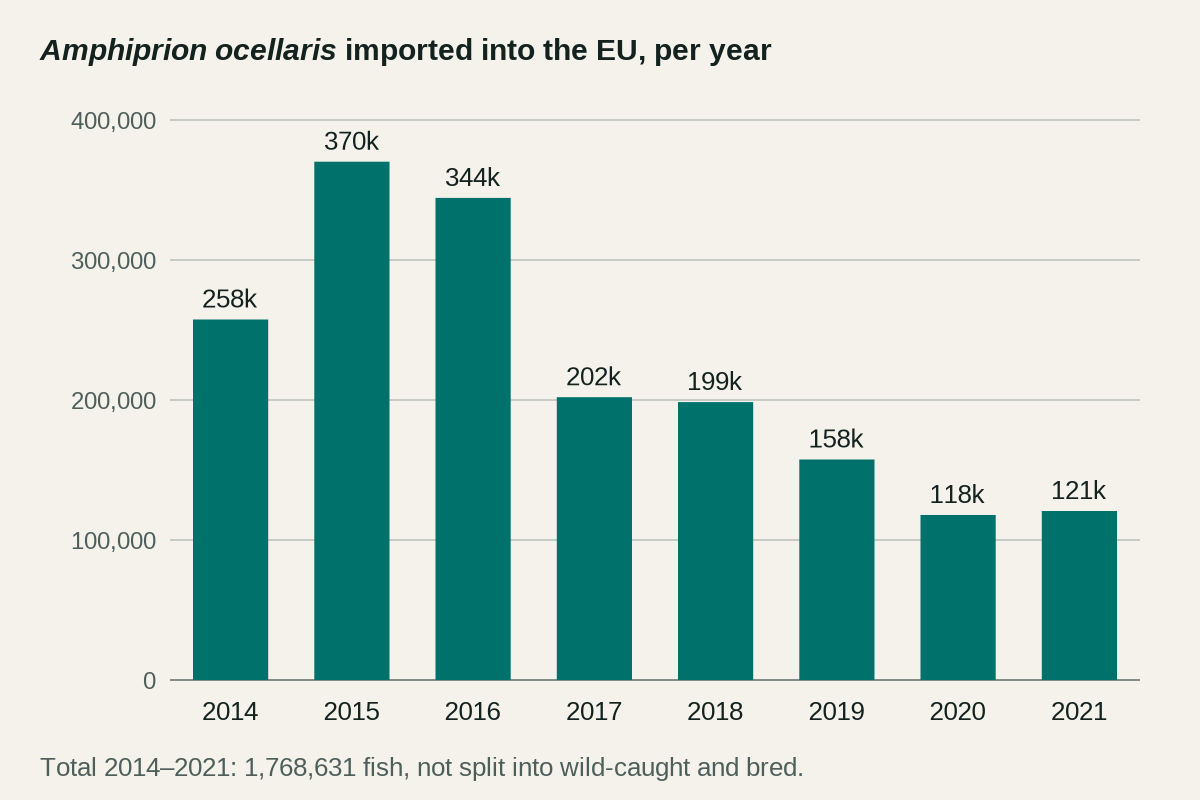
Open full-size chart, or scroll it sideways to read every label
Amphiprion ocellaris recorded as imported into the European Union each year, 2014–2021, from the TRACES records tabulated by Biondo et al. 2024. The counts are not split into caught and bred fish.
Credit and data
"Clownfish imported into the European Union, 2014 to 2021" by Ocean Life & Lore, https://oceanlifeandlore.com/aquarium/clownfish/, licensed under CC BY 4.0 (https://creativecommons.org/licenses/by/4.0/).
Data: Biondo et al. 2024, An Updated Review of the Marine Ornamental Fish Trade in the European Union, Animals 14: 1761, Table 4 (https://doi.org/10.3390/ani14121761), CC BY 4.0, retrieved 2026-10-15.
Are aquarium clownfish caught on reefs or bred?
Aquarium clownfish come both from reefs and from breeding. Anemonefishes can complete their whole life cycle in captivity (Herrera et al. 2023), and Biondo and colleagues write that A. ocellaris is increasingly bred in importing countries, which may partly explain the European decline. Their import figures do not separate wild fish from bred ones, so the share of each cannot be read from them.
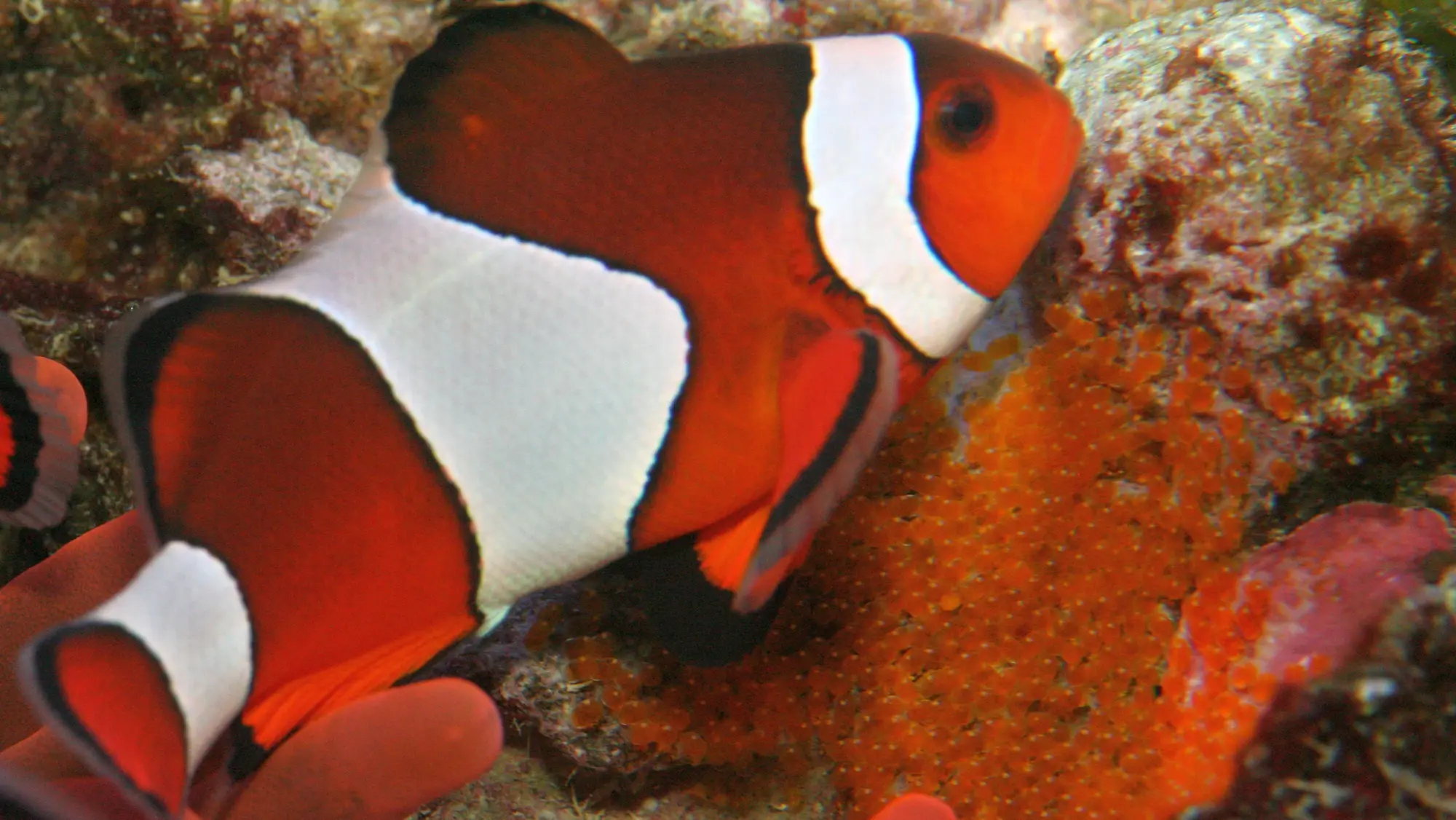
Amphiprion ocellaris beside a clutch of orange eggs, 2010. Anemonefishes can complete their life cycle in captivity, and the breeding male does most of the egg care (Herrera et al. 2023).
"Amphiprion ocellaris, puesta" by Andreas März — https://commons.wikimedia.org/wiki/File:Amphiprion_ocellaris,_puesta.jpg — CC BY 2.0 (https://creativecommons.org/licenses/by/2.0/)

How many of the clownfish sold since 2003 came off a reef, and how many from a hatchery, remains unsounded in the sources used here. The European counts are not split by origin, and the 2017 study's abstract gives no shares.
Lore check
3 claims sounded: holds ×1bends ×1sinks ×1
| Claim | Verdict | Evidence |
|---|---|---|
| Nemo's father would have become female | holds | Herrera et al. 2023: when the female is removed, the male changes sex; Bray 2021 reports the same for A. ocellaris. The story's source here: University of Exeter news release, 2017. |
| Clownfish are immune to anemone stings | bends | They live unharmed in their hosts, but Fautin & Allen 1992: "not immune"; the protection lies in the mucus. Roux et al. 2025: 0 of 20 early larvae survived contact with Stichodactyla gigantea. |
| Finding Nemo set off an immediate rush to buy wild-caught clownfish | sinks | Militz & Foale 2017 (abstract): import and export figures show little evidence of fan-based buying of wild-caught fish immediately after the film's release, within 1.5 years. The abstract reports nothing on later years. |
Further down:
- Nitrogen cycle in new tanks: one layer down from the fish, why nitrite peaks only after ammonia in a new aquarium.
- Geography cone: Conus geographus, a fish-hunting snail recorded from the intertidal zone to 20 m (66 ft) deep (Peters et al. 2013), a band that overlaps the clownfish's 1 to 15 m.
Sources
- 1Fautin, Daphne G., and Gerald R. Allen. Field Guide to Anemone Fishes and Their Host Sea Anemones. Western Australian Museum, 1992. Web edition, University of Kansas Natural History Museum: introduction, chapter 1 (sea anemones) and chapter 2 (anemonefishes). https://web.archive.org/web/20150110004043/http://www.nhm.ku.edu/inverts/ebooks/ch2.html Read: introduction and chapters 1–2 of the web edition, archived copies of 2004-08-24, 2004-09-06 and 2015-01-10.
- 2Roux, N., C. Delannoy, S.-Y. Yu, S. Miura, L. Carlu, L. Besseau, T. Nakagawa, C. Sato, K. Kitajima, Y. Guerardel, and V. Laudet. "Anemonefish use sialic acid metabolism as Trojan horse to avoid giant sea anemone stinging." BMC Biology 23 (2025): 39. https://doi.org/10.1186/s12915-025-02144-8 Read: full text and Additional file 6 (Table S3).
- 3Heim, S., T. Teav, F. Cortesi, H. Gallart-Ayala, J. Ivanisevic, and N. Salamin. "N-acetylated sugars in clownfish and damselfish skin mucus as messengers involved in chemical recognition by anemone host." Scientific Reports 15 (2025): 2048. https://doi.org/10.1038/s41598-024-84495-w Read: abstract.
- 4Parker, C. G., G. W. Gruenhagen, B. E. Hegarty, A. R. Histed, J. T. Streelman, J. S. Rhodes, and Z. V. Johnson. "Adult sex change leads to extensive forebrain reorganization in clownfish." Biology of Sex Differences 15 (2024): 58. https://doi.org/10.1186/s13293-024-00632-0 Read: abstract, introduction and methods (animals and husbandry).
- 5Rueger, T., T. A. Barbasch, M. Patel, S. M. Bogdanowicz, and P. M. Buston. "No evidence for kin selection as an explanation for social group formation in clown anemonefish." Behavioral Ecology 36, no. 4 (2025): araf075. https://doi.org/10.1093/beheco/araf075 Read: abstract, methods (sampling) and results.
- 6Militz, Thane A., and Simon Foale. "The ‘Nemo Effect’: Perception and reality of Finding Nemo's impact on marine aquarium fisheries." Fish and Fisheries 18, no. 3 (2017): 596–606. https://doi.org/10.1111/faf.12202 Read: abstract.
- 7Biondo, M. V., R. P. Burki, F. Aguayo, and R. Calado. "An Updated Review of the Marine Ornamental Fish Trade in the European Union." Animals 14, no. 12 (2024): 1761. https://doi.org/10.3390/ani14121761 Read: full text (results, discussion and Table 4).
- 8Peters, H., B. C. O'Leary, J. P. Hawkins, K. E. Carpenter, and C. M. Roberts. "Conus: first comprehensive conservation red list assessment of a marine gastropod mollusc genus." PLoS ONE 8, no. 12 (2013): e83353. https://doi.org/10.1371/journal.pone.0083353 Read: figure 1 caption.
- 9Herrera, M., T. Ravasi, and V. Laudet. "Anemonefishes: A model system for evolutionary genomics." F1000Research 12 (2023): 204 (version 2). https://doi.org/10.12688/f1000research.130752.2 Read: full text.
- 10Bray, D. J. "Amphiprion ocellaris." In Fishes of Australia, edited by D. J. Bray and M. F. Gomon. Museums Victoria and OzFishNet, 2021. https://fishesofaustralia.net.au/home/species/1275 Read: species account.
- 11Froese, R. and D. Pauly. Editors. (2026). FishBase. Amphiprion ocellaris Cuvier, 1830 (AphiaID 278400); Amphiprion percula (Lacepède, 1802) (AphiaID 278402); Amphiprion akindynos Allen, 1972 (AphiaID 278392); Dascyllus trimaculatus (Rüppell, 1829) (AphiaID 212846); Betta splendens Regan, 1910 (AphiaID 862539). Accessed through: World Register of Marine Species at: https://www.marinespecies.org on 2026-10-15 https://www.marinespecies.org/aphia.php?p=taxdetails&id=278400 Read: catalogue records.
- 12Rodríguez, E.; Fautin, D; Daly, M. (2026). World List of Actiniaria. Radianthus magnifica (Quoy & Gaimard, 1833) (AphiaID 854493); Stichodactyla gigantea (Forsskål, 1775) (AphiaID 291133); Stichodactyla mertensii Brandt, 1835 (AphiaID 291136). Accessed through: World Register of Marine Species at: https://www.marinespecies.org on 2026-10-15 https://www.marinespecies.org/aphia.php?p=taxdetails&id=854493 Read: catalogue records.
- 13MolluscaBase eds. (2026). MolluscaBase. Conus geographus Linnaeus, 1758 (AphiaID 215499). Accessed through: World Register of Marine Species at: https://www.marinespecies.org/aphia.php?p=taxdetails&id=215499 on 2026-10-15 Read: catalogue record.
- 14NOAA Ocean Exploration. "Titanic Bow." Daily image from the R.M.S. Titanic Expedition 2003. https://oceanexplorer.noaa.gov/multimedia/daily-image-media-20210415/ Read: full text.
- 15NOAA Ocean Exploration. "How deep is the ocean?" https://oceanexplorer.noaa.gov/ocean-fact/ocean-depth/ Read: full text.
- 16NOAA National Ocean Service. "How far does light travel in the ocean?" https://oceanservice.noaa.gov/facts/light_travel.html Read: full text.
- 17University of Exeter. "Clownfish males become fierce females if their ‘wife’ is eaten." News release, 15 July 2017. https://news-archive.exeter.ac.uk/2017/july/title_594884_en.html Read: full text.
Cite this page
Ocean Life & Lore. “Clownfish: The Largest in Each Anemone Is the Female.” Ocean Life & Lore. Published 2026-10-15; last substantive revision 2026-10-15. https://oceanlifeandlore.com/aquarium/clownfish/ (accessed the date you read it).
Download the data: Sounding line (CSV) CSV (source and license record) Data: Bray, D. J. 2021, Amphiprion ocellaris in Fishes of Australia, Museums Victoria (https://fishesofaustralia.net.au/home/species/1275), CC BY 3.0 AU, retrieved 2026-10-15; NOAA Ocean Service, How far does light travel in the ocean? (https://oceanservice.noaa.gov/facts/light_travel.html), public domain (US federal government work), retrieved 2026-10-15; NOAA Ocean Exploration, Titanic Bow, daily image from the R.M.S. Titanic Expedition 2003 (https://oceanexplorer.noaa.gov/multimedia/daily-image-media-20210415/), public domain (US federal government work), retrieved 2026-10-15; NOAA Ocean Exploration, How deep is the ocean? (https://oceanexplorer.noaa.gov/ocean-fact/ocean-depth/), public domain (US federal government work), retrieved 2026-10-15. · Larval sting trials (CSV) CSV (source and license record) Data: Roux et al. 2025, Anemonefish use sialic acid metabolism as Trojan horse to avoid giant sea anemone stinging, BMC Biology 23: 39, Additional file 6, Table S3 (https://doi.org/10.1186/s12915-025-02144-8), CC BY 4.0, retrieved 2026-10-15. · EU imports (CSV) CSV (source and license record) Data: Biondo et al. 2024, An Updated Review of the Marine Ornamental Fish Trade in the European Union, Animals 14: 1761, Table 4 (https://doi.org/10.3390/ani14121761), CC BY 4.0, retrieved 2026-10-15.
Corrections
No corrections yet.
Every correction on the site is listed in the Corrections logbook. To report an error on this page, use Report a correction with the page URL, the sentence and your source. How claims are sounded sets out the sources, recalculations and verdict rules behind each page.
More from Aquarium
-
How it works
Nitrogen Cycle in New Tanks: Why Nitrite Peaks After Ammonia
Ocean nitrate maximum (global mean): 1,000 m
-
Entry
Betta Fish: A Marsh Fish That Breathes Air at the Surface
Betta splendens: 0–1.2 m