How it works
Nitrogen Cycle in New Tanks: Why Nitrite Peaks After Ammonia
In two-step nitrification, microbes run a relay: the ones that clear nitrite can only grow after others have made it. Comammox bacteria carry out both steps in a single cell.
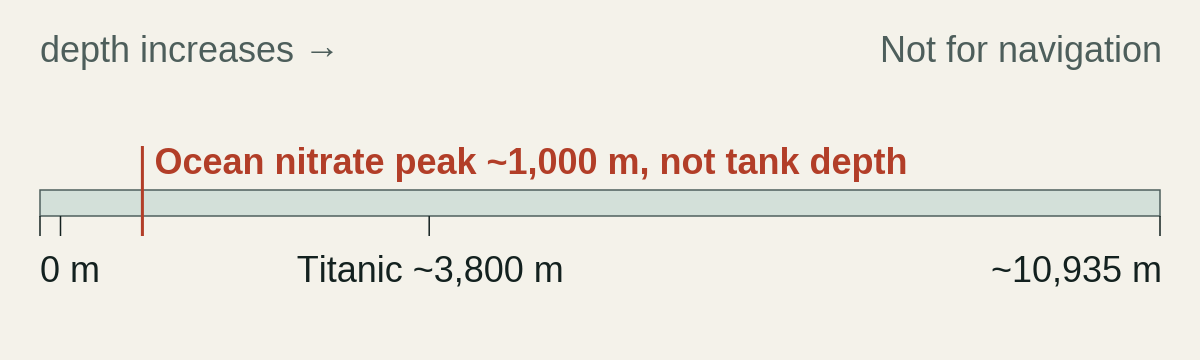
Ocean comparison, not tank depth: in the World Ocean Atlas 2023 global mean, nitrate peaks near 1,000 m (Garcia et al. 2024).
Credit and data
"Sounding line: the ocean's nitrate peak, about 1,000 m" by Ocean Life & Lore, https://oceanlifeandlore.com/aquarium/nitrogen-cycle/, licensed under CC BY 4.0 (https://creativecommons.org/licenses/by/4.0/).
Data: Garcia et al. 2024, World Ocean Atlas 2023, Volume 4: Dissolved Inorganic Nutrients, NOAA Atlas NESDIS 92, pp. 63-64 (https://doi.org/10.25923/39qw-7j08), CC0 1.0, retrieved 2026-10-15; NOAA Ocean Service, How far does light travel in the ocean? (https://oceanservice.noaa.gov/facts/light_travel.html), public domain (US federal government work), retrieved 2026-10-15; NOAA Ocean Exploration, Titanic bow, daily image from the R.M.S. Titanic Expedition 2003 (https://oceanexplorer.noaa.gov/multimedia/daily-image-media-20210415/), public domain (US federal government work), retrieved 2026-10-15; NOAA Ocean Exploration, How deep is the ocean? (https://oceanexplorer.noaa.gov/ocean-fact/ocean-depth/), public domain (US federal government work), retrieved 2026-10-15.
TL;DR. In three new home tanks tracked in a 2025 study, nitrite peaked once ammonia oxidation took off. That was week 2 in two tanks and week 7 in the third, and the tanks cleared both by weeks 3, 3 and 8. Gene surveys of freshwater filters find archaea or comammox Nitrospira in the lead, and the textbook Nitrobacter was not detected in the aquarium filters tested.
Down this page 8 sections
Open full-size chart, or scroll it sideways to read every label
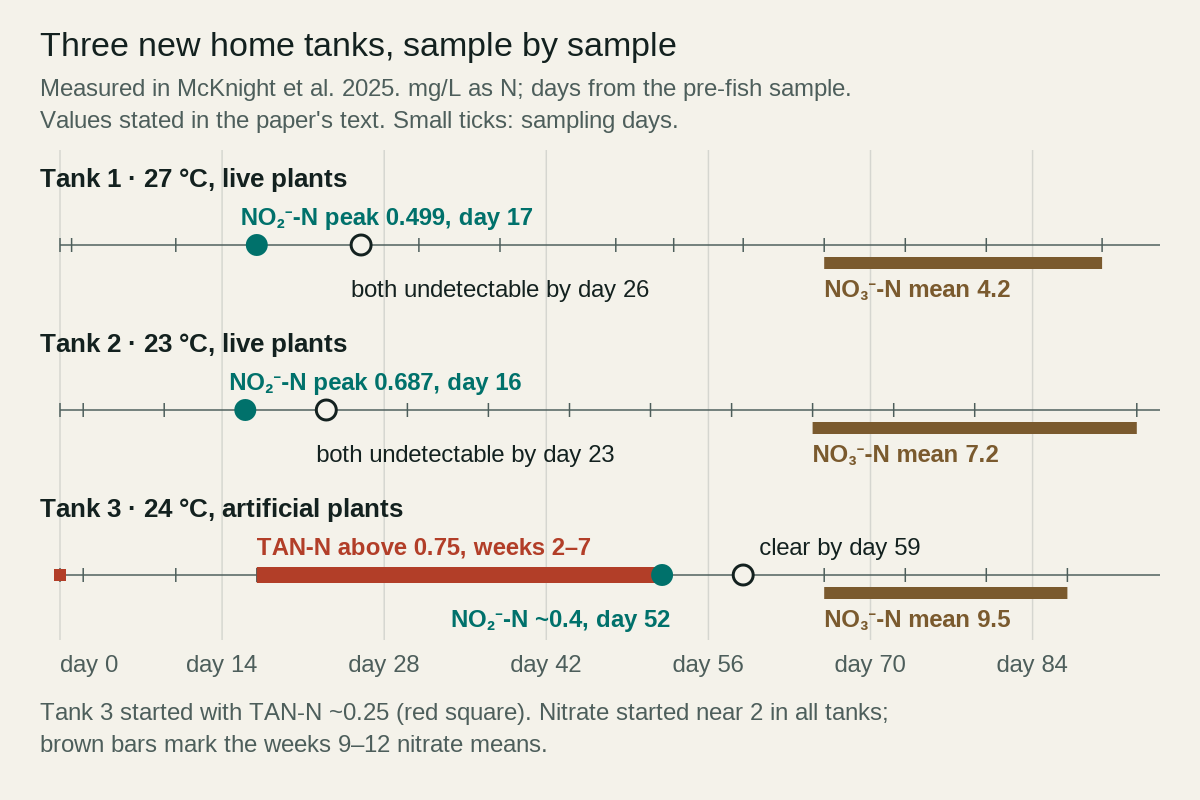
Measured in McKnight et al. 2025: three freshwater home tanks, sampled about weekly. Values stated in the paper's text, converted from µg N/L to mg/L as N.
Credit and data
"Three new home tanks, sample by sample" by Ocean Life & Lore, https://oceanlifeandlore.com/aquarium/nitrogen-cycle/, licensed under CC BY 4.0 (https://creativecommons.org/licenses/by/4.0/).
Data: McKnight, Szabolcs, Graham & Neufeld 2025, Microbial community succession of home aquarium biofilters associated with early establishment of comammox Nitrospira, ISME Communications 5: ycaf212; data adapted from values stated in the text and sample dates in Table S1 (https://doi.org/10.1093/ismeco/ycaf212), CC BY 4.0 (https://creativecommons.org/licenses/by/4.0/), retrieved 2026-10-15.
Two new home aquariums in a 2025 study hit peak nitrite in week 2, the same week ammonia became undetectable. The timing works like a relay. Ammonia oxidizers grow first in a new filter, Michelle McKnight and colleagues write in ISME Communications, and nitrite oxidizers increase later, in response to the nitrite those first microbes make.
Nitrite in those two tanks fell below detection by week 3. A third tank stalled. It held total ammonia above 0.75 mg/L as N from week 2 to week 7, and it cleared both ammonia and nitrite only by week 8.
What does a tank have to do that the ocean does for free?
An aquarium connected to a natural body of water gets constant circulation that keeps ammonia low, Oliaro and colleagues note. The ocean holds about 1,335,000,000 km³ of water (about 320 million cubic miles, by this page's conversion), according to an estimate from NOAA's National Geophysical Data Center. A closed tank has to do that job, and others, on its own.
This site calls that arrangement the kept sea. For each job the ocean does for free, ask who or what keeps it in the tank. For nitrogen, McKnight's team describes the answer: the filter's microbes keep nitrification, and water changes or live plants keep nitrate down.
Three numbers follow nitrogen through a new tank: total ammonia nitrogen (TAN-N, the sum of NH₃ and NH₄⁺), nitrite nitrogen (NO₂⁻-N) and nitrate nitrogen (NO₃⁻-N). This page gives all three in mg/L as N, counting only the nitrogen. McKnight's team reported most values in micrograms of nitrogen per liter, so those are divided by 1,000 here.
How much nitrate does the ocean hold?
The open ocean keeps its nitrate deep. In NOAA's World Ocean Atlas 2023, the global mean is under about 5 µmol/kg at the surface. It rises to about 33 µmol/kg at the nitrate maximum near 1,000 m (3,281 ft), about a quarter of the way down to the Titanic wreck at 3,800 m (12,467 ft). Dead phytoplankton and detritus can sink, the atlas notes, and nitrification turns the ammonium released from that organic matter into nitrate in the deep ocean.
 Illustration
Bright surface water fading into the dark, with a faint band far below standing in for the nitrate maximum. In the World Ocean Atlas 2023 global mean, it lies near 1,000 m (3,281 ft).
Illustration: Ocean Life & Lore. Generated illustration — not a photograph, specimen or historical record. Reuse: CC BY 4.0 (https://creativecommons.org/licenses/by/4.0/); no rights are claimed beyond what the law grants.
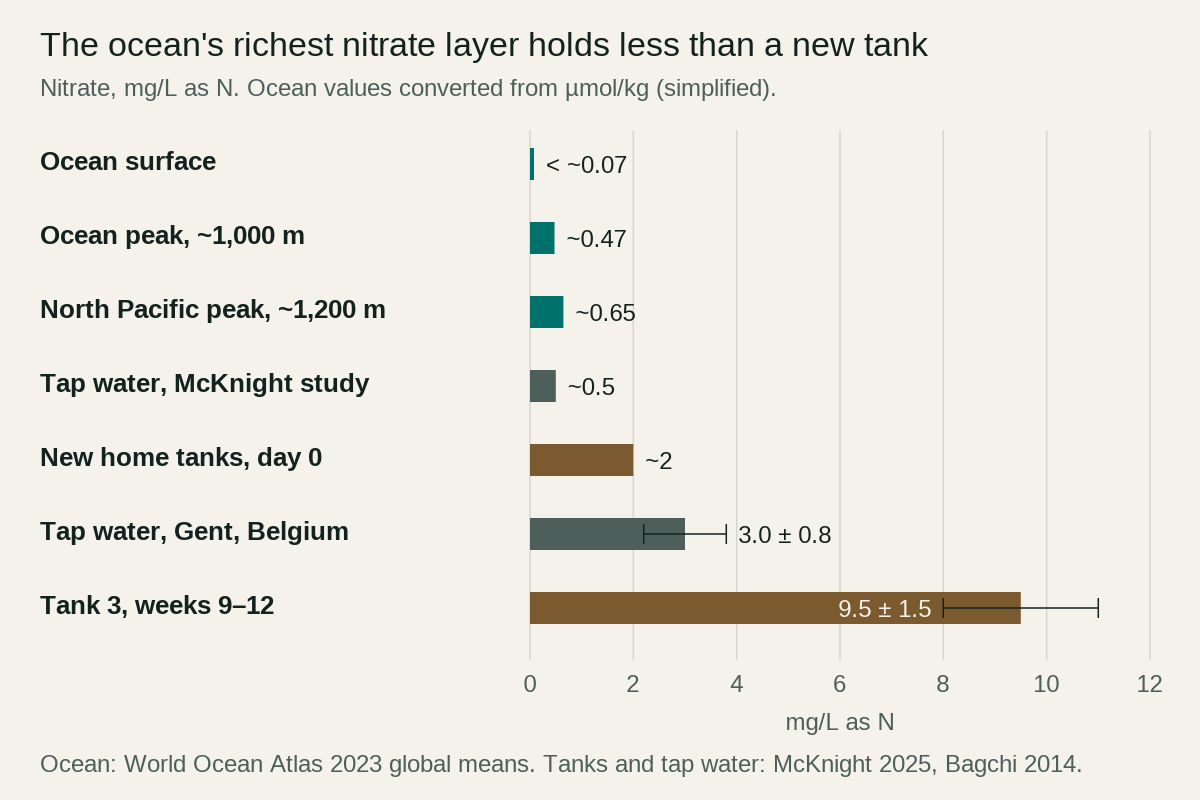
By this page's calculation, 33 µmol/kg is about 0.47 mg/L as N. The conversion uses 14.007 g per mole of nitrogen and a typical seawater density of 1.026 kg per liter, and it ignores compression at depth. McKnight's new tanks started near 2 mg/L as N of nitrate on day 0. Bagchi et al. (2014) reported tap water in Gent, Belgium, at 3.0 ± 0.8 mg/L as N.
The ocean's richest nitrate layer, in the global mean, carries about a quarter of the nitrate these new tanks started with.
That layer also lies below the range of the chambered nautilus (Nautilus pompilius). At Osprey Reef in the Coral Sea, Dunstan and colleagues (2011) tracked nautiluses between 130 and 700 m (427 and 2,297 ft). They gave 800 m (2,625 ft) as the depth at which the shells implode, about 200 m (656 ft) shallower than the global nitrate peak.
Open full-size chart, or scroll it sideways to read every label
Nitrate as N. Ocean values are World Ocean Atlas 2023 global means converted from µmol/kg; tank and tap values come from McKnight et al. 2025 and Bagchi et al. 2014.
Credit and data
"The ocean's richest nitrate layer holds less than a new tank" by Ocean Life & Lore, https://oceanlifeandlore.com/aquarium/nitrogen-cycle/, licensed under CC BY 4.0 (https://creativecommons.org/licenses/by/4.0/).
Data: Garcia et al. 2024, World Ocean Atlas 2023, Volume 4: Dissolved Inorganic Nutrients, NOAA Atlas NESDIS 92, pp. 63-64 (https://doi.org/10.25923/39qw-7j08), CC0 1.0, retrieved 2026-10-15; McKnight, Szabolcs, Graham & Neufeld 2025, Microbial community succession of home aquarium biofilters associated with early establishment of comammox Nitrospira, ISME Communications 5: ycaf212; data adapted from values stated in the text and sample dates in Table S1 (https://doi.org/10.1093/ismeco/ycaf212), CC BY 4.0 (https://creativecommons.org/licenses/by/4.0/), retrieved 2026-10-15; Bagchi et al. 2014, Temporal and spatial stability of ammonia-oxidizing archaea and bacteria in aquarium biofilters, PLoS ONE 9(12): e113515 (https://doi.org/10.1371/journal.pone.0113515), CC BY, values as reported, retrieved 2026-10-15; CIAAW, Atomic Weight of Nitrogen (https://www.ciaaw.org/nitrogen.htm), factual value, no license stated, retrieved 2026-10-15; US GLOBEC, How do we measure the density of sea water? (https://gb11.whoi.edu/globec-dir/sea_water_density_description.html), factual value, no license stated, retrieved 2026-10-15.
Where does the ammonia come from, and which form is toxic?
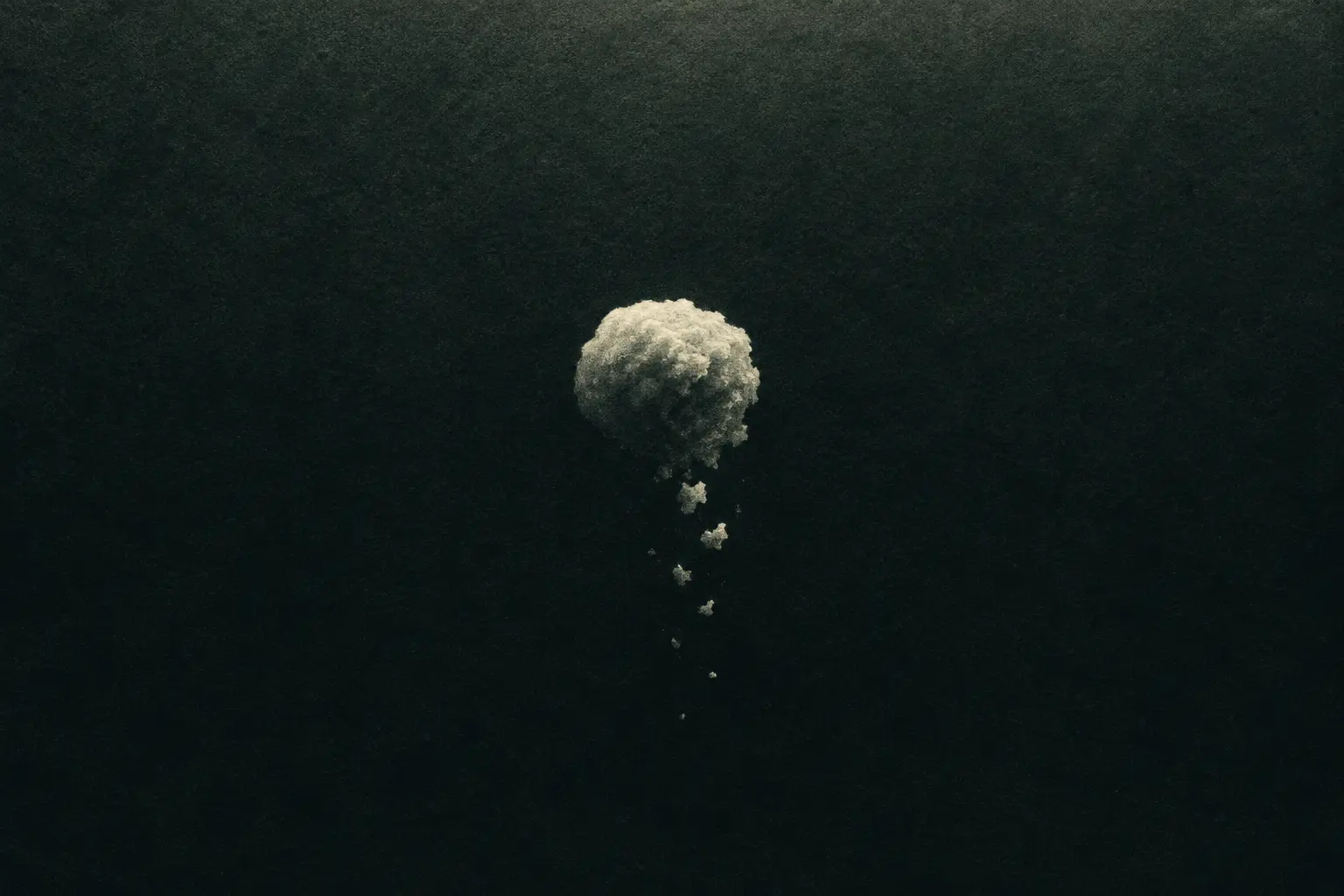
In a tank with fish, ammonia arrives from day one. Fish excrete it, mainly through their gills, Oliaro and colleagues note. More comes from the breakdown of uneaten food and feces, a step called ammonification (Bagchi et al. 2014). In tank 3 of McKnight's study, ammonia climbed above 0.75 mg/L as N between the samples of days 10 and 17.
 Illustration
A piece of uneaten food crumbling as it sinks. The breakdown of uneaten food and feces, a step called ammonification, is one source of a tank's ammonia.
Illustration: Ocean Life & Lore. Generated illustration — not a photograph, specimen or historical record. Reuse: CC BY 4.0 (https://creativecommons.org/licenses/by/4.0/); no rights are claimed beyond what the law grants.
A test reading of ammonia covers two chemicals. Total ammonia nitrogen counts un-ionized ammonia (NH₃) and the ammonium ion (NH₄⁺) together. The US Environmental Protection Agency's 2013 freshwater criteria note that total ammonia is what is measured in water samples, and that ammonium is the more abundant form.
Fish get rid of ammonia largely by letting NH₃ diffuse out across the gills, the 2013 EPA criteria explain. High NH₃ in the water outside slows or reverses that flow, so ammonia builds up in the fish's blood and tissues.
Why does pH matter?
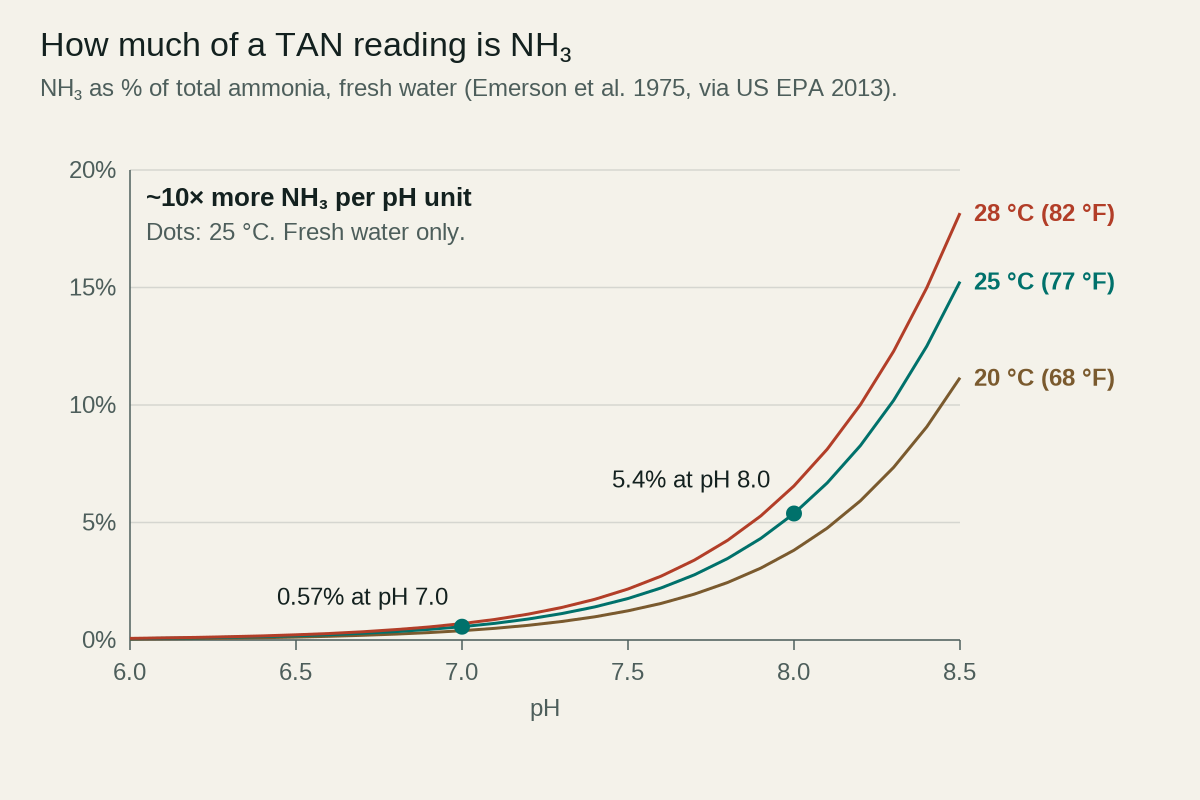
The balance between the two forms shifts with pH and temperature. EPA, citing Erickson (1985), gives two rules for fresh water. The ratio of NH₃ to NH₄⁺ rises about tenfold for each unit of pH. It roughly doubles with each 10 °C (18 °F) of warming between 0 and 30 °C (32 and 86 °F).
By this page's calculation with the Emerson et al. (1975) equation that EPA gives, NH₃ is about 0.57% of TAN at pH 7.0 and 25 °C (77 °F). At pH 8.0 it is about 5.4%. EPA calls that rise in NH₃ one hypothesis for why total ammonia grows more toxic as pH climbs.
The chart below uses the freshwater equation. EPA notes that the constant in it also depends on ionic strength, so this is not a seawater curve.
Open full-size chart, or scroll it sideways to read every label
Share of total ammonia present as NH₃ in fresh water at 20, 25 and 28 °C (68, 77 and 82 °F), from the Emerson et al. 1975 equation given by EPA. Not adjusted for seawater.
Credit and data
"How much of a TAN reading is NH3" by Ocean Life & Lore, https://oceanlifeandlore.com/aquarium/nitrogen-cycle/, licensed under CC BY 4.0 (https://creativecommons.org/licenses/by/4.0/).
Data: US EPA 2013, Aquatic Life Ambient Water Quality Criteria for Ammonia, Freshwater, EPA-822-R-13-001, pp. 6-7, Emerson et al. 1975 equation (https://www.epa.gov/sites/default/files/2015-08/documents/aquatic-life-ambient-water-quality-criteria-for-ammonia-freshwater-2013.pdf), public domain (US federal government work), retrieved 2026-10-15.
A fishless start takes its ammonia from a bottle, not from gills. The only source this site describes is an ammonia solution with supplier-confirmed ingredients, a labeled concentration, and no fragrance or surfactants; anhydrous ammonia and concentrated industrial ammonia are ruled out. The NIOSH Pocket Guide lists eye, nose and throat irritation and skin burns among the symptoms, so avoid breathing the vapor, keep it off skin and out of eyes, and work in a ventilated space. This page gives no amounts or target concentrations.
Why does nitrite spike after ammonia drops?
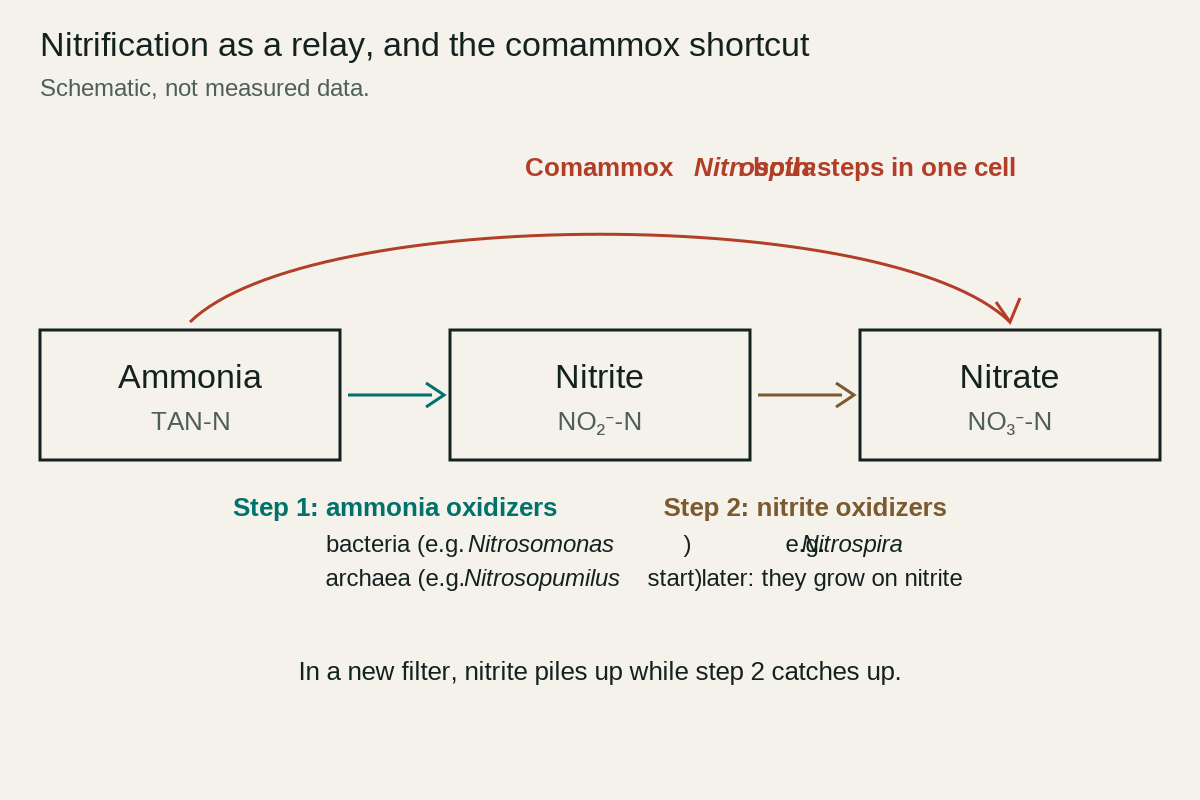
Nitrification here takes two steps. Ammonia oxidizers turn ammonia into nitrite, and nitrite oxidizers turn nitrite into nitrate. The second group runs on the first group's product, so in a new filter it grows later, the order McKnight's team describes.
In McKnight's two faster tanks, the relay ran like this, with days counted from the sample taken before fish went in:
- Day 0: no detectable nitrite; nitrate about 2 mg/L as N.
- Days 1–10: ammonia rose a little after the fish arrived, and nitrite began to climb.
- Days 16–17 (week 2): ammonia undetectable; nitrite at its peak, 0.499 mg/L as N in tank 1 and 0.687 mg/L as N in tank 2.
- Days 23–26 (week 3): nitrite below detection; nitrate still rising.
The peak comes at the handover. Once ammonia oxidizers keep pace, ammonia falls, but nitrite oxidizers are still few, so nitrite piles up until they catch up.
There is a shortcut. In 2015, two teams reported Nitrospira bacteria that carry out both steps in a single cell (Daims et al. 2015; van Kessel et al. 2015). The process is called comammox, for complete ammonia oxidation. McKnight's team writes that it may suit aquariums because it avoids releasing nitrite, which can also harm aquatic animals.
Open full-size chart, or scroll it sideways to read every label
Two-step nitrification and the one-cell comammox shortcut. Schematic, not measured data; based on McKnight et al. 2025, Oliaro et al. 2025, Daims et al. 2015 and van Kessel et al. 2015.
"Nitrification as a relay, and the comammox shortcut" by Ocean Life & Lore, https://oceanlifeandlore.com/aquarium/nitrogen-cycle/, licensed under CC BY 4.0 (https://creativecommons.org/licenses/by/4.0/).
Which microbes actually do the work?
The story goes that two bacteria run every filter. Nitrosomonas turns ammonia into nitrite, and Nitrobacter turns nitrite into nitrate. An undated beginners' FAQ hosted on Thomas Narten's Duke University web pages names those two, "among others." In 1998, Hovanec and colleagues wrote that nitrite oxidation in aquaria is "typically attributed" to Nitrobacter.
In the same paper, Hovanec et al. found Nitrospira-like bacteria in freshwater aquarium biofilms and did not detect Nitrobacter. Two years earlier, Hovanec and DeLong (1996) detected Nitrosomonas europaea and its relatives in every nitrifying seawater system they sampled. They found such bacteria in only two freshwater samples. In neither kind of tank did they detect rRNA from the alpha-proteobacterial nitrite oxidizers, the group that includes Nitrobacter.
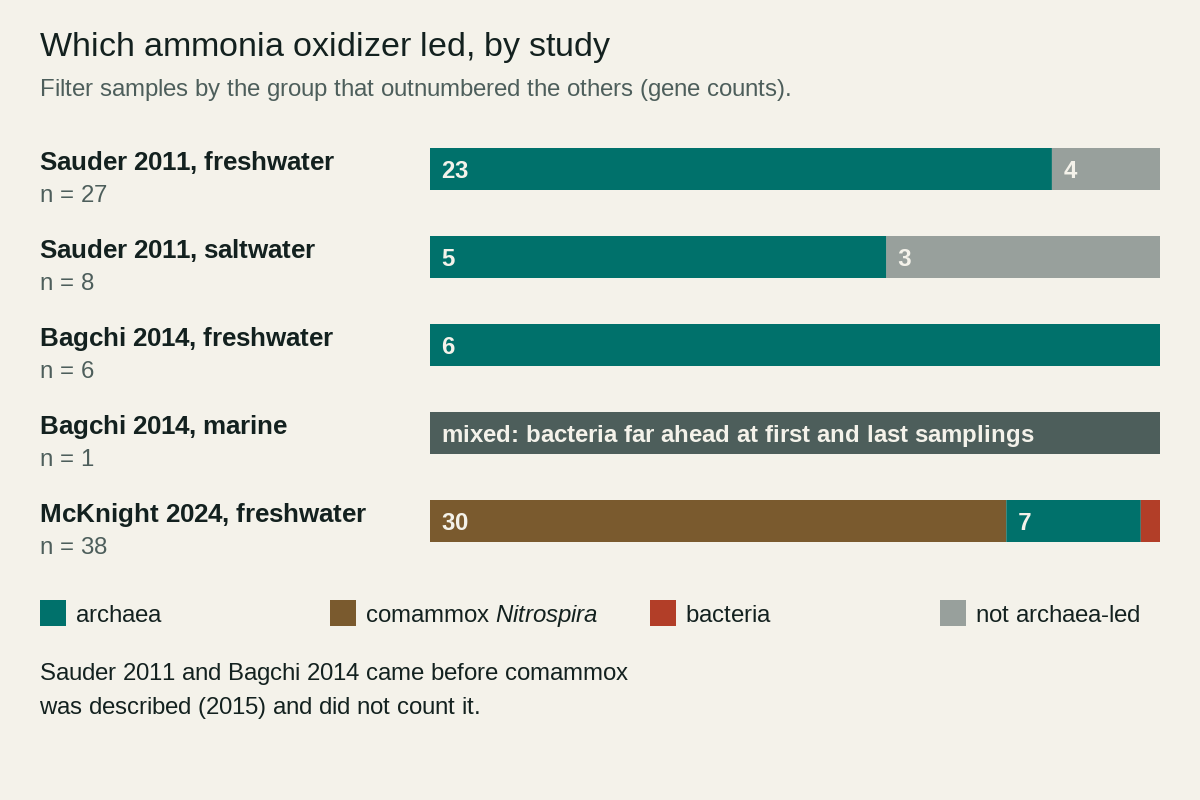
Archaea came next. Sauder et al. (2011) found ammonia-oxidizing archaea ahead of ammonia-oxidizing bacteria in 23 of 27 freshwater biofilters. After comammox was described, McKnight and Neufeld (2024) found comammox Nitrospira genes in all 38 freshwater filter samples they tested. Comammox led in 30, archaea in 7 and bacteria in 1.
The new home tanks fit that pattern. In McKnight's study, comammox Nitrospira led the ammonia oxidizers in all three filters from week 6 to week 12, and the only nitrite oxidizers detected were Nitrospira.
Saltwater filters do not tell one story. McKnight and Neufeld detected no comammox in saltwater biofilters. Sauder's team found archaea ahead in 5 of its 8 saltwater biofilters. In the one marine aquarium Bagchi et al. (2014) followed, bacteria were ahead by three to five orders of magnitude at the first and last samplings, but archaea were the only ammonia oxidizers detected at the other samplings.
Oliaro et al. tracked a newly commissioned public saltwater exhibit at Shedd Aquarium in Chicago for 54 days. There, the archaeon Nitrosopumilus was the main nitrifier. The authors note that Nitrosopumilus was first discovered in a large public saltwater aquarium. The nitrite oxidizer Nitrospina rose a few days after the period of highest nitrite.
Open full-size chart, or scroll it sideways to read every label
Which ammonia oxidizer outnumbered the others, by study, as reported. Sauder et al. 2011 and Bagchi et al. 2014 predate the 2015 description of comammox and did not count it.
Credit and data
"Which ammonia oxidizer led, by study" by Ocean Life & Lore, https://oceanlifeandlore.com/aquarium/nitrogen-cycle/, licensed under CC BY 4.0 (https://creativecommons.org/licenses/by/4.0/).
Data: Sauder et al. 2011, Aquarium nitrification revisited, PLoS ONE 6(8): e23281 (https://doi.org/10.1371/journal.pone.0023281), CC BY, counts as reported in the abstract, retrieved 2026-10-15; Bagchi et al. 2014, Temporal and spatial stability of ammonia-oxidizing archaea and bacteria in aquarium biofilters, PLoS ONE 9(12): e113515 (https://doi.org/10.1371/journal.pone.0113515), CC BY, values as reported, retrieved 2026-10-15; McKnight & Neufeld 2024, Comammox Nitrospira among dominant ammonia oxidizers within aquarium biofilter microbial communities, Applied and Environmental Microbiology 90(7): e00104-24 (https://doi.org/10.1128/aem.00104-24), CC BY 4.0 (https://creativecommons.org/licenses/by/4.0/), retrieved 2026-10-15.
How long does a tank take to cycle?
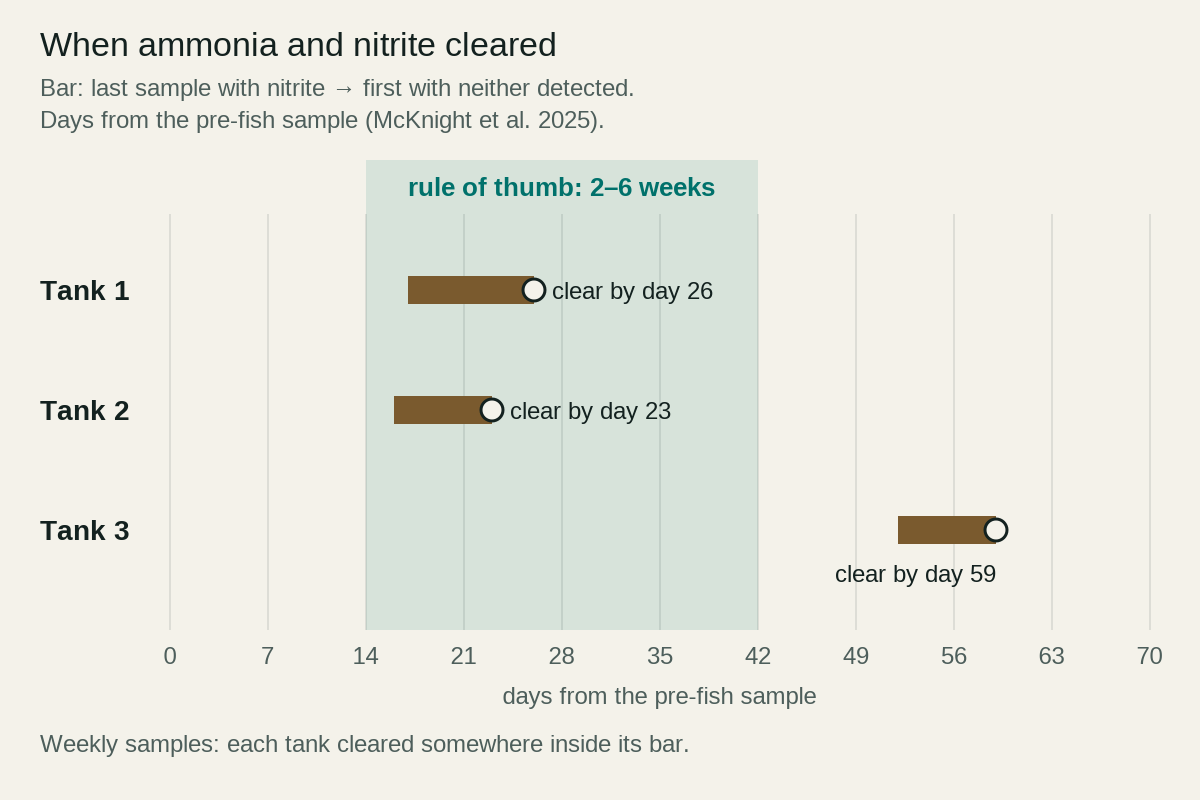
The story goes that a new tank takes two to six weeks to cycle. The beginners' FAQ gives that rule of thumb, saying the process "normally takes anywhere from 2-6 weeks," and adds that cycling takes longer below 21 °C (70 °F).
The measured tanks spread wider. In McKnight's 2025 study, two tanks cleared ammonia and nitrite by week 3, on days 23 and 26 from the pre-fish sample, and the third took until week 8, day 59.
The three tanks differed in more than speed. They ran at about 27, 23 and 24 °C (81, 73 and 75 °F), and tank 2's fish included a betta. Tanks 1 and 2 had live plants, and tank 3 had artificial ones.
The authors hypothesize that the plants carried in nitrifying microbes. They add that other factors not apparent in their data may have delayed tank 3; with so small a sample, they note, conclusions about causes are difficult.
Oliaro's public exhibit followed its own schedule. Its sump ran without animals for 36 days before the exhibit tank was filled, and weedy seadragons went in on day 41. Oliaro's team writes that, unaided, it "can take many weeks" for a stable nitrifying community to establish in an aquarium.
Open full-size chart, or scroll it sideways to read every label
Days from the pre-fish sample to the first sample with neither ammonia nor nitrite detected (McKnight et al. 2025), against the 2-to-6-week rule of thumb. Each bar starts at the last sample with nitrite.
Credit and data
"When ammonia and nitrite cleared, against the 2-to-6-week rule" by Ocean Life & Lore, https://oceanlifeandlore.com/aquarium/nitrogen-cycle/, licensed under CC BY 4.0 (https://creativecommons.org/licenses/by/4.0/).
Data: McKnight, Szabolcs, Graham & Neufeld 2025, Microbial community succession of home aquarium biofilters associated with early establishment of comammox Nitrospira, ISME Communications 5: ycaf212; data adapted from values stated in the text and sample dates in Table S1 (https://doi.org/10.1093/ismeco/ycaf212), CC BY 4.0 (https://creativecommons.org/licenses/by/4.0/), retrieved 2026-10-15; Beginners' aquarium FAQ, What is meant by Cycling Your Tank and New Tank Syndrome? (https://users.cs.duke.edu/~narten/faq/cycling.html), quoted rule of thumb, no license stated, retrieved 2026-10-15.
What happens to the nitrate after day 26?
Once nitrite clears, nitrate keeps rising. McKnight's team calls nitrate less toxic than ammonia. Across weeks 9 to 12, its three tanks averaged 4.2, 7.2 and 9.5 mg/L as N. The authors write that the live plants in tanks 1 and 2 took up some nitrate, possibly explaining their lower averages.
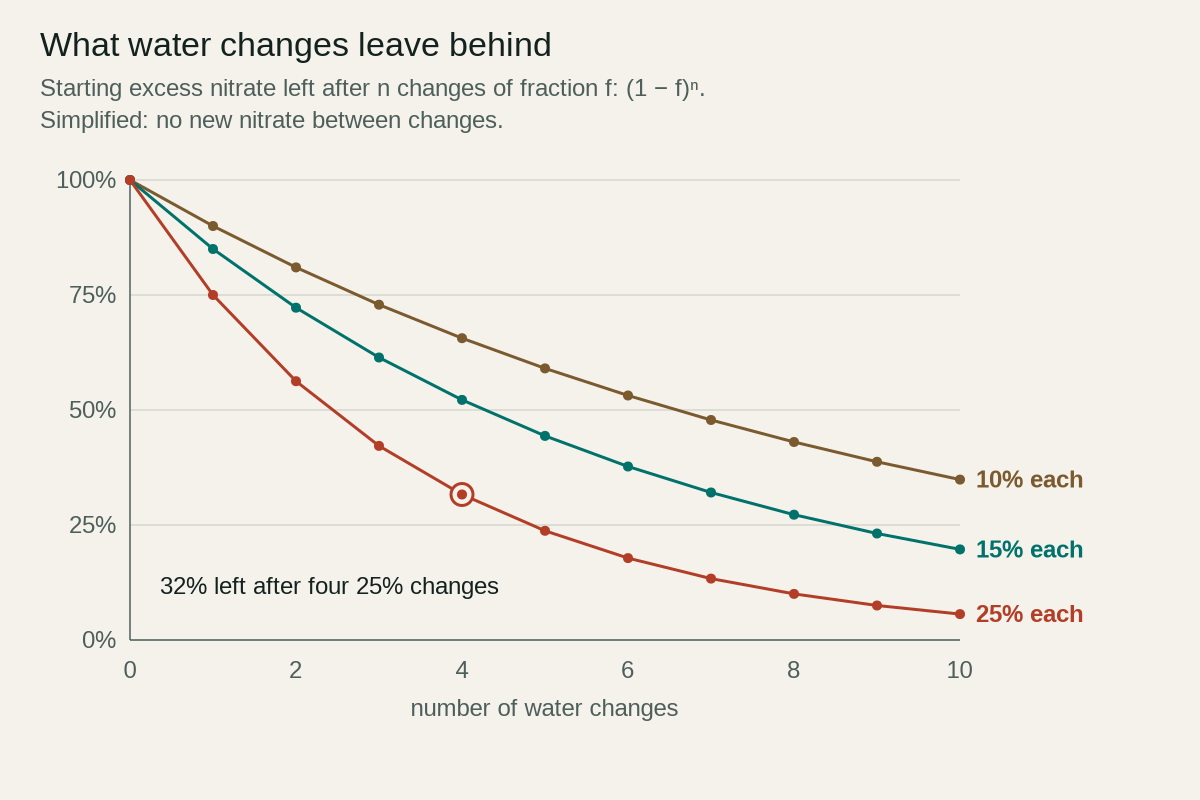
A water change is plain dilution. Say a fraction f of the water is replaced n times, and no new nitrate is made in between. Then the share of the starting excess left is (1 − f) raised to the power n. The excess here is the nitrate above the level in the new water.
The chart below plots that rule for changes of 10%, 15% and 25%, fractions Bagchi et al. (2014) reported for the aquaria they studied. By this page's calculation, four 25% changes leave about 32% of the excess.
That rule is a simplification. It ignores the nitrate a tank keeps making between changes. It also cannot take nitrate below the new water's own level, which for Bagchi's tap water in Gent was 3.0 ± 0.8 mg/L as N.
Open full-size chart, or scroll it sideways to read every label
Share of the starting excess nitrate left after each water change, for 10%, 15% and 25% changes. Simplified: assumes no new nitrate is made between changes.
Credit and data
"What water changes leave behind" by Ocean Life & Lore, https://oceanlifeandlore.com/aquarium/nitrogen-cycle/, licensed under CC BY 4.0 (https://creativecommons.org/licenses/by/4.0/).
Data: Bagchi et al. 2014, Temporal and spatial stability of ammonia-oxidizing archaea and bacteria in aquarium biofilters, PLoS ONE 9(12): e113515 (https://doi.org/10.1371/journal.pone.0113515), CC BY, values as reported, retrieved 2026-10-15.
The ocean can also turn fixed nitrogen back into gas. In oxygen-depleted zones, the World Ocean Atlas 2023 notes, microbes reduce nitrate to nitrogen gas. Kuypers and colleagues reported in 2005 that 30–50% of the ocean's total nitrogen loss occurs in oxygen-minimum zones. In the Benguela upwelling system, they found most of it came from anammox, which turns ammonium and nitrite into nitrogen gas.
One question from tank 1 is still unsounded. Its gene counts found comammox Nitrospira from week 1, archaea only from week 3 and no ammonia-oxidizing bacteria in any week; sequencing caught only a rare Nitrosomonas variant, under 0.3% relative abundance, in weeks 1, 5 and 9. Yet nitrite still peaked at 0.499 mg/L as N in week 2. The study did not measure which microbes made that nitrite, and the authors leave open why ammonia-oxidizing bacteria took hold in tank 2 but not in tank 1.
Lore check
2 claims sounded: bends ×2
| Claim | Verdict | Evidence |
|---|---|---|
| Nitrosomonas and Nitrobacter run your filter | bends | Nitrite oxidizers of the Nitrobacter group not detected in freshwater or seawater aquarium filters (Hovanec & DeLong 1996; Hovanec et al. 1998). Nitrosomonas relatives found in every nitrifying seawater system sampled (Hovanec & DeLong 1996), but archaea or comammox Nitrospira led in most freshwater filters tested (Sauder et al. 2011; McKnight & Neufeld 2024). |
| A new tank takes 2–6 weeks to cycle | bends | A rule of thumb from an undated beginners' FAQ. Two of three home tanks cleared ammonia and nitrite by week 3, inside the range; the third took until week 8, outside it (McKnight et al. 2025). |
Further down:
- Vampire squid: it spends most of its life in the oxygen-minimum layer, the kind of water where the ocean loses much of its fixed nitrogen.
- Clownfish: does the largest fish in each anemone really become the female?
Sources
- 1McKnight, M. M., N. Szabolcs, A. Graham, and J. D. Neufeld. "Microbial community succession of home aquarium biofilters associated with early establishment of comammox Nitrospira." ISME Communications 5, no. 1 (2025): ycaf212. doi:10.1093/ismeco/ycaf212. License: CC BY 4.0. https://europepmc.org/article/PMC/PMC12704419 Read: full text and supplementary Table S1.
- 2McKnight, M. M., and J. D. Neufeld. "Comammox Nitrospira among dominant ammonia oxidizers within aquarium biofilter microbial communities." Applied and Environmental Microbiology 90, no. 7 (2024): e00104-24. doi:10.1128/aem.00104-24. License: CC BY 4.0. https://europepmc.org/article/PMC/PMC11267875 Read: full text.
- 3Sauder, L. A., K. Engel, J. C. Stearns, A. P. Masella, R. Pawliszyn, and J. D. Neufeld. "Aquarium nitrification revisited: Thaumarchaeota are the dominant ammonia oxidizers in freshwater aquarium biofilters." PLoS ONE 6, no. 8 (2011): e23281. doi:10.1371/journal.pone.0023281. https://europepmc.org/article/PMC/PMC3156731 Read: abstract.
- 4Bagchi, S., S. E. Vlaeminck, L. A. Sauder, M. Mosquera, J. D. Neufeld, and N. Boon. "Temporal and spatial stability of ammonia-oxidizing archaea and bacteria in aquarium biofilters." PLoS ONE 9, no. 12 (2014): e113515. doi:10.1371/journal.pone.0113515. https://europepmc.org/article/PMC/PMC4257543 Read: full text.
- 5Oliaro, F. J., et al. "The Role of Ammonia-Oxidizing Archaea During Cycling and Animal Introduction in a Newly Commissioned Saltwater Aquarium." Animals 15, no. 10 (2025): 1446. doi:10.3390/ani15101446. License: CC BY 4.0. https://europepmc.org/article/PMC/PMC12108315 Read: full text.
- 6Hovanec, T. A., L. T. Taylor, A. Blakis, and E. F. DeLong. "Nitrospira-like bacteria associated with nitrite oxidation in freshwater aquaria." Applied and Environmental Microbiology 64, no. 1 (1998): 258–264. doi:10.1128/aem.64.1.258-264.1998. https://europepmc.org/article/MED/16349486 Read: abstract.
- 7Hovanec, T. A., and E. F. DeLong. "Comparative analysis of nitrifying bacteria associated with freshwater and marine aquaria." Applied and Environmental Microbiology 62, no. 8 (1996): 2888–2896. doi:10.1128/aem.62.8.2888-2896.1996. https://europepmc.org/article/MED/8702281 Read: abstract.
- 8Daims, H., et al. "Complete nitrification by Nitrospira bacteria." Nature 528 (2015): 504–509. doi:10.1038/nature16461. https://europepmc.org/article/MED/26610024 Read: abstract.
- 9van Kessel, M. A. H. J., et al. "Complete nitrification by a single microorganism." Nature 528 (2015): 555–559. doi:10.1038/nature16459. https://europepmc.org/article/MED/26610025 Read: abstract.
- 10Kuypers, M. M. M., et al. "Massive nitrogen loss from the Benguela upwelling system through anaerobic ammonium oxidation." Proceedings of the National Academy of Sciences 102, no. 18 (2005): 6478–6483. doi:10.1073/pnas.0502088102. https://europepmc.org/article/MED/15843458 Read: abstract.
- 11Hoving, H. J. T., and B. H. Robison. "Vampire squid: detritivores in the oxygen minimum zone." Proceedings of the Royal Society B 279 (2012): 4559–4567. doi:10.1098/rspb.2012.1357. https://europepmc.org/article/MED/23015627 Read: abstract.
- 12Dunstan, A. J., P. D. Ward, and N. J. Marshall. "Vertical distribution and migration patterns of Nautilus pompilius." PLoS ONE 6, no. 2 (2011): e16311. doi:10.1371/journal.pone.0016311. https://europepmc.org/article/PMC/PMC3043052 Read: abstract.
- 13Garcia, H. E., C. Bouchard, S. L. Cross, C. R. Paver, J. R. Reagan, T. P. Boyer, R. A. Locarnini, A. V. Mishonov, O. K. Baranova, D. Seidov, Z. Wang, and D. Dukhovskoy. World Ocean Atlas 2023, Volume 4: Dissolved Inorganic Nutrients (Phosphate, Nitrate, and Silicate). NOAA Atlas NESDIS 92. NOAA National Centers for Environmental Information, 2024. doi:10.25923/39qw-7j08. License: CC0 1.0. https://repository.library.noaa.gov/view/noaa/60602 Read: pages 62–64.
- 14US Environmental Protection Agency. Aquatic Life Ambient Water Quality Criteria for Ammonia – Freshwater 2013. EPA-822-R-13-001. Office of Water, April 2013. https://www.epa.gov/sites/default/files/2015-08/documents/aquatic-life-ambient-water-quality-criteria-for-ammonia-freshwater-2013.pdf Read: pages 6–8.
- 15National Institute for Occupational Safety and Health. "NIOSH Pocket Guide to Chemical Hazards: Ammonia." Centers for Disease Control and Prevention. Page last reviewed 30 October 2019. https://www.cdc.gov/niosh/npg/npgd0028.html Read: full page.
- 16"What is meant by 'Cycling Your Tank' and 'New Tank Syndrome'?" Beginners' aquarium FAQ, hosted on Thomas Narten's Duke University web pages. Undated. https://users.cs.duke.edu/~narten/faq/cycling.html Read: full page.
- 17NOAA National Ocean Service. "How much water is in the ocean?" https://oceanservice.noaa.gov/facts/oceanwater.html Read: full page.
- 18NOAA National Ocean Service. "How far does light travel in the ocean?" https://oceanservice.noaa.gov/facts/light_travel.html Read: full page.
- 19NOAA Ocean Exploration. "Titanic Bow," daily image from the R.M.S. Titanic Expedition 2003. https://oceanexplorer.noaa.gov/multimedia/daily-image-media-20210415/ Read: full page.
- 20NOAA Ocean Exploration. "How deep is the ocean?" https://oceanexplorer.noaa.gov/ocean-fact/ocean-depth/ Read: full page.
- 21Manning, Jim. "How do we measure the density of sea water?" US GLOBEC (draft page), 2001. https://gb11.whoi.edu/globec-dir/sea_water_density_description.html Read: full page.
- 22Commission on Isotopic Abundances and Atomic Weights (CIAAW). "Atomic Weight of Nitrogen." https://www.ciaaw.org/nitrogen.htm Read: full page.
- 23WoRMS Editorial Board (2026). World Register of Marine Species. Nautilus pompilius Linnaeus, 1758, AphiaID 216384. Available from https://www.marinespecies.org at VLIZ. Accessed 2026-10-15. doi:10.14284/170 https://www.marinespecies.org/aphia.php?p=taxdetails&id=216384 Read: catalogue record.
Cite this page
Ocean Life & Lore. “Nitrogen Cycle in New Tanks: Why Nitrite Peaks After Ammonia.” Ocean Life & Lore. Published 2026-10-15; last substantive revision 2026-10-23. https://oceanlifeandlore.com/aquarium/nitrogen-cycle/ (accessed the date you read it).
Download the data: Three tanks, sample by sample (CSV) CSV (source and license record) Data: McKnight, Szabolcs, Graham & Neufeld 2025, Microbial community succession of home aquarium biofilters associated with early establishment of comammox Nitrospira, ISME Communications 5: ycaf212; data adapted from values stated in the text and sample dates in Table S1 (https://doi.org/10.1093/ismeco/ycaf212), CC BY 4.0 (https://creativecommons.org/licenses/by/4.0/), retrieved 2026-10-15. · Sounding line (CSV) CSV (source and license record) Data: Garcia et al. 2024, World Ocean Atlas 2023, Volume 4: Dissolved Inorganic Nutrients, NOAA Atlas NESDIS 92, pp. 63-64 (https://doi.org/10.25923/39qw-7j08), CC0 1.0, retrieved 2026-10-15; NOAA Ocean Service, How far does light travel in the ocean? (https://oceanservice.noaa.gov/facts/light_travel.html), public domain (US federal government work), retrieved 2026-10-15; NOAA Ocean Exploration, Titanic bow, daily image from the R.M.S. Titanic Expedition 2003 (https://oceanexplorer.noaa.gov/multimedia/daily-image-media-20210415/), public domain (US federal government work), retrieved 2026-10-15; NOAA Ocean Exploration, How deep is the ocean? (https://oceanexplorer.noaa.gov/ocean-fact/ocean-depth/), public domain (US federal government work), retrieved 2026-10-15. · Nitrate, ocean and tanks (CSV) CSV (source and license record) Data: Garcia et al. 2024, World Ocean Atlas 2023, Volume 4: Dissolved Inorganic Nutrients, NOAA Atlas NESDIS 92, pp. 63-64 (https://doi.org/10.25923/39qw-7j08), CC0 1.0, retrieved 2026-10-15; McKnight, Szabolcs, Graham & Neufeld 2025, Microbial community succession of home aquarium biofilters associated with early establishment of comammox Nitrospira, ISME Communications 5: ycaf212; data adapted from values stated in the text and sample dates in Table S1 (https://doi.org/10.1093/ismeco/ycaf212), CC BY 4.0 (https://creativecommons.org/licenses/by/4.0/), retrieved 2026-10-15; Bagchi et al. 2014, Temporal and spatial stability of ammonia-oxidizing archaea and bacteria in aquarium biofilters, PLoS ONE 9(12): e113515 (https://doi.org/10.1371/journal.pone.0113515), CC BY, values as reported, retrieved 2026-10-15; CIAAW, Atomic Weight of Nitrogen (https://www.ciaaw.org/nitrogen.htm), factual value, no license stated, retrieved 2026-10-15; US GLOBEC, How do we measure the density of sea water? (https://gb11.whoi.edu/globec-dir/sea_water_density_description.html), factual value, no license stated, retrieved 2026-10-15. · NH₃ share by pH and temperature (CSV) CSV (source and license record) Data: US EPA 2013, Aquatic Life Ambient Water Quality Criteria for Ammonia, Freshwater, EPA-822-R-13-001, pp. 6-7, Emerson et al. 1975 equation (https://www.epa.gov/sites/default/files/2015-08/documents/aquatic-life-ambient-water-quality-criteria-for-ammonia-freshwater-2013.pdf), public domain (US federal government work), retrieved 2026-10-15. · Ammonia oxidizer surveys (CSV) CSV (source and license record) Data: Sauder et al. 2011, Aquarium nitrification revisited, PLoS ONE 6(8): e23281 (https://doi.org/10.1371/journal.pone.0023281), CC BY, counts as reported in the abstract, retrieved 2026-10-15; Bagchi et al. 2014, Temporal and spatial stability of ammonia-oxidizing archaea and bacteria in aquarium biofilters, PLoS ONE 9(12): e113515 (https://doi.org/10.1371/journal.pone.0113515), CC BY, values as reported, retrieved 2026-10-15; McKnight & Neufeld 2024, Comammox Nitrospira among dominant ammonia oxidizers within aquarium biofilter microbial communities, Applied and Environmental Microbiology 90(7): e00104-24 (https://doi.org/10.1128/aem.00104-24), CC BY 4.0 (https://creativecommons.org/licenses/by/4.0/), retrieved 2026-10-15. · Clearing windows (CSV) CSV (source and license record) Data: McKnight, Szabolcs, Graham & Neufeld 2025, Microbial community succession of home aquarium biofilters associated with early establishment of comammox Nitrospira, ISME Communications 5: ycaf212; data adapted from values stated in the text and sample dates in Table S1 (https://doi.org/10.1093/ismeco/ycaf212), CC BY 4.0 (https://creativecommons.org/licenses/by/4.0/), retrieved 2026-10-15; Beginners' aquarium FAQ, What is meant by Cycling Your Tank and New Tank Syndrome? (https://users.cs.duke.edu/~narten/faq/cycling.html), quoted rule of thumb, no license stated, retrieved 2026-10-15. · Water-change dilution (CSV) CSV (source and license record) Data: Bagchi et al. 2014, Temporal and spatial stability of ammonia-oxidizing archaea and bacteria in aquarium biofilters, PLoS ONE 9(12): e113515 (https://doi.org/10.1371/journal.pone.0113515), CC BY, values as reported, retrieved 2026-10-15.
Corrections
- 2026-10-23 — Opening summary: "In effect, microbes run a relay: the ones that clear nitrite can only grow after others have made it," with no mention of comammox → "In two-step nitrification, microbes run a relay: the ones that clear nitrite can only grow after others have made it. Comammox bacteria carry out both steps in a single cell." Found on recheck. Source: McKnight et al. 2025.
Every correction on the site is listed in the Corrections logbook. To report an error on this page, use Report a correction with the page URL, the sentence and your source. How claims are sounded sets out the sources, recalculations and verdict rules behind each page.
More from Aquarium
-
Entry
Clownfish: The Largest in Each Anemone Is the Female
Amphiprion ocellaris: 1–15 m
-
Entry
Betta Fish: A Marsh Fish That Breathes Air at the Surface
Betta splendens: 0–1.2 m