Entry
Betta Fish: A Marsh Fish That Breathes Air at the Surface
Wild bettas live in shallow marsh water that is short of oxygen and take air from the surface; the flowing fins came later, from breeding.
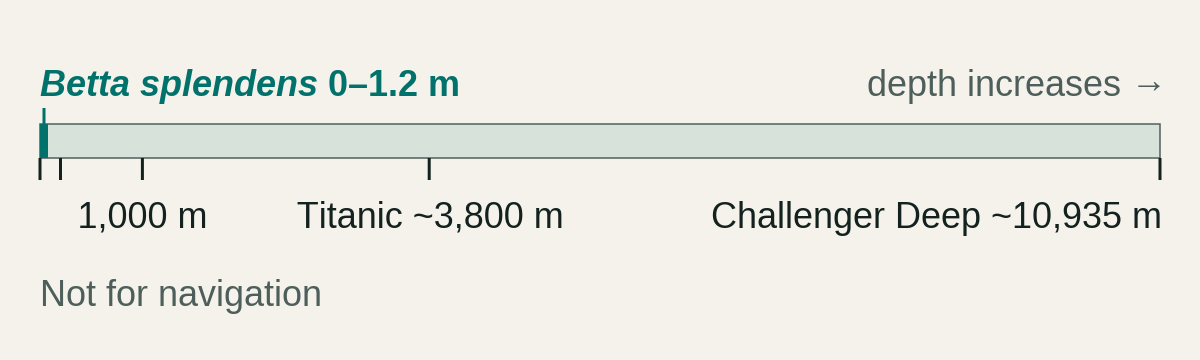
Sounding line: Betta splendens was found in water up to 1.2 m (3.9 ft) deep at five wild marsh sites in Chiang Rai (Ramos et al. 2025), against the ocean's full depth.
Credit and data
"Sounding line: where Betta splendens lives" by Ocean Life & Lore, https://oceanlifeandlore.com/aquarium/betta-fish/, licensed under CC BY 4.0 (https://creativecommons.org/licenses/by/4.0/).
Data: Ramos, Gonçalves & Vasconcelos 2025, PeerJ 13: e18491, Table 1 (https://doi.org/10.7717/peerj.18491), CC BY 4.0, retrieved 2026-10-15; NOAA Ocean Service, How far does light travel in the ocean? (https://oceanservice.noaa.gov/facts/light_travel.html), public domain (US federal government work), retrieved 2026-10-15; NOAA Ocean Exploration, How deep is the ocean? (https://oceanexplorer.noaa.gov/ocean-fact/ocean-depth/), public domain (US federal government work), retrieved 2026-10-15; NOAA Ocean Exploration, Titanic Bow, daily image from the R.M.S. Titanic Expedition 2003 (https://oceanexplorer.noaa.gov/multimedia/daily-image-media-20210415/), public domain (US federal government work), retrieved 2026-10-15.
Spec card
- Common name
- Siamese fighting fish (betta)
- Scientific name
- Betta splendens Regan, 1910 (WoRMS AphiaID 862539)
- Origin (wild range)
- Southeast Asia: Thailand, the northern Malay Peninsula, Cambodia, Indonesia and southern Vietnam; first described from Bangkok, the Menam River and Pinang
- Adult size
- 35–55 mm total length in the nine specimens Regan described
- Temperature range (°C, °F)
- 22.1–25.1 °C (71.8–77.2 °F), daytime readings at five wild sites in Chiang Rai, March 2023 (dry season); not a care range
- pH range
- 4.8–5.8 at the same five sites, March 2023; not a care range
- Hardness range (dGH)
- n/a (not measured at the five sites; conductivity was 33.2–92.8 µS/cm)
- Source
- Ramos, Gonçalves & Vasconcelos 2025, Table 1 (field measurements); Regan 1910 (original description); Kwon et al. 2022; WoRMS
- Data checked
- 2026-10-15
betta-fish-spec.csv CSV (source and license record)
Data: Froese, R. and D. Pauly (eds.) (2026), FishBase, Betta splendens Regan, 1910, accessed through World Register of Marine Species (https://www.marinespecies.org/aphia.php?p=taxdetails&id=862539), factual name data; WoRMS/Aphia record based on FishBase, retrieved 2026-10-15; Ramos, Gonçalves & Vasconcelos 2025, PeerJ 13: e18491, Table 1 (https://doi.org/10.7717/peerj.18491), CC BY 4.0, retrieved 2026-10-15; Regan 1910, The Asiatic Fishes of the Family Anabantidae, Proceedings of the Zoological Society of London 1909: 767–787 (https://commons.wikimedia.org/wiki/File:Proceedings_of_the_Zoological_Society_of_London_%28IA_proceedingsofzoo1909545952zool%29.pdf), public domain, retrieved 2026-10-15; Kwon et al. 2022, Genomic consequences of domestication of the Siamese fighting fish, Science Advances 8: eabm4950 (https://doi.org/10.1126/sciadv.abm4950), CC BY 4.0, retrieved 2026-10-15.
TL;DR. At five wild sites in northern Thailand, Betta splendens lived in marsh water 0.16 to 1.20 m (0.5 to 3.9 ft) deep that held as little as 0.19 mg/L of dissolved oxygen (Ramos et al. 2025). A labyrinth organ above the gills takes oxygen from air at the surface, though the studies read here disagree on whether an adult must breathe air. The long fins of pet bettas are a product of breeding from short-finned ancestors, on a timeline the sources date only loosely.
Down this page 6 sections
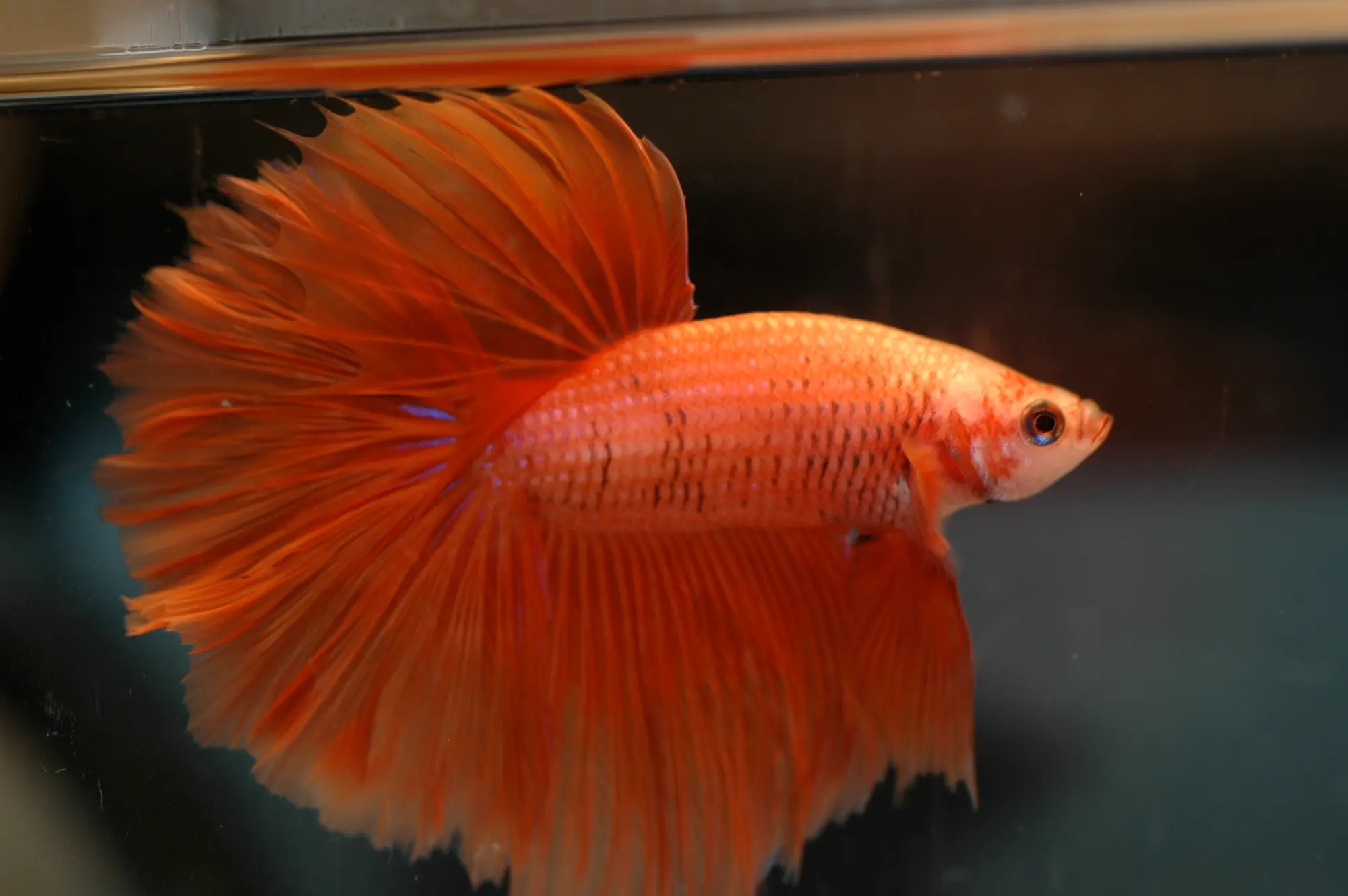
A domestic Betta splendens male of the long-finned halfmoon form, in an aquarium. The long fins are a product of breeding.
"HM Orange M Sarawut" by Daniella Vereeken — https://commons.wikimedia.org/wiki/File:HM_Orange_M_Sarawut.jpg — CC BY 2.0 (https://creativecommons.org/licenses/by/2.0/)

Betta splendens, the Siamese fighting fish, comes from marsh water that holds very little dissolved oxygen. In March 2023, Ramos and colleagues recorded wild bettas at five marsh sites in Chiang Rai, northern Thailand. The water there was 0.16 to 1.20 m (0.5 to 3.9 ft) deep, and one canal held 0.19 to 0.37 mg/L of oxygen. The fish copes with a labyrinth organ, a folded breathing organ above its gills that takes oxygen from air.
The long-finned betta sold as a pet is a domestic form. A 2022 genome study by Kwon and colleagues describes its ancestors as short-finned.
Where do bettas live in the wild?
C. Tate Regan described the species in 1910 from nine specimens 35 to 55 mm long, collected at Bangkok, the Menam River and Pinang, and gave its home as Siam and the Malay Peninsula. A 2025 field study lists wild populations in Thailand, the northern Malay Peninsula, Cambodia, Indonesia and southern Vietnam, in poorly oxygenated water such as small ponds and rice paddies.
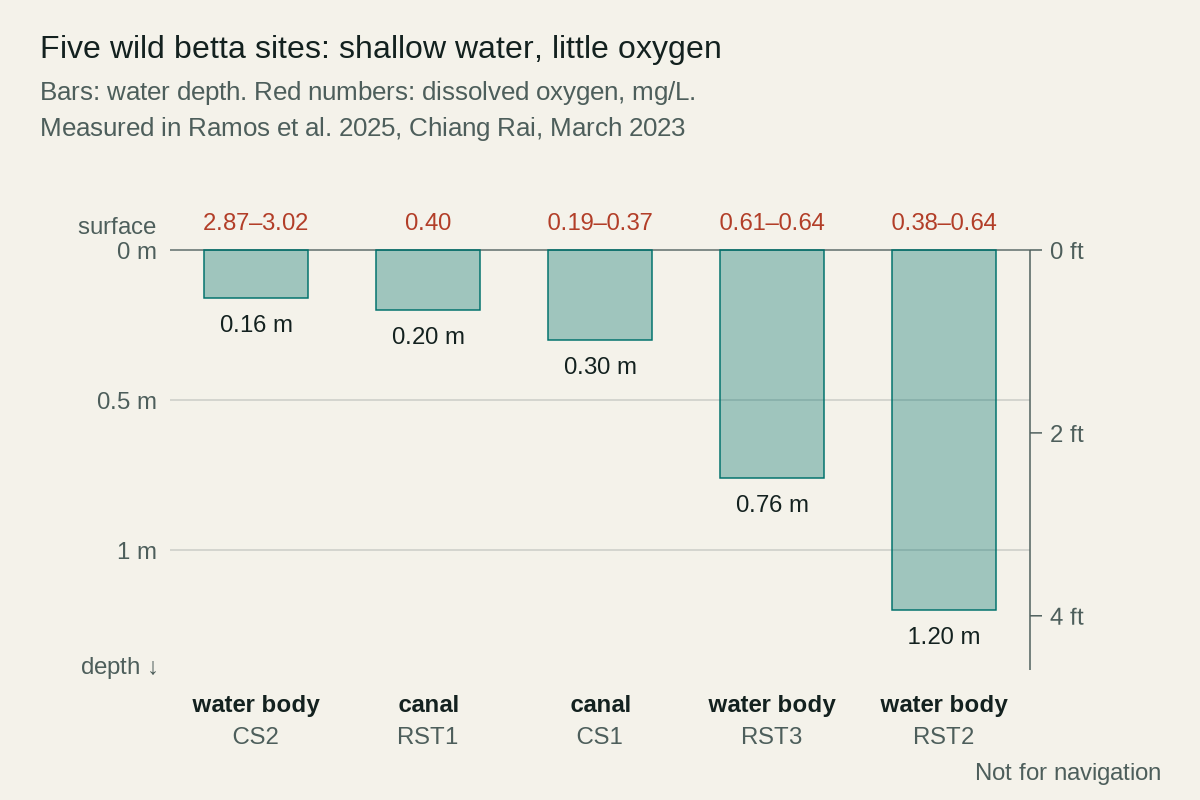
The most detailed field measurements in the sources here come from Ramos, Gonçalves and Vasconcelos. On March 13 and 14, 2023, in the dry season, they recorded five betta sites near Chiang Saen Lake and the Rai Son Thon Reservoir: two canals, a small pool on a mudflat and two marshland water bodies thick with herbaceous plants. Four of the five were less than 1 m (3.3 ft) deep.
The water was 22.1 to 25.1 °C (71.8 to 77.2 °F) and acidic, at pH 4.8 to 5.8, and dissolved oxygen was low at every site (Ramos et al. 2025). The canal labeled CS1 held 0.19 to 0.37 mg/L, a small fraction of the 2.87 to 3.02 mg/L in the mudflat pool. These are daytime readings from two days in one dry season, so they describe those sites at that time, not a range the species needs.
Open full-size chart, or scroll it sideways to read every label
Water depth and dissolved oxygen at five wild betta sites in Chiang Rai, March 2023, from Table 1 of Ramos et al. 2025, whose text gives most of the habitats as 0.2–0.76 m (0.7–2.5 ft).
Credit and data
"Five wild betta sites: shallow water, little oxygen" by Ocean Life & Lore, https://oceanlifeandlore.com/aquarium/betta-fish/, licensed under CC BY 4.0 (https://creativecommons.org/licenses/by/4.0/).
Data: Ramos, Gonçalves & Vasconcelos 2025, PeerJ 13: e18491, Table 1 (https://doi.org/10.7717/peerj.18491), CC BY 4.0, retrieved 2026-10-15.
On this site's depth index, those depths put the betta at the very surface end. The Titanic wreck, at about 3,800 m (12,467 ft) according to NOAA Ocean Exploration, lies about 3,200 times deeper than the deepest of the five sites, 1.20 m (3.9 ft), by this page's calculation (3,800 ÷ 1.2).
The same shallow end of the scale holds the geography cone, Conus geographus, a fish-hunting snail of Indo-West Pacific coral reefs. Kohn (2018) places it mainly from the intertidal zone to about 20 m (66 ft), and Peters and colleagues (2013) list it from the intertidal to 20 m.
Do wild bettas really live in puddles?
The story goes that wild bettas live in puddles. A 2024 article in the Wellington Advertiser, an Ontario newspaper, listed the idea among betta myths, drawing on a betta-care website.
The habitat studies read here describe something larger and more varied, if still shallow. Monvises and colleagues, of Mahidol University in Bangkok, wrote in 2009 that B. splendens is the most widespread of Thailand's bubble-nesting bettas in the Central Plain, living in small bodies of water in paddy fields, ponds, lagoons and marshes. Of the five sites Ramos and colleagues measured, one was a small pool 0.16 m (0.5 ft) deep; the others were canals and marsh water bodies up to 1.20 m (3.9 ft).
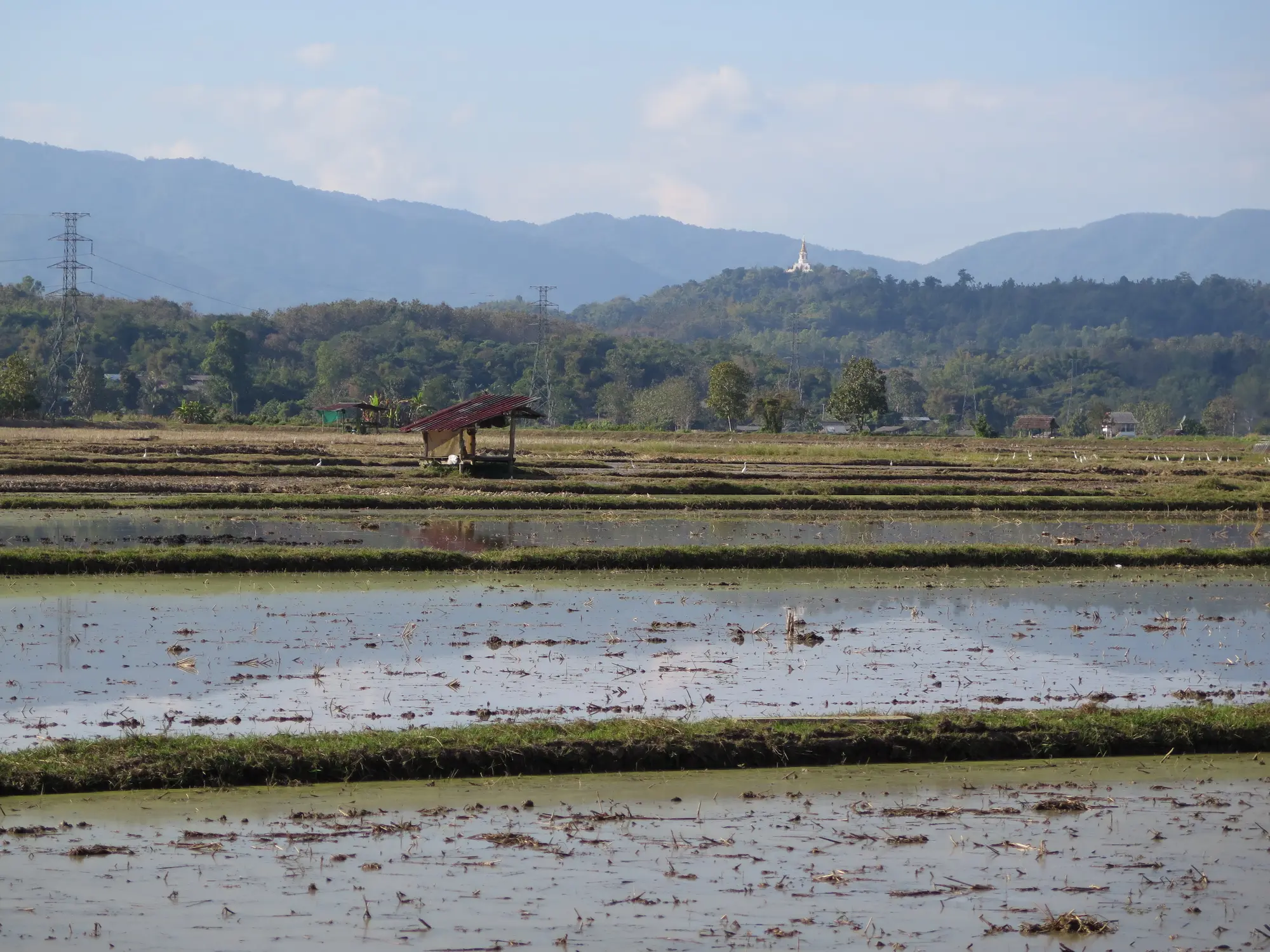
Empty, flooded rice fields in Chiang Rai Province, Thailand, in late December 2014. Paddy fields are a listed habitat of Betta splendens; none of the five study sites above was one.
"Chiang Rai Fields 2" by Douglas Perkins — https://commons.wikimedia.org/wiki/File:Chiang_Rai_Fields_2.jpg — CC BY 4.0 (https://creativecommons.org/licenses/by/4.0/)

Whether wild bettas are endangered gets no IUCN answer on this page, because the IUCN assessment itself was not available to check. Monvises and colleagues (2009), citing Thailand's 2005 Red Data list for fishes, place B. splendens among the bettas listed as "threatened in situ." The studies cited here also describe two kinds of pressure on wild fish.
Monvises and colleagues reported in 2009 that ponds, paddy fields and swamps in Thailand had dwindled over the previous 20 to 30 years with urbanization and industry. Kwon and colleagues found genetic traces of ornamental bettas in wild B. splendens from three of the four populations they sampled. They write that this is perhaps related to breeders releasing surplus fish into the wild. It may, they add, threaten wild Betta populations.
Why does a betta breathe air?
A betta's gills take oxygen from water. A second organ, the labyrinth, sits in a separate chamber above the gills. Adamek-Urbańska and colleagues examined it in B. splendens and two other labyrinth fishes in 2021. They describe an organ built of plates, covered by a respiratory epithelium full of blood vessels, a thin lining that lets gases pass between air and blood.
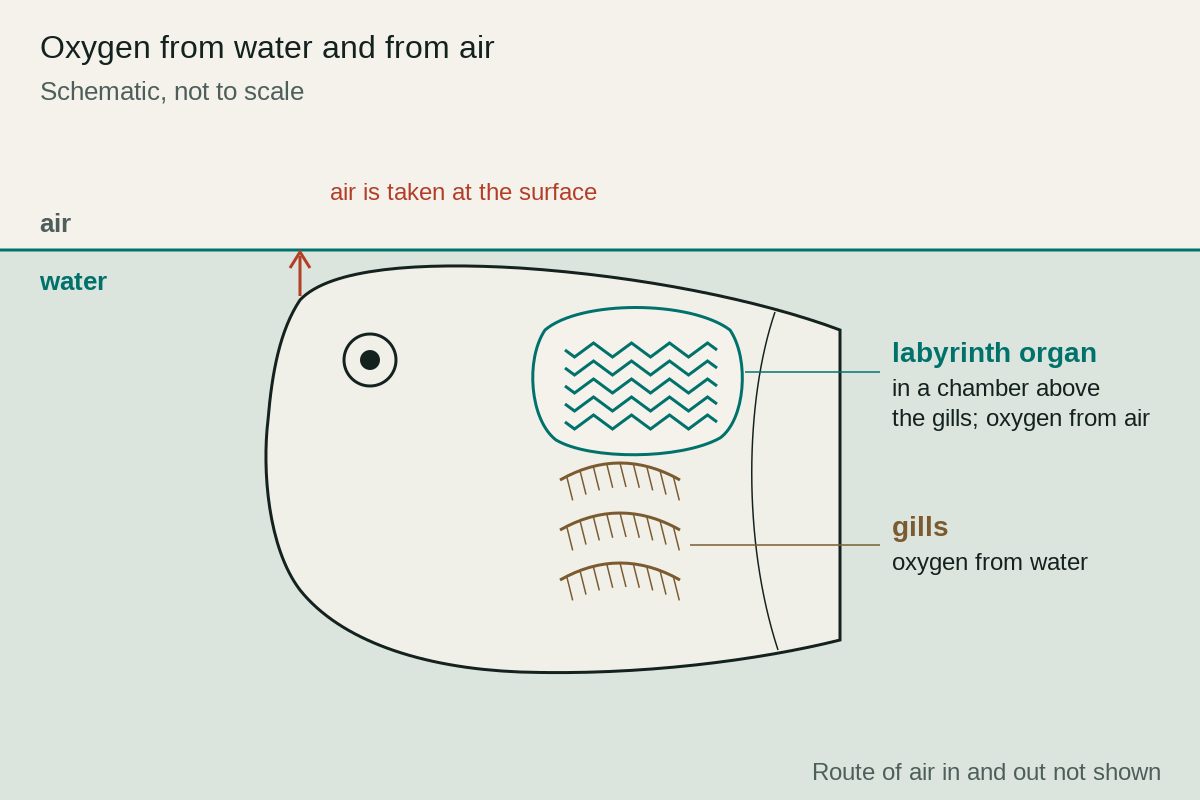
Open full-size chart, or scroll it sideways to read every label
Schematic, not to scale: the gills take oxygen from water, and the labyrinth organ, in a chamber above them, takes it from air. The route air takes is not drawn.
Credit and data
"Gills and the labyrinth organ: oxygen from water and air" by Ocean Life & Lore, https://oceanlifeandlore.com/aquarium/betta-fish/, licensed under CC BY 4.0 (https://creativecommons.org/licenses/by/4.0/).
Data: Adamek-Urbańska et al. 2021, Histological Study of Suprabranchial Chamber Membranes in Anabantoidei and Clariidae Fishes, Animals 11: 1158 (https://doi.org/10.3390/ani11041158), CC BY 4.0, retrieved 2026-10-15; Oldfield & Murphy 2024, Life in a fishbowl, Animal Welfare 33: e1 (https://doi.org/10.1017/awf.2024.1), CC BY 4.0, retrieved 2026-10-15; Monvises et al. 2009, The Siamese fighting fish: Well-known generally but little-known scientifically, ScienceAsia 35: 8–16 (https://doi.org/10.2306/scienceasia1513-1874.2009.35.008), facts cited, no license stated, retrieved 2026-10-15.
Oldfield and Murphy (2024) tie the organ to the habitat. The labyrinth lets bettas breathe air at the water's surface, they write, and that is why bettas can tolerate shallow, stagnant water thick with plants. Mendez-Sanchez and Burggren wrote in 2017 that bettas breed in isolated ponds on flood plains such as rice paddies, ponds that are frequently hypoxic (short of oxygen) and even anoxic (with none at all) at the bottom.
The organ is not there from the start. In labyrinth fishes generally, Adamek-Urbańska and colleagues note, it develops late in growth, sometimes after sexual maturity, and until then the gills lead. Mendez-Sanchez and Burggren describe it as the site of air breathing in juveniles and adults, and add that young betta larvae are unable to escape hypoxic water.
Whether an adult betta must breathe air, or only can, is disputed in the studies read here.
Mendez-Sanchez and Burggren read their larval measurements as a sign that Betta is a facultative air breather. In their usage, a facultative fish breathes air when oxygen runs low, while an obligatory one must. Adamek-Urbańska and colleagues instead set the labyrinth fishes, the suborder Anabantoidei, apart from air-breathing catfishes, which they call "only facultative air-breathers."
The air chamber may also do a second job. Ramos and colleagues describe the labyrinth organ as enhancing hearing, and their tests on lab-bred fish of a wild Chiang Rai strain found the best hearing between 100 and 400 Hz.
How did a short-finned fighter become a long-finned pet?
The flowing fins came from breeding. In 2022 Kwon and colleagues sequenced the genomes of 37 ornamental bettas and 58 wild-caught fish of B. splendens and close relatives. They write that ornamental bettas were diversified from short-finned ancestors. Fish bred for fighting went another way: Monvises and colleagues note that fighters are selected for a large, strong body with hard scales and smaller fins, which give an opponent less to bite.
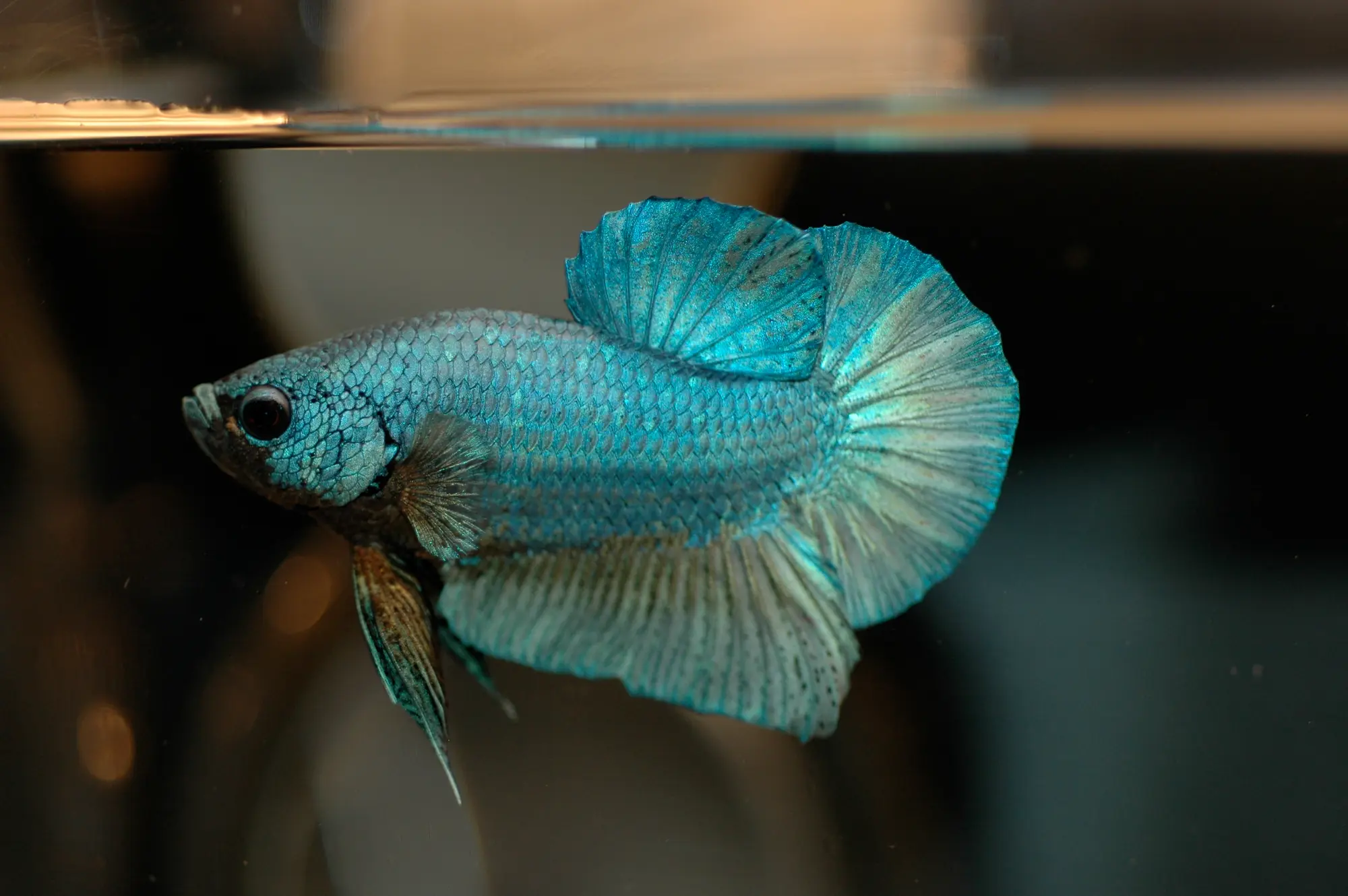
A domestic halfmoon plakat male in an aquarium. Wang and colleagues trace the short-finned plakat to fish bred for staged fights.
"DVJ Betta splendens 004" by Daniella Vereeken — https://commons.wikimedia.org/wiki/File:DVJ_Betta_splendens_004.jpg — CC BY 2.0 (https://creativecommons.org/licenses/by/2.0/)

Theodore Cantor's 1849 catalog of Malayan fishes includes his drawing of a fish he gave as the "Pla kat of the Siamese." He wrote that it appeared to be a variety of a Penang fish he called Macropodus pugnax, "produced by artificial means, like the varieties of the golden carp of China." Cantor wrote his description in 1840 at Singapore, from fish the King of Siam had given to a gentleman there, and noted that their fin lengths varied from fish to fish.
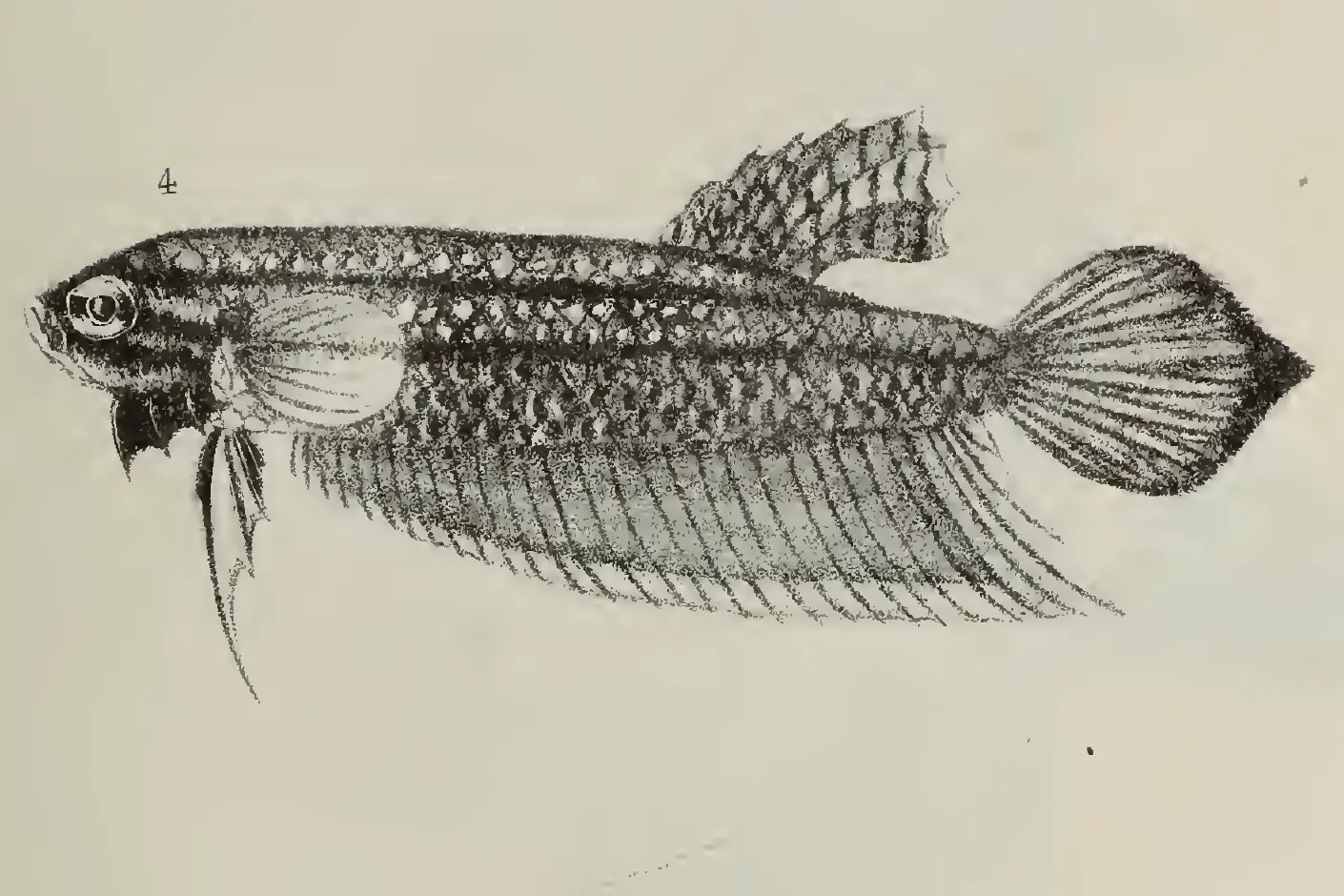
Cantor's 1849 drawing of the pla kat, magnified, from the Journal of the Asiatic Society of Bengal. In 1910 Regan listed Cantor's figure, as Betta pugnax var., under his new species Betta splendens.
Credit and data
"Journal of Asiatic Society of Bengal (IA journalofasiatic182asia)" by Theodore Cantor — https://commons.wikimedia.org/wiki/File:Journal_of_Asiatic_Society_of_Bengal_%28IA_journalofasiatic182asia%29.pdf — Public domain (US: published 1849; EU: drawn by Theodore Cantor, who signed the plate Dr Cantor del. and died in 1860; no lithographer named); modified: cropped to Plate II, fig. 4
How old the breeding is depends on which source is read. The story goes that bettas have been bred for fighting since the 14th century. Kwon and colleagues cite a 2007 encyclopedia for reports of fighting-fish breeding in Thailand that early, while Wang and colleagues (2021) put its documented start as early as 600 years ago. For ornamental traits such as colors and fins, Wang's team traces selection to the middle of the 19th century and Kwon's team to the early 20th, so that date is disputed.
Genomes give only a loose date. Kwon's team found a population bottleneck in ornamental bettas about 680 generations ago, roughly 400 years, but uncertainty in the mutation rate stretches that from about 160 to 1,670 years. They also found that 28 of 37 ornamental fish, or 76%, carried ancestry from two other wild Betta species, in stretches covering up to 6% of the genome.
The fins turn out to be modular. In crosses of veiltail and crowntail fish, Kwon's team linked webbing on the anal fin and on the tail to two different chromosomes. A 2022 study of 727 domestic bettas by Zhang and colleagues mapped the long-fin trait to a region containing the gene kcnj15.
Every water reading on this page comes from two dry-season days in March 2023. What the same marshes hold in the wet season is not in any source read here, and none of those sources tests whether an adult betta kept from the surface can live on its gills alone.
Lore check
2 claims sounded: bends ×1unsounded ×1
| Claim | Verdict | Evidence |
|---|---|---|
| Wild bettas live in puddles | bends | Shallow, but only one of five wild sites in Chiang Rai was a small pool (0.16 m, 0.5 ft); the others were canals and marsh water bodies up to 1.20 m (3.9 ft) deep (Ramos et al. 2025, Table 1). Habitats listed: paddy fields, ponds, lagoons and marshes (Monvises et al. 2009). |
| Bettas have been bred for fighting since the 14th century | unsounded | Missing: the early record itself. Kwon et al. 2022 cite a 2007 encyclopedia; Wang et al. 2021 cite Smith 1945 for a start as early as 600 years ago. Checked: those two papers and Cantor 1849. A bottleneck in ornamental bettas about 400 years ago (160–1,670 years; Kwon et al. 2022) is too loosely dated to test it. |
Further down:
- The nitrogen cycle in new tanks: the chemistry under every tank, a betta's included, and why nitrite peaks after ammonia.
- Clownfish: a reef fish of the same hobby whose wild groups follow a size rule: the largest in each anemone is the female.
Sources
- 1Ramos, Andreia, David Gonçalves, and Raquel O. Vasconcelos. "Exploring freshwater soundscapes of tropical marshland habitats in Southeast Asia: insights into auditory sensory adaptation of wild Siamese fighting fish Betta splendens." PeerJ 13 (2025): e18491. https://doi.org/10.7717/peerj.18491 Read: full text.
- 2Regan, C. Tate. "The Asiatic Fishes of the Family Anabantidae." Proceedings of the Zoological Society of London 1909, part 4 (1910): 767–787, Plates 77–79. https://commons.wikimedia.org/wiki/File:Proceedings_of_the_Zoological_Society_of_London_%28IA_proceedingsofzoo1909545952zool%29.pdf Read: pages 767 and 782 of a scan of the 1909 volume.
- 3Cantor, Theodore. "Catalogue of Malayan Fishes." Journal of the Asiatic Society of Bengal 18, part 2 (1849): 1066–1069 and Plate II. https://commons.wikimedia.org/wiki/File:Journal_of_Asiatic_Society_of_Bengal_%28IA_journalofasiatic182asia%29.pdf Read: pages 1066–1069 and Plate II of a scan of volume 18, part 2.
- 4Kwon, Young Mi, Nathan Vranken, Carla Hoge, Madison R. Lichak, et al. "Genomic consequences of domestication of the Siamese fighting fish." Science Advances 8, no. 10 (2022): eabm4950. https://doi.org/10.1126/sciadv.abm4950 Read: full text.
- 5Wang, Le, Fei Sun, Zi Yi Wan, Baoqing Ye, Yanfei Wen, Huiming Liu, Zituo Yang, Hongyan Pang, et al. "Genomic Basis of Striking Fin Shapes and Colors in the Fighting Fish." Molecular Biology and Evolution 38, no. 8 (2021): 3383–3396. https://doi.org/10.1093/molbev/msab110 Read: full text.
- 6Zhang, Wanchang, Hongru Wang, Débora Y. C. Brandt, Beijuan Hu, et al. "The genetic architecture of phenotypic diversity in the Betta fish (Betta splendens)." Science Advances 8, no. 38 (2022): eabm4955. https://doi.org/10.1126/sciadv.abm4955 Read: full text.
- 7Adamek-Urbańska, Dobrochna, Ewelina Błażewicz, Magdalena Sobień, Robert Kasprzak, and Maciej Kamaszewski. "Histological Study of Suprabranchial Chamber Membranes in Anabantoidei and Clariidae Fishes." Animals 11, no. 4 (2021): 1158. https://doi.org/10.3390/ani11041158 Read: full text.
- 8Mendez-Sanchez, Jose F., and Warren W. Burggren. "Cardiorespiratory physiological phenotypic plasticity in developing air-breathing anabantid fishes (Betta splendens and Trichopodus trichopterus)." Physiological Reports 5, no. 15 (2017): e13359. https://doi.org/10.14814/phy2.13359 Read: full text.
- 9Oldfield, Ronald G., and Emily K. Murphy. "Life in a fishbowl: Space and environmental enrichment affect behaviour of Betta splendens." Animal Welfare 33 (2024): e1. https://doi.org/10.1017/awf.2024.1 Read: full text.
- 10Monvises, Adisorn, Bunlung Nuangsaeng, Namkang Sriwattanarothai, and Bhinyo Panijpan. "The Siamese fighting fish: Well-known generally but little-known scientifically." ScienceAsia 35 (2009): 8–16. https://doi.org/10.2306/scienceasia1513-1874.2009.35.008 Read: full text.
- 11Froese, R. and D. Pauly. Editors. (2026). FishBase. Betta splendens Regan, 1910. Accessed through: World Register of Marine Species at: https://www.marinespecies.org/aphia.php?p=taxdetails&id=862539 on 2026-10-15 Read: catalogue record.
- 12Peters, H., B. C. O'Leary, J. P. Hawkins, K. E. Carpenter, and C. M. Roberts. "Conus: first comprehensive conservation red list assessment of a marine gastropod mollusc genus." PLoS ONE 8, no. 12 (2013): e83353. https://doi.org/10.1371/journal.pone.0083353 Read: figure 1 caption.
- 13Kohn, Alan J. "Conus Envenomation of Humans: In Fact and Fiction." Toxins 11, no. 1 (2018): 10. https://doi.org/10.3390/toxins11010010 Read: full text.
- 14NOAA Ocean Exploration. "Titanic Bow," daily image from the R.M.S. Titanic Expedition 2003. https://oceanexplorer.noaa.gov/multimedia/daily-image-media-20210415/ Read: full text.
- 15NOAA Ocean Service. "How far does light travel in the ocean?" https://oceanservice.noaa.gov/facts/light_travel.html Read: full text.
- 16NOAA Ocean Exploration. "How deep is the ocean?" https://oceanexplorer.noaa.gov/ocean-fact/ocean-depth/ Read: full text.
- 17Thompson, Ellouise. "Betta fish: myth verses fact." Wellington Advertiser (Fergus, Ontario), October 30, 2024. https://www.wellingtonadvertiser.com/betta-fish-myth-verses-fact/ Read: full text.
Cite this page
Ocean Life & Lore. “Betta Fish: A Marsh Fish That Breathes Air at the Surface.” Ocean Life & Lore. Published 2026-10-15; last substantive revision 2026-10-23. https://oceanlifeandlore.com/aquarium/betta-fish/ (accessed the date you read it).
Download the data: Five wild betta sites (CSV) CSV (source and license record) Data: Ramos, Gonçalves & Vasconcelos 2025, PeerJ 13: e18491, Table 1 (https://doi.org/10.7717/peerj.18491), CC BY 4.0, retrieved 2026-10-15. · Sounding line (CSV) CSV (source and license record) Data: Ramos, Gonçalves & Vasconcelos 2025, PeerJ 13: e18491, Table 1 (https://doi.org/10.7717/peerj.18491), CC BY 4.0, retrieved 2026-10-15; NOAA Ocean Service, How far does light travel in the ocean? (https://oceanservice.noaa.gov/facts/light_travel.html), public domain (US federal government work), retrieved 2026-10-15; NOAA Ocean Exploration, How deep is the ocean? (https://oceanexplorer.noaa.gov/ocean-fact/ocean-depth/), public domain (US federal government work), retrieved 2026-10-15; NOAA Ocean Exploration, Titanic Bow, daily image from the R.M.S. Titanic Expedition 2003 (https://oceanexplorer.noaa.gov/multimedia/daily-image-media-20210415/), public domain (US federal government work), retrieved 2026-10-15.
Corrections
- 2026-10-23 — Depth shown for this page on the home page, the Aquarium page, page cards and this page's share image: "0–1 m" → "0–1.2 m". The deepest of the five wild sites was 1.20 m (Table 1), the figure already given in the text and CSV files on this page. Found on recheck. Source: Ramos et al. 2025.
Every correction on the site is listed in the Corrections logbook. To report an error on this page, use Report a correction with the page URL, the sentence and your source. How claims are sounded sets out the sources, recalculations and verdict rules behind each page.
More from Aquarium
-
How it works
Nitrogen Cycle in New Tanks: Why Nitrite Peaks After Ammonia
Ocean nitrate maximum (global mean): 1,000 m
-
Entry
Clownfish: The Largest in Each Anemone Is the Female
Amphiprion ocellaris: 1–15 m