Entry
Vampire Squid: It Drinks No Blood and Eats Marine Snow
Neither squid nor octopus, the only living vampyromorph gathers sinking detritus in low-oxygen water, where predators are few.
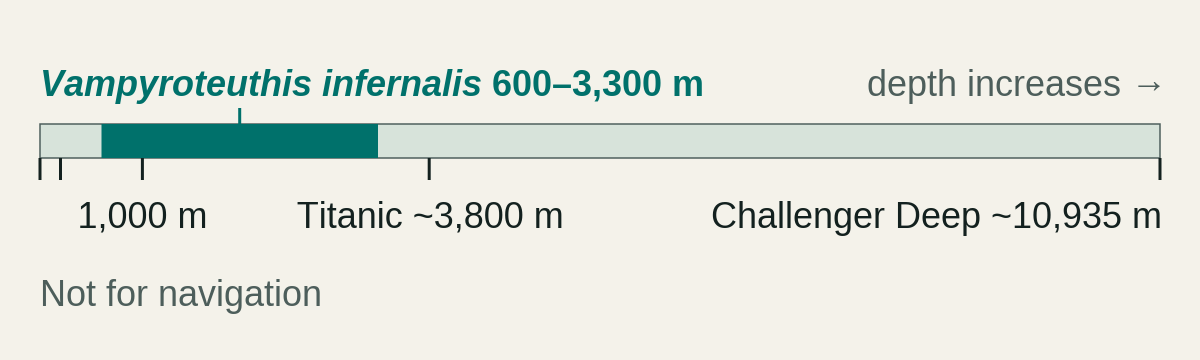
Sounding line: the vampire squid, Vampyroteuthis infernalis, recorded from 600 to 3,300 m (1,969–10,827 ft; Golikov et al. 2019), shown against the full depth of the ocean.
Credit and data
"Sounding line: where the vampire squid lives" by Ocean Life & Lore, https://oceanlifeandlore.com/deep/vampire-squid/, licensed under CC BY 4.0 (https://creativecommons.org/licenses/by/4.0/).
Data: Golikov et al. 2019, The first global deep-sea stable isotope assessment reveals the unique trophic ecology of Vampire Squid Vampyroteuthis infernalis (Cephalopoda), Scientific Reports 9: 19099 (https://doi.org/10.1038/s41598-019-55719-1), CC BY 4.0, retrieved 2026-10-15; NOAA National Ocean Service, How far does light travel in the ocean? (https://oceanservice.noaa.gov/facts/light_travel.html), public domain (US federal government work), retrieved 2026-10-15; NOAA Ocean Exploration, How deep is the ocean? (https://oceanexplorer.noaa.gov/ocean-fact/ocean-depth/), public domain (US federal government work), retrieved 2026-10-15; NOAA Ocean Exploration, Titanic Bow, daily image from the R.M.S. Titanic Expedition 2003 (https://oceanexplorer.noaa.gov/multimedia/daily-image-media-20210415/), public domain (US federal government work), retrieved 2026-10-15.
Spec card
- Common name
- Vampire squid
- Scientific name
- Vampyroteuthis infernalis Chun, 1903 (WoRMS AphiaID 141887)
- Group
- Cephalopoda: Coleoidea: Octopodiformes: order Vampyromorpha, family Vampyroteuthidae
- Depth range (m, ft)
- 600–3,300 m (1,969–10,827 ft) recorded, often in oxygen minimum zones; an oxygen minimum layer at 600–800 m (1,969–2,625 ft) per Seibel et al. 1998
- Max size
- mantle length up to 210 mm, the largest reported
- Light strategy
- bioluminescence: light organs at the tips of all eight arms; can release a glowing cloud of luminous particles
- Food strategy
- detritivore: marine snow and other detritus, from small particles to larger aggregates; juveniles eat more zooplankton
- First described
- Chun, 1903
vampire-squid-spec.csv CSV (source and license record)
Data: MolluscaBase eds. (2026), MolluscaBase, Vampyroteuthis infernalis Chun, 1903, accessed through World Register of Marine Species (https://www.marinespecies.org/aphia.php?p=taxdetails&id=141887), CC BY 4.0, retrieved 2026-10-15; Golikov et al. 2019, The first global deep-sea stable isotope assessment reveals the unique trophic ecology of Vampire Squid Vampyroteuthis infernalis (Cephalopoda), Scientific Reports 9: 19099 (https://doi.org/10.1038/s41598-019-55719-1), CC BY 4.0, retrieved 2026-10-15; Seibel, Thuesen & Childress 1998, Flight of the vampire: ontogenetic gait-transition in Vampyroteuthis infernalis, Journal of Experimental Biology 201: 2413-2424 (https://doi.org/10.1242/jeb.201.16.2413), published values cited as facts, retrieved 2026-10-15; Hoving & Robison 2012, Vampire squid: detritivores in the oxygen minimum zone, Proceedings of the Royal Society B 279: 4559-4567 (https://doi.org/10.1098/rspb.2012.1357), published findings cited as facts, retrieved 2026-10-15; Robison, Reisenbichler, Hunt & Haddock 2003, Light production by the arm tips of the deep-sea cephalopod Vampyroteuthis infernalis, Biological Bulletin 205: 102-109 (https://doi.org/10.2307/1543231), published findings cited as facts, retrieved 2026-10-15.
TL;DR. The vampire squid, Vampyroteuthis infernalis, has been recorded from 600 to 3,300 m (1,969 to 10,827 ft), often in oxygen minimum zones, where it gathers marine snow and other detritus. It sits on the octopus side of the cephalopod family tree, as the only living member of its order. The blood-drinking story sinks, and the "living fossil" label bends.
Down this page 8 sections
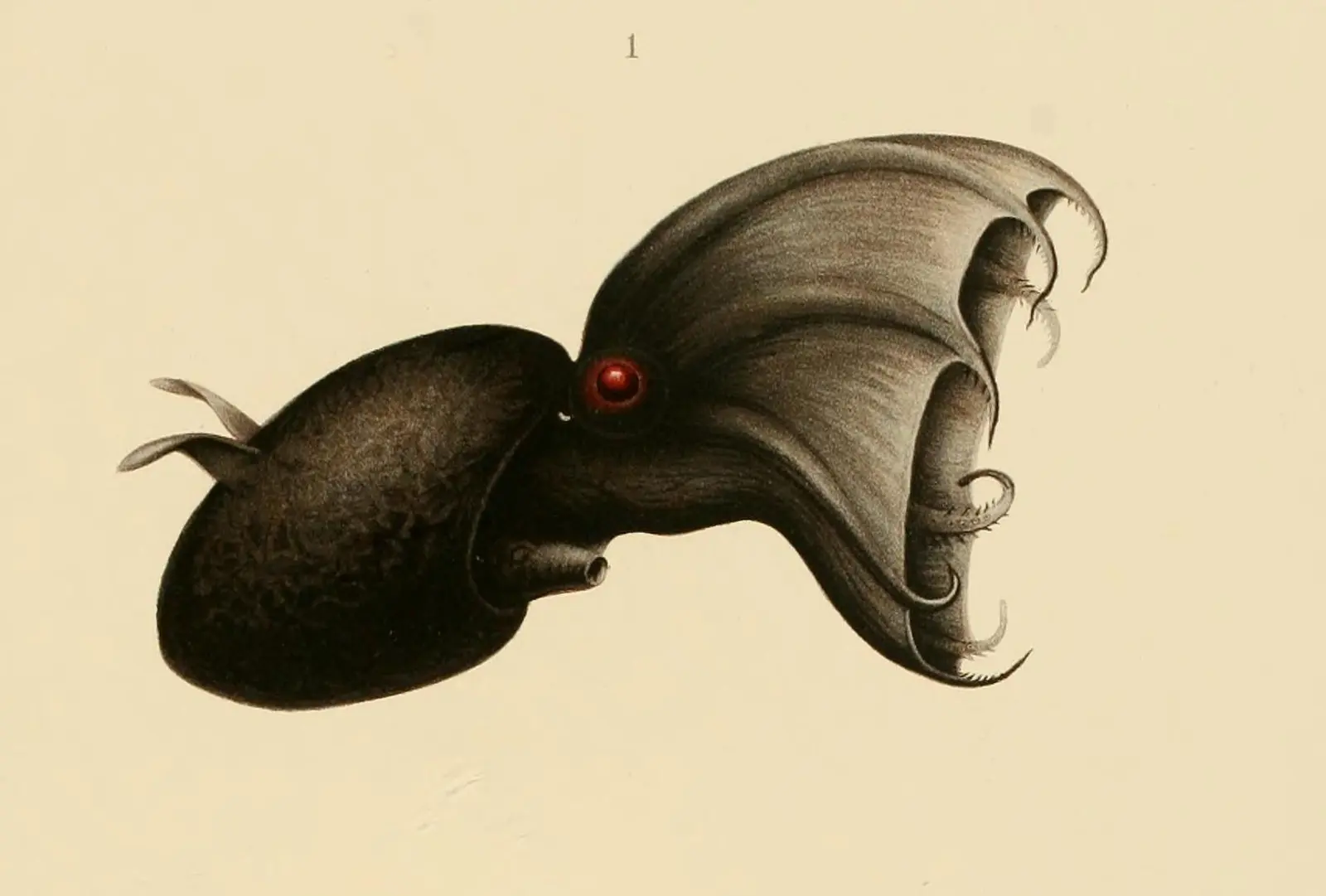
The best-preserved of three vampire squid caught by the German Deep-Sea Expedition of 1898–99, drawn 3.5 times life size for its report. The specimen measured 37 mm.
Credit and data
"Vampyroteuthis infernalis Chun 1910" by E. H. Rübsaamen, plate XC in C. Chun, Die Cephalopoden, II. Teil (Jena: G. Fischer, 1915) — https://commons.wikimedia.org/wiki/File:Vampyroteuthis_infernalis_Chun_1910.jpg — Public domain (US: published in Jena, Germany, in 1915, before 1931; EU: painter Ewald Heinrich Rübsaamen died in 1919; faithful scan of a two-dimensional plate)

Below 600 m, often in water with very little oxygen, the vampire squid lives on sinking marine snow, not blood. Vampyroteuthis infernalis is a small cephalopod recorded from 600 to 3,300 m (1,969 to 10,827 ft) in the Atlantic, Pacific and Indian Oceans (Golikov et al. 2019). Despite its name, it is not a squid. The World Register of Marine Species (WoRMS) puts it in the order Vampyromorpha, on the octopus side of the cephalopod family tree.
It is the only living member of that order (Košťák et al. 2021). Hoving and Robison reported in 2012 that it gathers detritus with two retractile filaments, based on deep-sea video and lab feeding trials. This way of feeding, they wrote, lets it spend most of its life where oxygen is very low and predators are few.
How deep does the vampire squid live?
Golikov and colleagues, summing up earlier studies in 2019, put its vertical distribution at 600 to 3,300 m. In NOAA's terms, that range starts in the twilight zone, 200 to 1,000 m (656 to 3,281 ft), where light fades fast, and it runs on into the midnight zone below 1,000 m, which sunlight does not reach. The deepest records stop about 500 m (1,640 ft) above the Titanic wreck, at 3,800 m (12,467 ft).
 Illustration
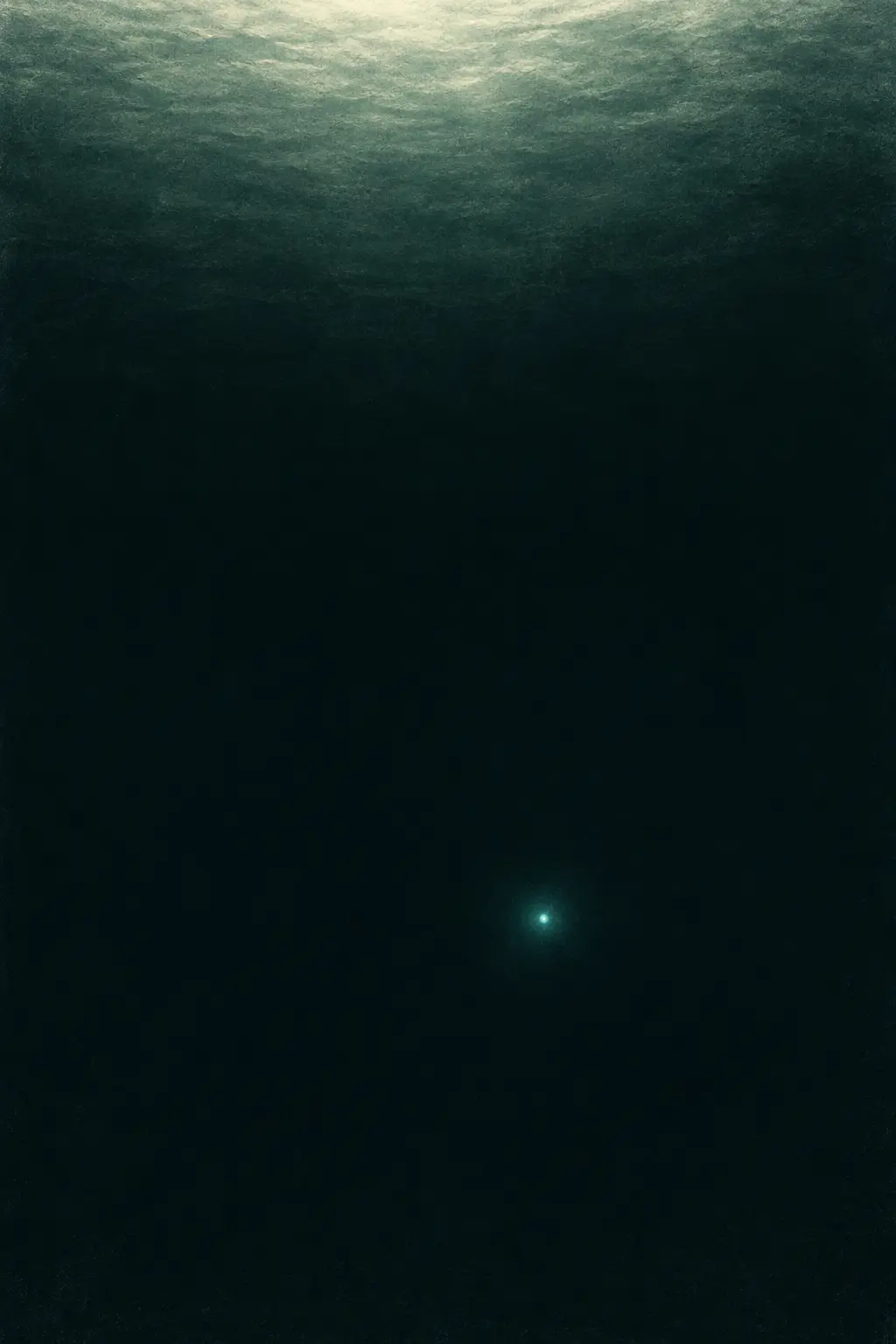
Light fading fast down the water column, with one small point of light far below. In NOAA's terms, sunlight does not reach the midnight zone below 1,000 m (3,281 ft).
Illustration: Ocean Life & Lore. Generated illustration — not a photograph, specimen or historical record. Reuse: CC BY 4.0 (https://creativecommons.org/licenses/by/4.0/); no rights are claimed beyond what the law grants.
Other studies describe a narrower band. Seibel, Thuesen and Childress wrote in 1998 that the species lives in the oxygen minimum layer between 600 and 800 m (1,969 and 2,625 ft). Robison's team found it in dark, oxygen-poor water below 600 m off Monterey Bay, California.
There is no single cutoff for an oxygen minimum zone. Golikov's team used less than 20 µmol of oxygen per kilogram of seawater in the Pacific and Indian Oceans. In the Atlantic, the cutoff was 45 µmol/kg. By that measure, 43 of their 104 specimens came from such zones and 55 from normally oxygenated water, with the rest from oxygen-limited zones in between.
Two depths from other pages on this site fall inside the vampire squid's recorded range. A Nautilus pompilius shell implodes at about 800 m (Dunstan et al. 2011), the bottom of that oxygen minimum layer; the nautilus shell page measures how that shell grows. The ocean's global-mean nitrate maximum lies near 1,000 m (3,281 ft) in the World Ocean Atlas 2023. The nitrogen cycle page follows nitrate into a new aquarium.
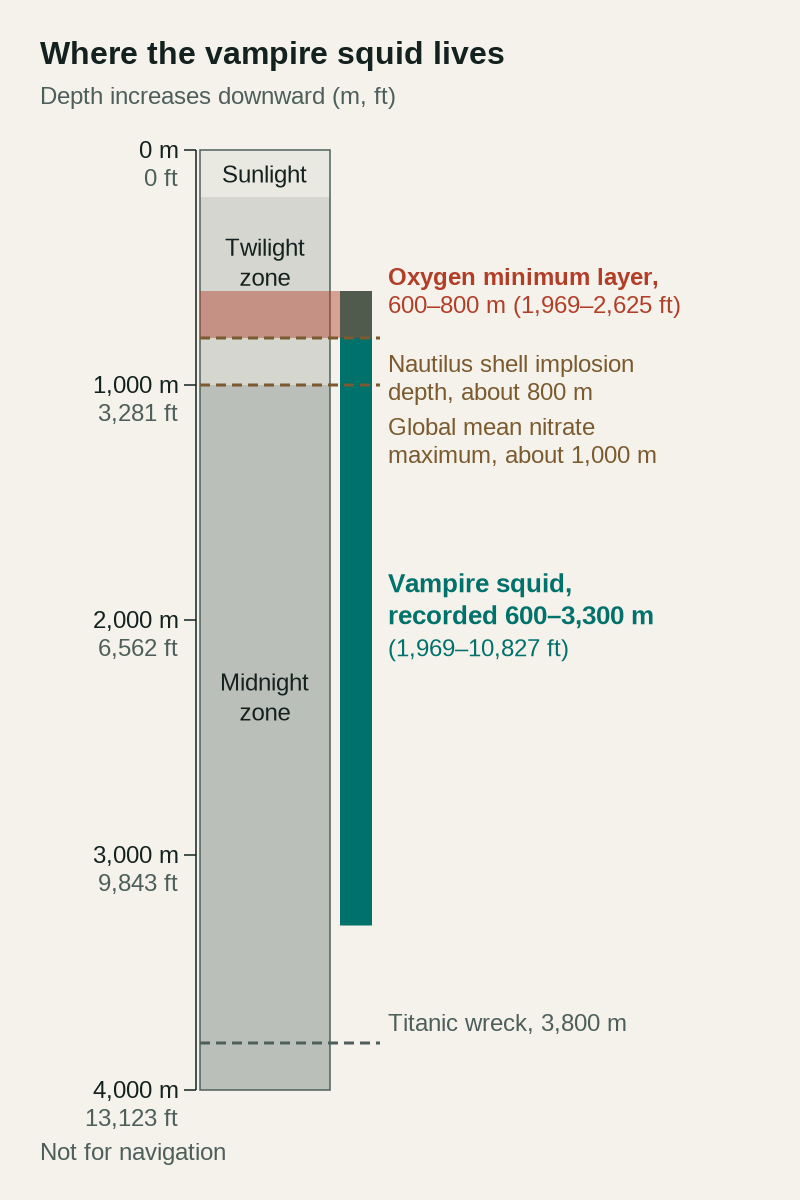
Depth layers around the vampire squid's recorded range: NOAA's light zones, the oxygen minimum layer a 1998 study places it in, and three reference depths from this site's other pages.
Credit and data
"Where the vampire squid lives, layer by layer" by Ocean Life & Lore, https://oceanlifeandlore.com/deep/vampire-squid/, licensed under CC BY 4.0 (https://creativecommons.org/licenses/by/4.0/).
Data: NOAA National Ocean Service, How far does light travel in the ocean? (https://oceanservice.noaa.gov/facts/light_travel.html), public domain (US federal government work), retrieved 2026-10-15; Golikov et al. 2019, The first global deep-sea stable isotope assessment reveals the unique trophic ecology of Vampire Squid Vampyroteuthis infernalis (Cephalopoda), Scientific Reports 9: 19099 (https://doi.org/10.1038/s41598-019-55719-1), CC BY 4.0, retrieved 2026-10-15; Seibel, Thuesen & Childress 1998, Flight of the vampire: ontogenetic gait-transition in Vampyroteuthis infernalis, Journal of Experimental Biology 201: 2413-2424 (https://doi.org/10.1242/jeb.201.16.2413), published values cited as facts, retrieved 2026-10-15; Dunstan, Ward & Marshall 2011, Vertical distribution and migration patterns of Nautilus pompilius, PLoS ONE 6(2): e16311 (https://doi.org/10.1371/journal.pone.0016311), CC BY, retrieved 2026-10-15; Garcia et al. 2024, World Ocean Atlas 2023, Volume 4: Dissolved Inorganic Nutrients, NOAA Atlas NESDIS 92, p. 64 (https://doi.org/10.25923/39qw-7j08), CC0 1.0, retrieved 2026-10-15; NOAA Ocean Exploration, Titanic Bow, daily image from the R.M.S. Titanic Expedition 2003 (https://oceanexplorer.noaa.gov/multimedia/daily-image-media-20210415/), public domain (US federal government work), retrieved 2026-10-15.
Is the vampire squid a squid or an octopus?
The vampire squid is neither, though it is closer to the octopuses. Hoving and Robison note that vampire squid are considered "phylogenetic relics with cephalopod features of both octopods and squids." Squids and cuttlefishes are ten-armed, and in squids some of those arms are specialized as feeding tentacles (Yoshida et al. 2025). The vampire squid has eight arms and two retractile filaments, which Hoving and Robison's findings suggest are modified arms.
WoRMS groups its order with the octopuses in the superorder Octopodiformes. Squids and cuttlefishes sit apart, in Decapodiformes, and a 2012 study of several genes by Lindgren and colleagues recovered the same two lineages. Golikov's team, summing up earlier work, places the vampire squid's split from the octopods soon after those two lineages parted, in the early Triassic.
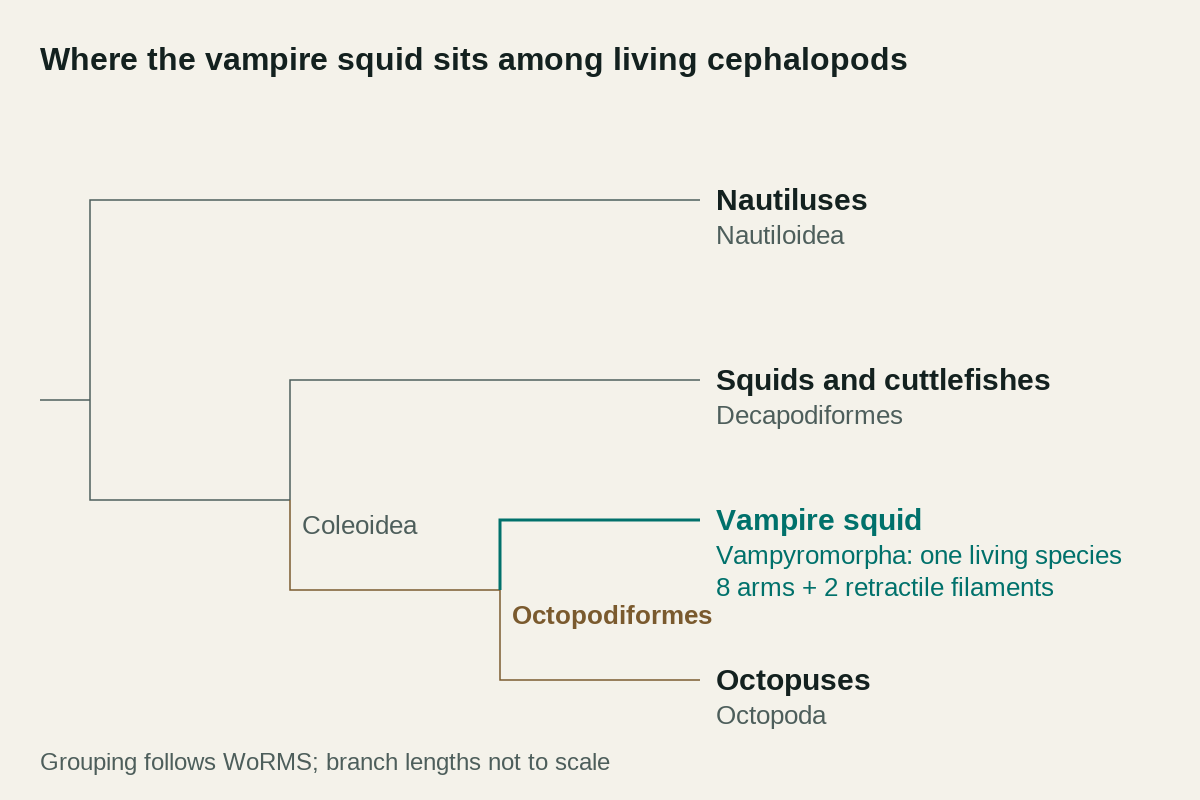
Open full-size chart, or scroll it sideways to read every label
Living cephalopods, simplified. The vampire squid's order pairs with the octopuses; squids and cuttlefishes form the other coleoid branch, and nautiluses branch off first. Branch lengths are not to scale.
Credit and data
"Where the vampire squid sits among living cephalopods" by Ocean Life & Lore, https://oceanlifeandlore.com/deep/vampire-squid/, licensed under CC BY 4.0 (https://creativecommons.org/licenses/by/4.0/).
Data: MolluscaBase eds. (2026), MolluscaBase, Vampyroteuthis infernalis Chun, 1903, accessed through World Register of Marine Species (https://www.marinespecies.org/aphia.php?p=taxdetails&id=141887), CC BY 4.0, retrieved 2026-10-15; Lindgren, Pankey, Hochberg & Oakley 2012, A multi-gene phylogeny of Cephalopoda, BMC Evolutionary Biology 12: 129 (https://doi.org/10.1186/1471-2148-12-129), CC BY 2.0, retrieved 2026-10-15; Hoving & Robison 2012, Vampire squid: detritivores in the oxygen minimum zone, Proceedings of the Royal Society B 279: 4559-4567 (https://doi.org/10.1098/rspb.2012.1357), published findings cited as facts, retrieved 2026-10-15; Košťák et al. 2021, Fossil evidence for vampire squid inhabiting oxygen-depleted ocean zones since at least the Oligocene, Communications Biology 4: 216 (https://doi.org/10.1038/s42003-021-01714-0), CC BY 4.0, retrieved 2026-10-15.
Yet its genome, sequenced by Yoshida and colleagues in 2025, keeps part of the chromosome layout of squids and cuttlefishes rather than octopuses.
WoRMS lists one living species. A second, Vampyroteuthis pseudoinfernalis, was named in 2024. As of October 2026, WoRMS treats it as a synonym of V. infernalis, citing a 2026 paper by Judkins and colleagues.
Is the vampire squid a living fossil?
The story goes that the vampire squid is a living fossil. The phrase appears in the title of a 2007 paper by Yokobori and colleagues, and in quotation marks in the 2025 genome paper. That paper traces the vampyropods, the wider group, back at least to the Middle Jurassic, about 165 million years ago. It calls the vampire squid the group's sole surviving species.
The lineage has moved, though. Košťák and colleagues reported in 2021 that the Mesozoic vampyromorphs, extinct relatives of the vampire squid, lived on shallow continental shelves. The last of them date from the Early Cretaceous, and until that study a gap of 120 million years in the fossil record separated them from the living species. The Oligocene fossil they studied, Necroteuthis hungarica, about 30 million years old, falls inside that gap and shows vampire squid in deep, oxygen-poor water by then.
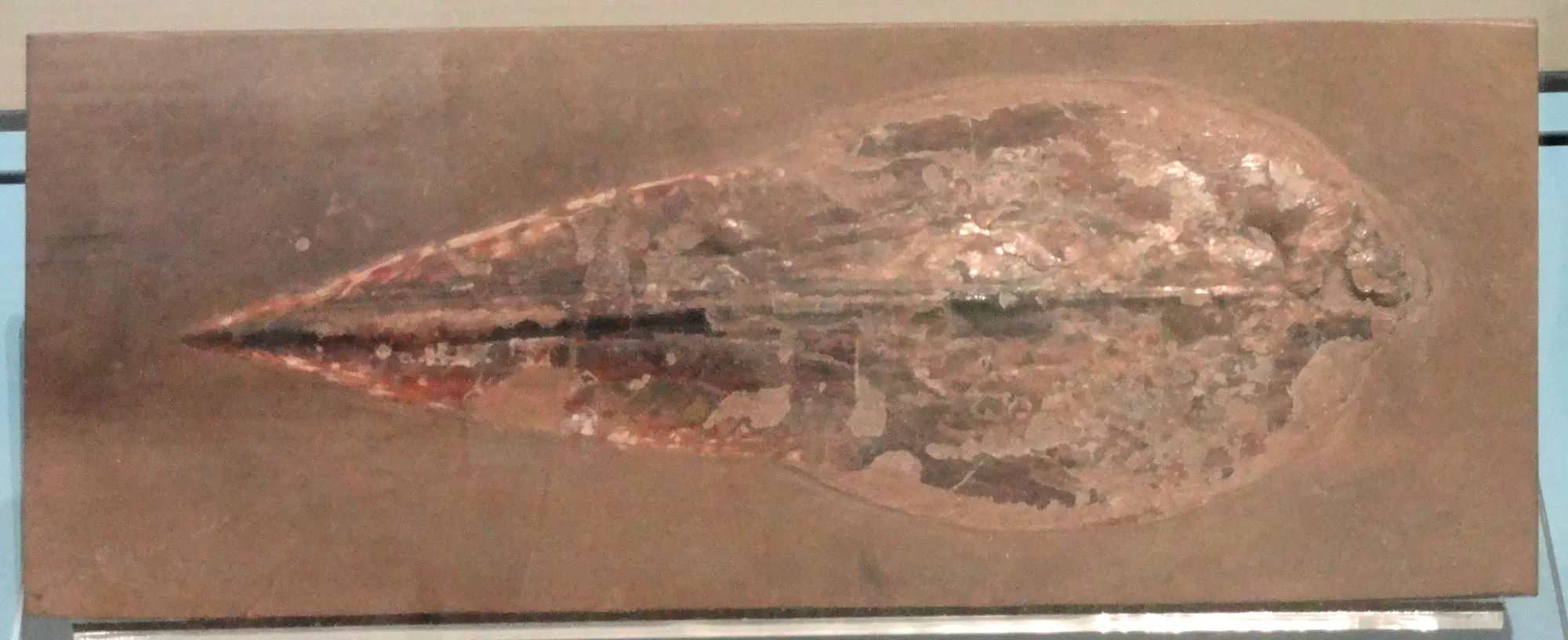
A fossil of Teudopsis subcostata from the Early Jurassic of Holzmaden, Germany, at the Royal Ontario Museum. Teudopsis is among the oldest known vampyropods.
Credit and data
"Teudopsis subcostata, Holzmaden, Germany, Early Jurassic - Royal Ontario Museum - DSC09936" by Daderot / Wikimedia Commons — https://commons.wikimedia.org/wiki/File:Teudopsis_subcostata,_Holzmaden,_Germany,_Early_Jurassic_-_Royal_Ontario_Museum_-_DSC09936.JPG — CC0 1.0 (https://creativecommons.org/publicdomain/zero/1.0/)

What does a vampire squid eat?
The story goes, from the name alone, that a vampire squid drinks blood. Ocean Exploration Trust's notes on the animal, posted by NOAA Ocean Exploration, say it does not. Its red eyes and dark color earned it the name, the notes add.
Below 600 m, it eats marine snow and other detritus. NOAA's National Ocean Service describes marine snow as organic material falling from upper waters to the deep ocean. It includes dead animals and plants, fecal matter, sand, soot and dust. Some flakes grow to several centimeters, and some take weeks to sink.
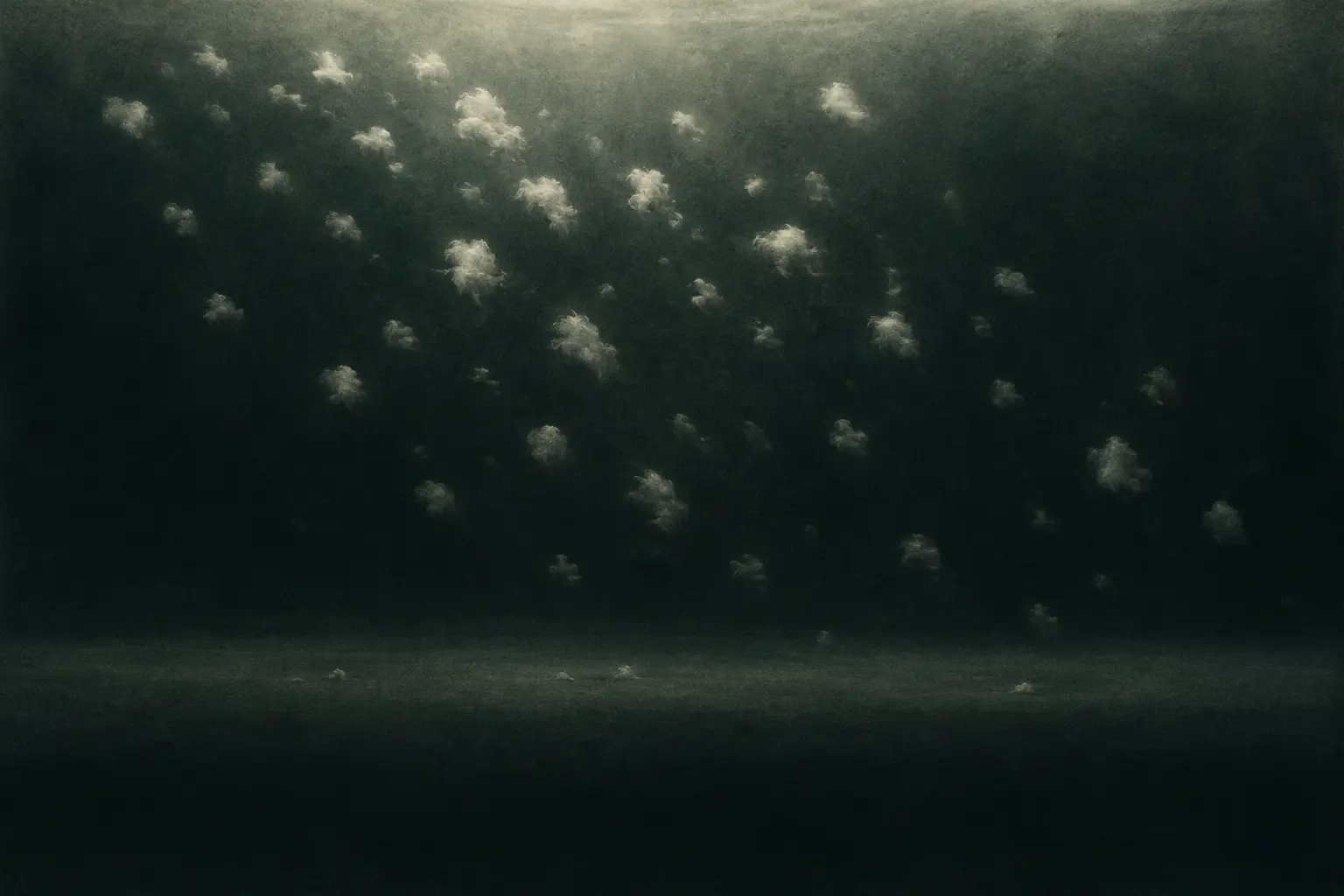 Illustration
Marine snow drifting down toward the seafloor: organic material falling from upper waters to the deep ocean. Some flakes take weeks to sink.
Illustration: Ocean Life & Lore. Generated illustration — not a photograph, specimen or historical record. Reuse: CC BY 4.0 (https://creativecommons.org/licenses/by/4.0/); no rights are claimed beyond what the law grants.
Hoving and Robison's 2012 study found vampire squid eating detritus of various sizes, from small particles to larger clumps. Ingested items included the remains of gelatinous zooplankton and crustaceans, diatoms and fecal pellets. Golikov's team adds that cirri, the small projections along the arms, help move food toward the mouth.
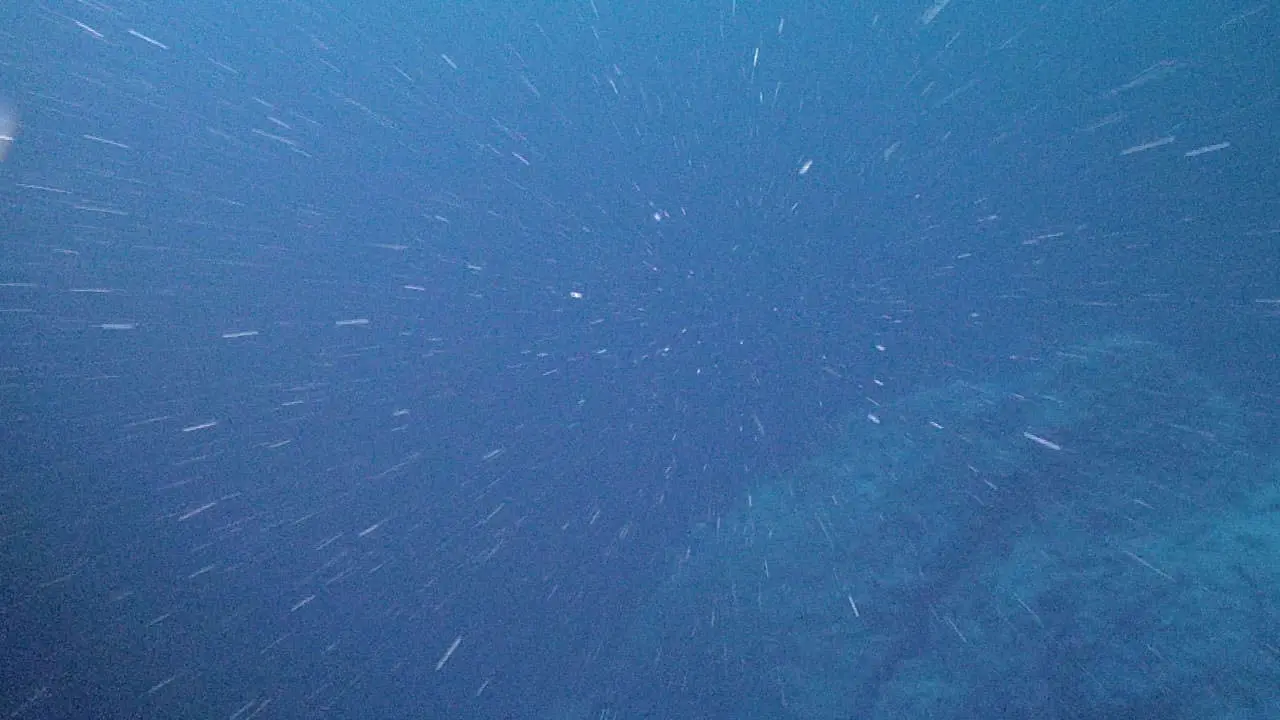
Marine snow, the shower of organic material that sinks from upper waters to the deep ocean, in an image from NOAA's National Ocean Service.
"Marinesnow-splash" by NOAA National Ocean Service — https://commons.wikimedia.org/wiki/File:Marinesnow-splash.jpg — Public domain (US federal government work, NOAA National Ocean Service)

The diet changes with size. Golikov's team measured isotopes in the beaks of 104 animals. Juveniles turned out to be mobile zooplankton eaters, while larger vampire squid were slow-swimming opportunists that took in particles of organic matter. Across its range, the species sat at a trophic level, or food-chain step, of 3.0 to 4.3, higher than other particle feeders studied but below top predators.
How does it survive with so little oxygen?
By spending very little energy. In a 1997 survey of 33 cephalopod species from California and Hawaii, Seibel and colleagues measured how fast each one used oxygen. The vampire squid, which lives in the oxygen minimum layer off California, averaged 0.07 µmol of oxygen per gram per hour. Gonatus onyx, a squid that migrates up and down the water column, used 8.79 µmol, about 126 times as much by this page's calculation.
One vampire squid in that study, at 0.02 µmol per gram per hour, had the lowest rate then measured for any cephalopod.
It also travels cheaply. Seibel, Thuesen and Childress noted in 1998 that earlier studies had found little capacity for jet propulsion in the species. Juveniles jet, but a rapid metamorphosis, or change in body form, moves and reshapes the fins; adults appear to swim mainly with their fins, a stroke the authors call inherently more efficient.
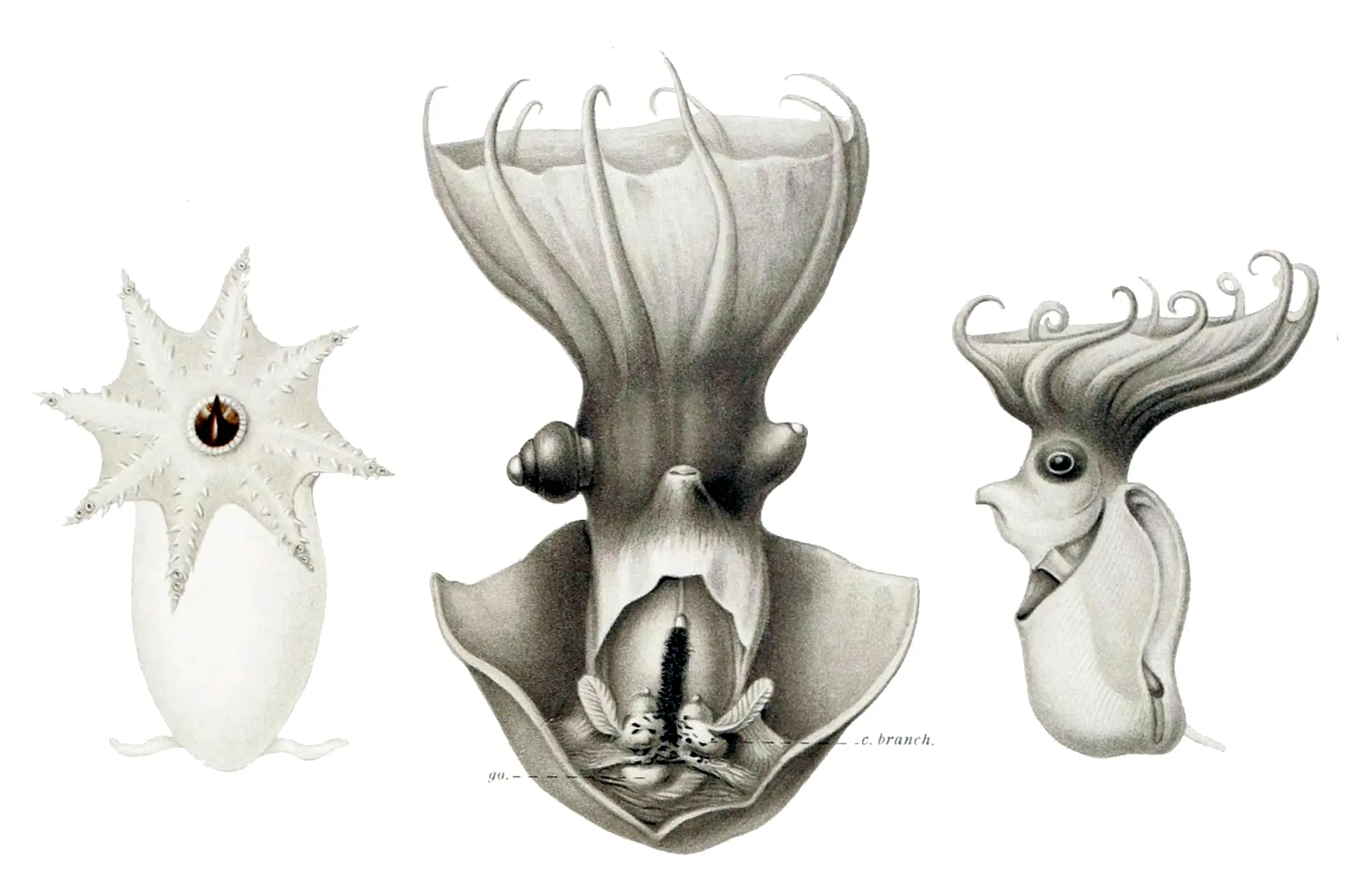
From the expedition report: the youngest specimen from below, web spread (left); the 37 mm animal from below with its mantle opened (center); a young animal from the Benguela Current (right).
Credit and data
"Vampyroteuthis1" by E. H. Rübsaamen and C. Chun, plate XCI in C. Chun, Die Cephalopoden, II. Teil (Jena: G. Fischer, 1915) — https://commons.wikimedia.org/wiki/File:Vampyroteuthis1.jpg — Public domain (US: published in Jena, Germany, in 1915, before 1931; EU: artists Ewald Heinrich Rübsaamen died in 1919 and Carl Chun in 1914; faithful scan of a two-dimensional plate)

Golikov's team lists two more traits from earlier studies. Neutral buoyancy cuts the cost of swimming. Its hemocyanin, the protein that carries oxygen in its blood, grips oxygen more tightly than any other cephalopod hemocyanin tested but one, from an Antarctic octopus.
Does a vampire squid squirt ink?
Ocean Exploration Trust's notes say the vampire squid lacks the ink sac of true squid and can release a cloud of glowing mucus instead. Robison and colleagues described two previously unknown ways it makes light in 2003, working with live animals collected gently by remotely operated vehicle (ROV) and taken to a lab ashore.
Light organs at the tips of all eight arms glow readily when touched. A stronger trigger makes the arm tips release a thick fluid with tiny glowing particles in it, forming a cloud of light around the animal. The team wrote that both kinds of light are apparently linked to defense against predators. They identified coelenterazine and luciferase as the chemistry behind the light.
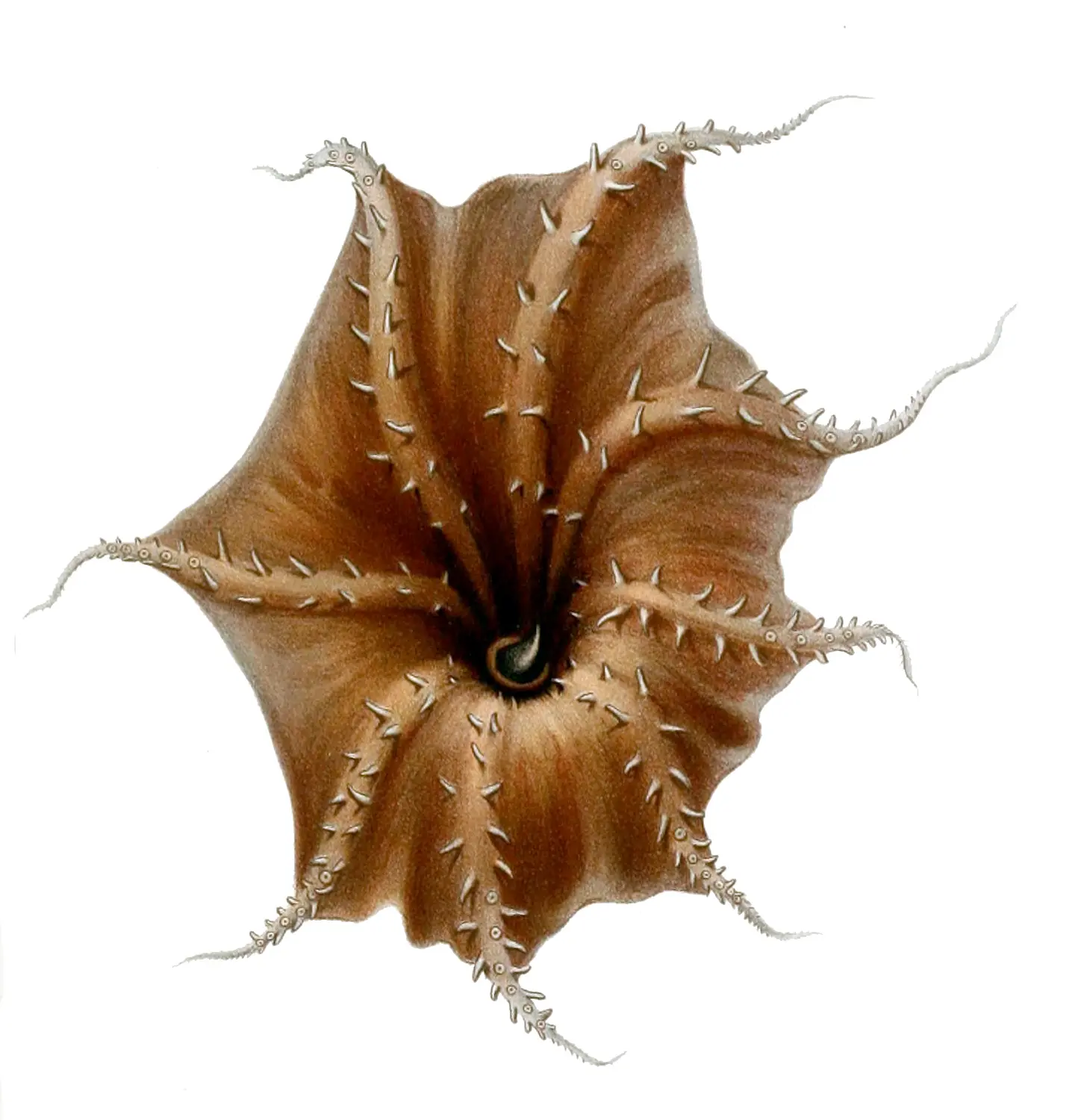
The arm crown of the 37 mm specimen seen from the front, with the web spread. Two rows of cirri line each arm.
Credit and data
"Vampyroteuthis infernalis arms" by E. H. Rübsaamen, plate XC in C. Chun, Die Cephalopoden, II. Teil (Jena: G. Fischer, 1915) — https://commons.wikimedia.org/wiki/File:Vampyroteuthis_infernalis_arms.jpg — Public domain (US: published in Jena, Germany, in 1915, before 1931; EU: painter Ewald Heinrich Rübsaamen died in 1919; faithful scan of a two-dimensional plate)

Within Octopodiformes, a 2012 analysis by Lindgren and colleagues suggests that making light evolved three separate times. The three are the vampire squid, a lineage within the cirrate octopods, and the family Bolitaenidae. J. Thiele, who described the expedition's specimens in its 1915 cephalopod report, noted a few whitish points in the skin and asked, with a question mark, whether they were light organs.
He recorded the skin as black and the eyes as purple. How red and black bodies look at these depths is the subject of Why So Many Deep-Sea Animals Are Red, and Look Black.
One date is still unsounded: when the deep-sea line of vampire squid split from its shallow-water relatives. Košťák and colleagues wrote in 2021 that the fossil record is too scarce to estimate it.
Lore check
2 claims sounded: bends ×1sinks ×1
| Claim | Verdict | Evidence |
|---|---|---|
| The vampire squid drinks blood | sinks | Hoving & Robison 2012: diet of detritus, from small particles to marine aggregates, with remains of gelatinous zooplankton and crustaceans. Golikov et al. 2019: beak isotopes from 104 animals show zooplankton-eating juveniles and larger animals that feed opportunistically on particulate organic matter. |
| The vampire squid is a living fossil | bends | Old lineage: vampyropods date from at least about 165 million years ago, and the vampire squid is the sole survivor (Yoshida et al. 2025). Not unchanged: Mesozoic relatives lived on shallow shelves; deep, oxygen-poor habitat is documented from about 30 million years ago (Košťák et al. 2021). |
Further down:
- Challenger Deep: the ocean's deepest known point, about 10,935 m (35,876 ft) down, lies some 7,600 m (25,000 ft) below the deepest vampire squid on record.
- The nitrogen cycle: in oxygen-depleted water like the vampire squid's, the World Ocean Atlas 2023 notes, microbes turn nitrate into nitrogen gas.
Sources
- 1Hoving, H. J., and B. H. Robison. "Vampire squid: detritivores in the oxygen minimum zone." Proceedings of the Royal Society B 279 (2012): 4559–4567. doi:10.1098/rspb.2012.1357 https://doi.org/10.1098/rspb.2012.1357 Read: abstract.
- 2Golikov, A. V., F. R. Ceia, R. M. Sabirov, et al. "The first global deep-sea stable isotope assessment reveals the unique trophic ecology of Vampire Squid Vampyroteuthis infernalis (Cephalopoda)." Scientific Reports 9 (2019): 19099. doi:10.1038/s41598-019-55719-1 https://doi.org/10.1038/s41598-019-55719-1 Read: full text.
- 3Seibel, B. A., E. V. Thuesen, and J. J. Childress. "Flight of the vampire: ontogenetic gait-transition in Vampyroteuthis infernalis (Cephalopoda: Vampyromorpha)." Journal of Experimental Biology 201 (1998): 2413–2424. doi:10.1242/jeb.201.16.2413 https://doi.org/10.1242/jeb.201.16.2413 Read: abstract.
- 4Seibel, B. A., E. V. Thuesen, J. J. Childress, and L. A. Gorodezky. "Decline in pelagic cephalopod metabolism with habitat depth reflects differences in locomotory efficiency." Biological Bulletin 192 (1997): 262–278. doi:10.2307/1542720 https://doi.org/10.2307/1542720 Read: abstract.
- 5Robison, B. H., K. R. Reisenbichler, J. C. Hunt, and S. H. D. Haddock. "Light production by the arm tips of the deep-sea cephalopod Vampyroteuthis infernalis." Biological Bulletin 205 (2003): 102–109. doi:10.2307/1543231 https://doi.org/10.2307/1543231 Read: abstract.
- 6Košťák, M., J. Schlögl, D. Fuchs, et al. "Fossil evidence for vampire squid inhabiting oxygen-depleted ocean zones since at least the Oligocene." Communications Biology 4 (2021): 216. doi:10.1038/s42003-021-01714-0 https://doi.org/10.1038/s42003-021-01714-0 Read: full text.
- 7Yoshida, M., E. Tóth, K. Kon-Nanjo, et al. "Giant genome of the vampire squid reveals the derived state of modern octopod karyotypes." iScience 28 (2025): 113832. doi:10.1016/j.isci.2025.113832 https://doi.org/10.1016/j.isci.2025.113832 Read: full text.
- 8Yokobori, S., D. J. Lindsay, M. Yoshida, et al. "Mitochondrial genome structure and evolution in the living fossil vampire squid, Vampyroteuthis infernalis, and extant cephalopods." Molecular Phylogenetics and Evolution 44 (2007): 898–910. doi:10.1016/j.ympev.2007.05.009 https://doi.org/10.1016/j.ympev.2007.05.009 Read: abstract.
- 9Lindgren, A. R., M. S. Pankey, F. G. Hochberg, and T. H. Oakley. "A multi-gene phylogeny of Cephalopoda supports convergent morphological evolution in association with multiple habitat shifts in the marine environment." BMC Evolutionary Biology 12 (2012): 129. doi:10.1186/1471-2148-12-129 https://doi.org/10.1186/1471-2148-12-129 Read: full text.
- 10Dunstan, A. J., P. D. Ward, and N. J. Marshall. "Vertical distribution and migration patterns of Nautilus pompilius." PLoS ONE 6, no. 2 (2011): e16311. doi:10.1371/journal.pone.0016311 https://doi.org/10.1371/journal.pone.0016311 Read: abstract.
- 11Chun, C. Die Cephalopoden. II. Teil: Myopsida, Octopoda. Wissenschaftliche Ergebnisse der Deutschen Tiefsee-Expedition auf dem Dampfer "Valdivia" 1898–1899, Bd. 18. Jena: Gustav Fischer, 1915. Vampyroteuthidae by J. Thiele, pp. 534–536; plates XC–XCI. https://commons.wikimedia.org/wiki/File:Die_Cephalopoden_(IA_diecephalopoden182chun).pdf Read: pages 534–536; plates XC–XCI.
- 12Garcia, H. E., C. Bouchard, S. L. Cross, C. R. Paver, J. R. Reagan, T. P. Boyer, R. A. Locarnini, A. V. Mishonov, O. K. Baranova, D. Seidov, Z. Wang, and D. Dukhovskoy. World Ocean Atlas 2023, Volume 4: Dissolved Inorganic Nutrients (Phosphate, Nitrate, and Silicate). NOAA Atlas NESDIS 92. NOAA National Centers for Environmental Information, 2024. doi:10.25923/39qw-7j08. License: CC0 1.0. https://repository.library.noaa.gov/view/noaa/60602 Read: pages 63–64.
- 13NOAA National Ocean Service. "How far does light travel in the ocean?" https://oceanservice.noaa.gov/facts/light_travel.html Read: full text.
- 14NOAA National Ocean Service. "What is marine snow?" Last updated November 5, 2020. https://oceanservice.noaa.gov/facts/marinesnow.html Read: full text.
- 15NOAA Ocean Exploration. "Titanic Bow." Daily image, R.M.S. Titanic Expedition 2003; posted April 15, 2021. https://oceanexplorer.noaa.gov/multimedia/daily-image-media-20210415/ Read: full text.
- 16NOAA Ocean Exploration. "How deep is the ocean?" https://oceanexplorer.noaa.gov/ocean-fact/ocean-depth/ Read: full text.
- 17MolluscaBase eds. (2026). MolluscaBase. Vampyroteuthis infernalis Chun, 1903. Accessed through: World Register of Marine Species at https://www.marinespecies.org/aphia.php?p=taxdetails&id=141887 on 2026-10-15. Read: catalogue record.
- 18MolluscaBase eds. (2026). MolluscaBase. Vampyroteuthis pseudoinfernalis D.-J. Qiu, B.-L. Liu & L.-M. Huang, 2024. Accessed through: World Register of Marine Species at https://www.marinespecies.org/aphia.php?p=taxdetails&id=1759859 on 2026-10-15. Read: catalogue record.
- 19Ocean Exploration Trust. "Not So Bloodthirsty: An Encounter with a Vampire Squid." Exploration Notes, Deep Ocean Education Project, 2021. Posted by NOAA Ocean Exploration. https://oceanexplorer.noaa.gov/expedition-feature/not-so-bloodthirsty-exploration-notes/ Read: full text.
Cite this page
Ocean Life & Lore. “Vampire Squid: It Drinks No Blood and Eats Marine Snow.” Ocean Life & Lore. Published 2026-10-15; last substantive revision 2026-10-15. https://oceanlifeandlore.com/deep/vampire-squid/ (accessed the date you read it).
Download the data: Sounding line (CSV) CSV (source and license record) Data: Golikov et al. 2019, The first global deep-sea stable isotope assessment reveals the unique trophic ecology of Vampire Squid Vampyroteuthis infernalis (Cephalopoda), Scientific Reports 9: 19099 (https://doi.org/10.1038/s41598-019-55719-1), CC BY 4.0, retrieved 2026-10-15; NOAA National Ocean Service, How far does light travel in the ocean? (https://oceanservice.noaa.gov/facts/light_travel.html), public domain (US federal government work), retrieved 2026-10-15; NOAA Ocean Exploration, How deep is the ocean? (https://oceanexplorer.noaa.gov/ocean-fact/ocean-depth/), public domain (US federal government work), retrieved 2026-10-15; NOAA Ocean Exploration, Titanic Bow, daily image from the R.M.S. Titanic Expedition 2003 (https://oceanexplorer.noaa.gov/multimedia/daily-image-media-20210415/), public domain (US federal government work), retrieved 2026-10-15. · Depth layers (CSV) CSV (source and license record) Data: NOAA National Ocean Service, How far does light travel in the ocean? (https://oceanservice.noaa.gov/facts/light_travel.html), public domain (US federal government work), retrieved 2026-10-15; Golikov et al. 2019, The first global deep-sea stable isotope assessment reveals the unique trophic ecology of Vampire Squid Vampyroteuthis infernalis (Cephalopoda), Scientific Reports 9: 19099 (https://doi.org/10.1038/s41598-019-55719-1), CC BY 4.0, retrieved 2026-10-15; Seibel, Thuesen & Childress 1998, Flight of the vampire: ontogenetic gait-transition in Vampyroteuthis infernalis, Journal of Experimental Biology 201: 2413-2424 (https://doi.org/10.1242/jeb.201.16.2413), published values cited as facts, retrieved 2026-10-15; Dunstan, Ward & Marshall 2011, Vertical distribution and migration patterns of Nautilus pompilius, PLoS ONE 6(2): e16311 (https://doi.org/10.1371/journal.pone.0016311), CC BY, retrieved 2026-10-15; Garcia et al. 2024, World Ocean Atlas 2023, Volume 4: Dissolved Inorganic Nutrients, NOAA Atlas NESDIS 92, p. 64 (https://doi.org/10.25923/39qw-7j08), CC0 1.0, retrieved 2026-10-15; NOAA Ocean Exploration, Titanic Bow, daily image from the R.M.S. Titanic Expedition 2003 (https://oceanexplorer.noaa.gov/multimedia/daily-image-media-20210415/), public domain (US federal government work), retrieved 2026-10-15.
Corrections
No corrections yet.
Every correction on the site is listed in the Corrections logbook. To report an error on this page, use Report a correction with the page URL, the sentence and your source. How claims are sounded sets out the sources, recalculations and verdict rules behind each page.
More from Deep Sea
-
How it works
Why So Many Deep-Sea Animals Are Red, and Look Black
Malacosteus niger: 600–1,000 m
-
How it works
Challenger Deep: The Deepest Spot Has No Single Agreed Depth
Challenger Deep: 10,935 m