How it works
Ming the Clam: Counted at 405 Years, Recounted at 507
The first count read a hinge that had packed more than 500 yearly lines into a few millimeters; a recount, checked against other shells, found about a century more.
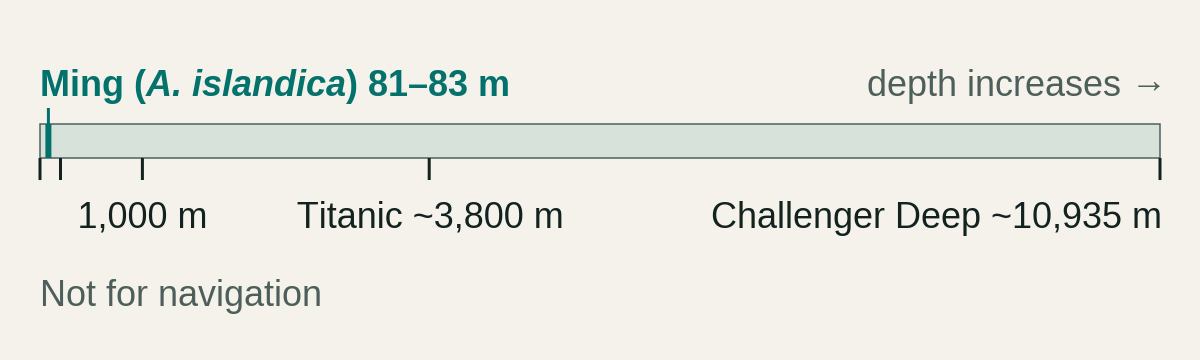
Sounding line: Ming (Arctica islandica), dredged alive from 81–83 m (266–272 ft) on the North Icelandic Shelf in 2006 (Wanamaker et al. 2008), shown against the full depth of the ocean.
Credit and data
"Sounding line: where Ming the clam lived" by Ocean Life & Lore, https://oceanlifeandlore.com/shells/shell-growth-lines/, licensed under CC BY 4.0 (https://creativecommons.org/licenses/by/4.0/).
Data: Wanamaker et al. 2008, Very long-lived mollusks confirm 17th century AD tephra-based radiocarbon reservoir ages for North Icelandic shelf waters, Radiocarbon 50(3): 399–412 (https://hdl.handle.net/10150/654085), all rights reserved; values cited as facts, retrieved 2026-10-15; NOAA Ocean Service, How far does light travel in the ocean? (https://oceanservice.noaa.gov/facts/light_travel.html), public domain (US federal government work), retrieved 2026-10-15; NOAA Ocean Exploration, How deep is the ocean? (https://oceanexplorer.noaa.gov/ocean-fact/ocean-depth/), public domain (US federal government work), retrieved 2026-10-15; NOAA Ocean Exploration, Titanic Bow, daily image from the R.M.S. Titanic Expedition 2003 (https://oceanexplorer.noaa.gov/multimedia/daily-image-media-20210415/), public domain (US federal government work), retrieved 2026-10-15.
Spec card
- Common name
- Ocean quahog; this individual is known as Ming
- Scientific name
- Arctica islandica (Linnaeus, 1767) (WoRMS AphiaID 138802)
- Class
- Bivalvia
- Coiling
- none
- Raup W, D, T
- n/a
- Size range
- about 71–109 mm (2.8–4.3 in) shell length, most US specimens
- Depth range
- about 8–400 m (25–1,300 ft) in US waters; Ming: 81–83 m (266–272 ft), North Icelandic Shelf
shell-growth-lines-spec.csv CSV (source and license record)
Data: MolluscaBase eds. (2026), MolluscaBase, Arctica islandica (Linnaeus, 1767), accessed through World Register of Marine Species (https://www.marinespecies.org/aphia.php?p=taxdetails&id=138802), CC BY 4.0, retrieved 2026-10-15; NOAA Fisheries, Ocean Quahog (https://www.fisheries.noaa.gov/species/ocean-quahog), public domain (US federal government work), retrieved 2026-10-15; Wanamaker et al. 2008, Very long-lived mollusks confirm 17th century AD tephra-based radiocarbon reservoir ages for North Icelandic shelf waters, Radiocarbon 50(3): 399–412 (https://hdl.handle.net/10150/654085), all rights reserved; values cited as facts, retrieved 2026-10-15; ScienceNordic, New record: World's oldest animal is 507 years old, 2013 (https://www.sciencenordic.com/ageing-denmark-geochemistry/new-record-worlds-oldest-animal-is-507-years-old/1392743), name cited as a fact, retrieved 2026-10-15.
TL;DR. Ming, an ocean quahog dredged from 81–83 m (266–272 ft) off Iceland in 2006, was 507 years old by the count Paul Butler and colleagues published in 2013, not the 405 counted first. The first count was made in the hinge, where the lines sat crowded together; the recount used the outer shell and was checked against other dated shells. Ming's record is also narrower than "oldest animal": the longest-lived non-colonial animal so far reported whose age at death can be accurately determined.
Down this page 8 sections
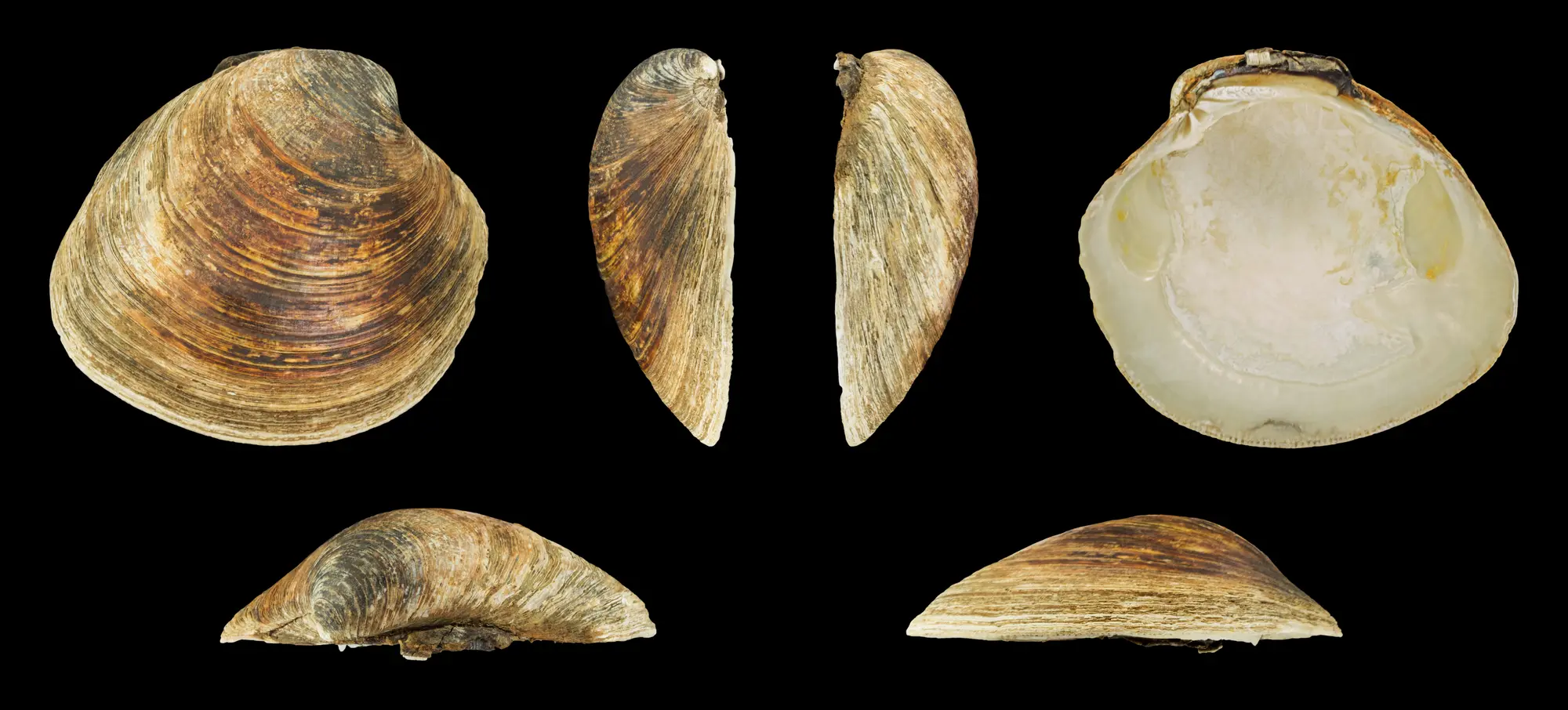
An ocean quahog, Arctica islandica, but not Ming: one valve from the North Sea, 7.9 cm long, shown from six sides. The concentric bands on the outside record its growth.
"Arctica islandica 01" by H. Zell — https://commons.wikimedia.org/wiki/File:Arctica_islandica_01.jpg — CC BY-SA 3.0 (https://creativecommons.org/licenses/by-sa/3.0/)

The first count of Ming, a clam dredged from 81–83 m off Iceland in 2006, missed about a century. Researchers at Bangor University first put the ocean quahog, Arctica islandica, at 405 to 410 years, counting the yearly lines in a section cut through its hinge. A recount published in 2013 by Paul Butler and colleagues gave 507 years, making Ming, in the words of their abstract, "the longest-lived non-colonial animal so far reported whose age at death can be accurately determined."
The recount moved from the hinge to the outer shell, ScienceNordic reported, and then checked Ming's run of wide and narrow years against other shells from the same waters. That check, called crossdating, comes from tree-ring science. It is also how the shells in Butler's study were joined into one record of the North Icelandic Shelf spanning 1,357 years.
How does a clam's shell record a year?
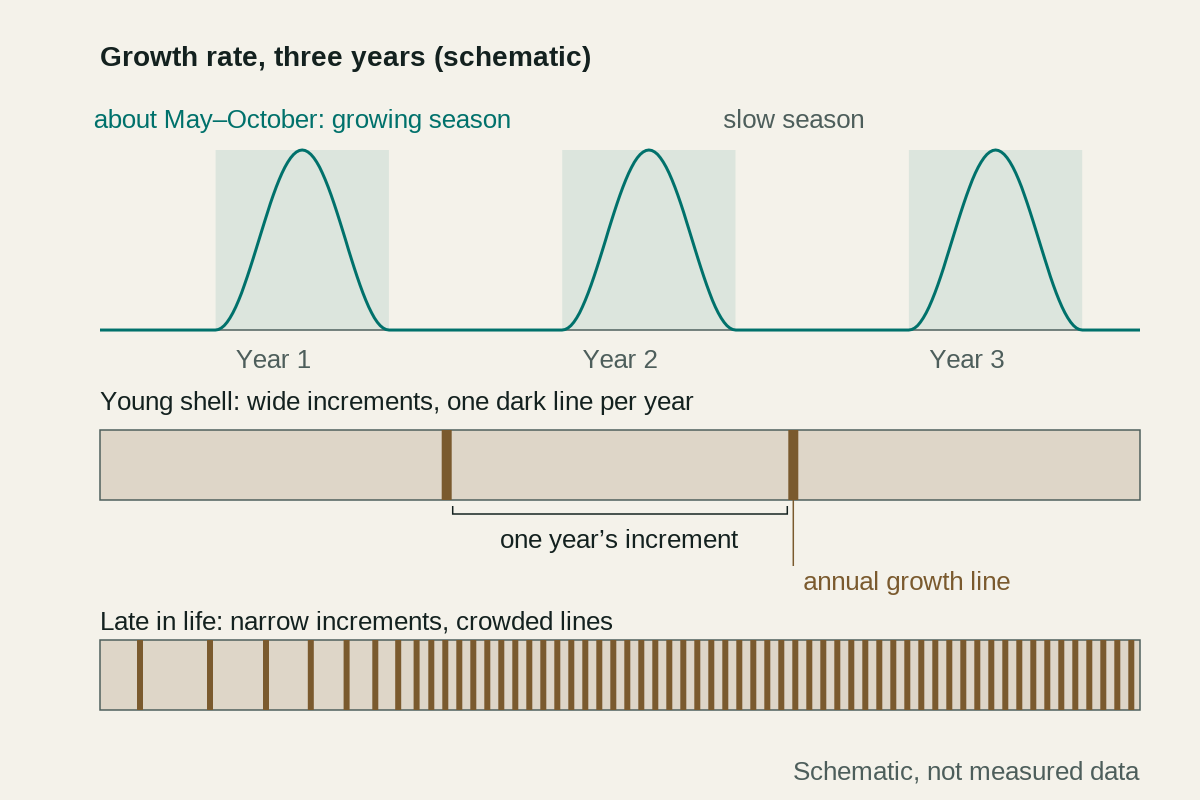
Off southwest Iceland, at 100 m (328 ft), Mette and colleagues used shell chemistry in 2023 to put the ocean quahog's growing season at about May to October. The clam builds shell in two places: at the edge, which makes the shell taller, and on the inner surface, which makes it thicker, as Stemmer and colleagues describe in a 2013 study of Western Baltic shells. The yearly growth lines belong to the outer layer, which forms at the edge.
Each growing season adds a band of new shell called an increment. Each increment ends at a thin band of darker shell, the annual growth line, which Mette's team describes as the boundary between two annual increments. Wanamaker and colleagues measure one year of growth from one line to the next, and they note that a quahog's yearly growth can differ by two orders of magnitude, about a hundredfold, over its life.
Open full-size chart, or scroll it sideways to read every label
Schematic, not measured data: each growing season, about May to October off southwest Iceland, adds a pale increment, and a thin dark line marks the end of each year. Late increments narrow and crowd together.
Credit and data
"How one year becomes one line" by Ocean Life & Lore, https://oceanlifeandlore.com/shells/shell-growth-lines/, licensed under CC BY 4.0 (https://creativecommons.org/licenses/by/4.0/).
Data: Mette et al. 2023, Estuarine, Coastal and Shelf Science 294: 108525 (https://doi.org/10.1016/j.ecss.2023.108525), CC BY-NC-ND 4.0; values cited as facts, retrieved 2026-10-15; Wanamaker et al. 2008, Very long-lived mollusks confirm 17th century AD tephra-based radiocarbon reservoir ages for North Icelandic shelf waters, Radiocarbon 50(3): 399–412 (https://hdl.handle.net/10150/654085), all rights reserved; values cited as facts, retrieved 2026-10-15.
Read from the oldest end, these increments form what this site calls "the growth diary," a record in time order but not a complete one. A. islandica also thickens its shell from the inside (Stemmer et al. 2013). The sources checked here do not report it repairing breaks or dissolving its own inner walls, a habit documented in cone snails, the group of the geography cone (Kohn et al. 1979). Its young increments usually carry many "false" annual lines, which Mette's team links to fast early growth.
The hinge is the usual place to count. ScienceNordic's 2013 report says the hinge is generally considered the best place for counting, and Höche and colleagues describe it as the only part of the A. islandica shell whose microstructure is relatively uniform. Wanamaker's team counted Ming there because the increments in the hinge were the most obvious.
How are a clam's growth lines counted?
Counting this way means cutting the shell open. The study of growth increments like these, and of their chemistry, is called sclerochronology, and the steps below follow the methods Wanamaker and colleagues published for Ming in 2008 and those Reynolds and colleagues used for North Sea shells in 2025.
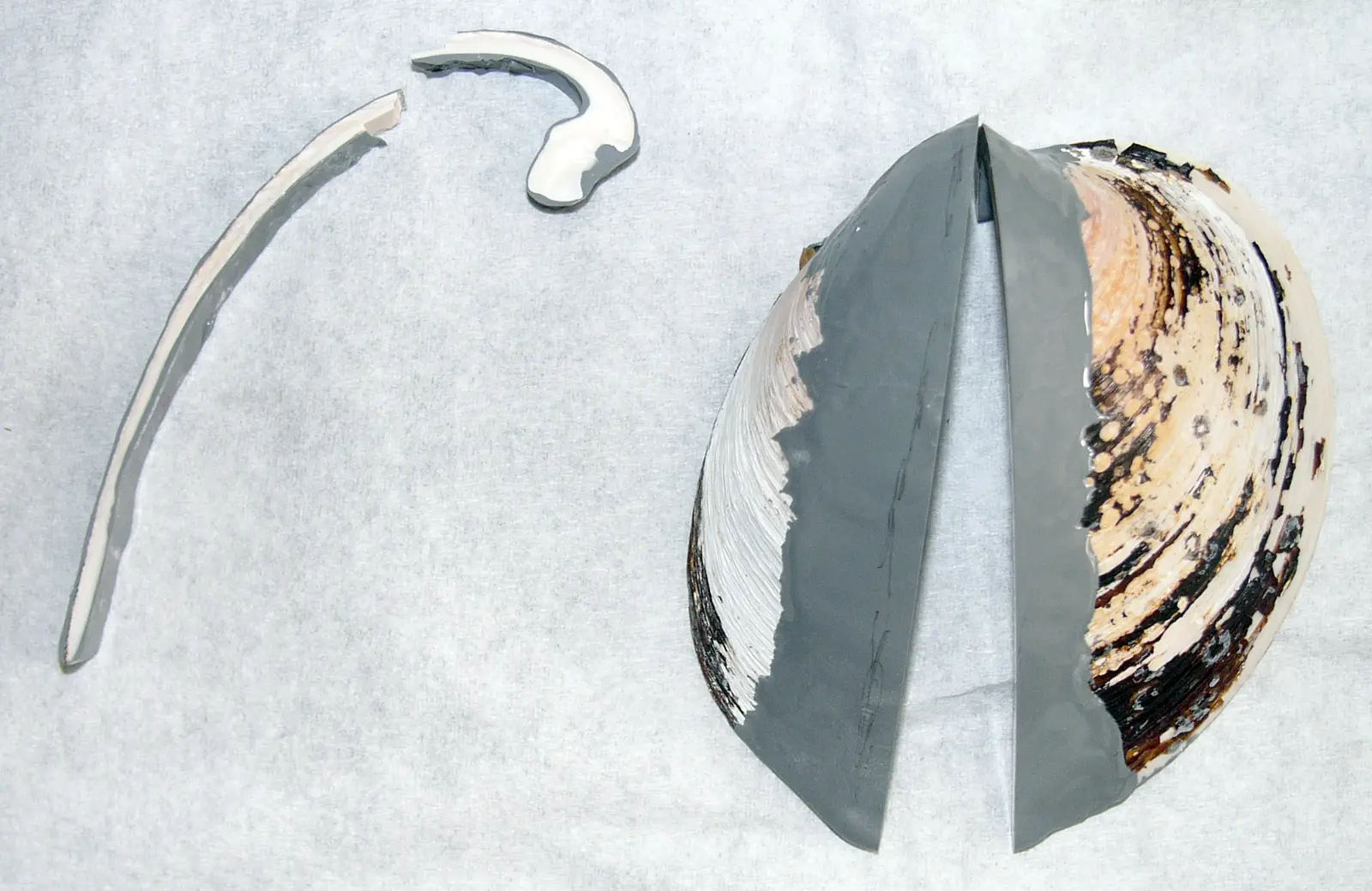
A North Sea Arctica islandica valve prepared for growth-band work, with a narrow strip cut from its middle lying at left. This shell is not Ming.
"Paleoclim-rec shells 48 hg" by Hannes Grobe/AWI — https://commons.wikimedia.org/wiki/File:Paleoclim-rec_shells_48_hg.jpg — CC BY 3.0 (https://creativecommons.org/licenses/by/3.0/)

- Cut a strip. A strip 1–2 cm wide is sawn along the line of fastest growth, from the umbo, the oldest point of the shell next to the hinge, to the outer edge.
- Embed and section. The strip is set in resin and sawn lengthwise, so the cut face runs through the hinge and out to the edge.
- Polish and etch. The cut face is ground smooth, polished, and etched so that the growth lines stand out.
- Take a peel. A thin acetate film pressed onto the etched face lifts off a replica of the lines, which is examined and photographed under a microscope, at ×2.5 to ×10 in Wanamaker's study.
- Count and measure. The lines are counted, and the width of each increment is measured. For Ming, three people counted at the same time and kept only the lines that all three agreed on.
- Crossdate. The sequence of wide and narrow increments is matched against other shells from the same area. Reynolds' team checked the matches both by eye and statistically.
- Assign years. For a clam caught alive, calendar years are assigned backward from the last full year before capture: 2005 for Ming, caught in 2006. Wanamaker's team reckoned the actual age as at least 2 years more than the number of bands counted, because the first and last years of life do not form complete annual increments.
The outside of the shell shows bands too. NOAA Fisheries notes that they can be used to determine age. Butler told ScienceNordic that the curved outer surface makes it hard to measure at the right angle, and that the lines inside the hinge are better protected.
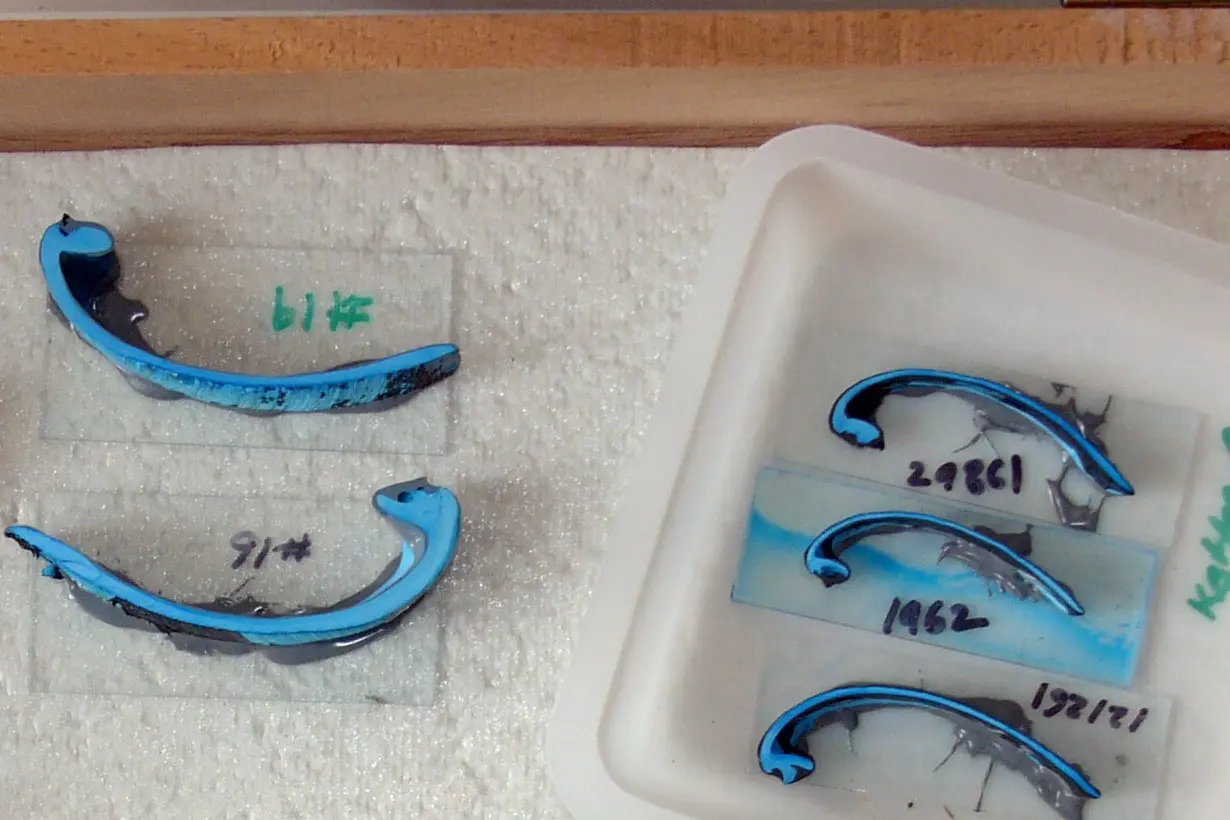
Sections cut from several Arctica islandica shells, mounted on glass slides for growth-band study, with handwritten sample labels. None of them is Ming.
"Paleoclim-rec shells 57 hg" by Hannes Grobe/AWI — https://commons.wikimedia.org/wiki/File:Paleoclim-rec_shells_57_hg.jpg — CC BY 3.0 (https://creativecommons.org/licenses/by/3.0/); modified: cropped

405, then 507: why did the first count fall short?
Ming came up in June 2006 near the island of Grímsey, from 81–83 m (266–272 ft) of water, in a dredge towed from the research vessel Bjarni Sæmundsson (Wanamaker et al. 2008). After its death, the clam was named Ming, for the Chinese dynasty in power when it was born, ScienceNordic reported.
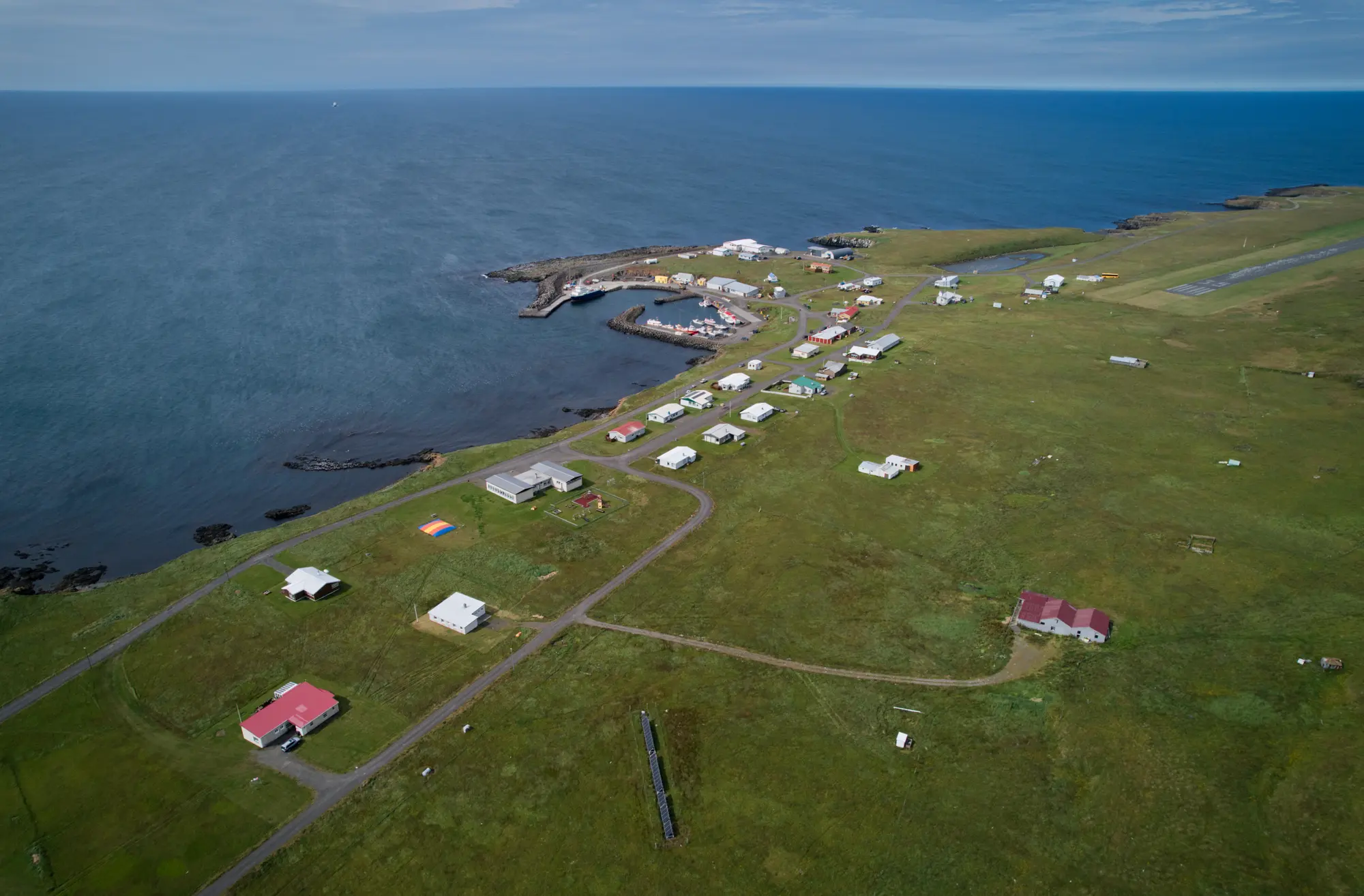
Grímsey, off north Iceland, seen from the air in 2025. Ming was dredged from 81–83 m of water near this island in 2006.
"Grímsey 0046" by Steinninn — https://commons.wikimedia.org/wiki/File:Gr%C3%ADmsey_0046.jpg — CC BY 4.0 (https://creativecommons.org/licenses/by/4.0/)

That depth sits well inside the top 200 m (656 ft), below which NOAA says there is rarely any significant light. The Lusitania wreck lies a little deeper, at 93 m (305 ft) off Ireland's Old Head of Kinsale (INFOMAR). The Titanic wreck, at 3,800 m (12,467 ft; NOAA Ocean Exploration), is about 46 times as deep as Ming's seafloor, by this page's arithmetic.
The story goes that Ming was 405 years old. That first figure, ScienceNordic recalled in 2013, made headlines around the world and reached the Guinness Book of World Records.
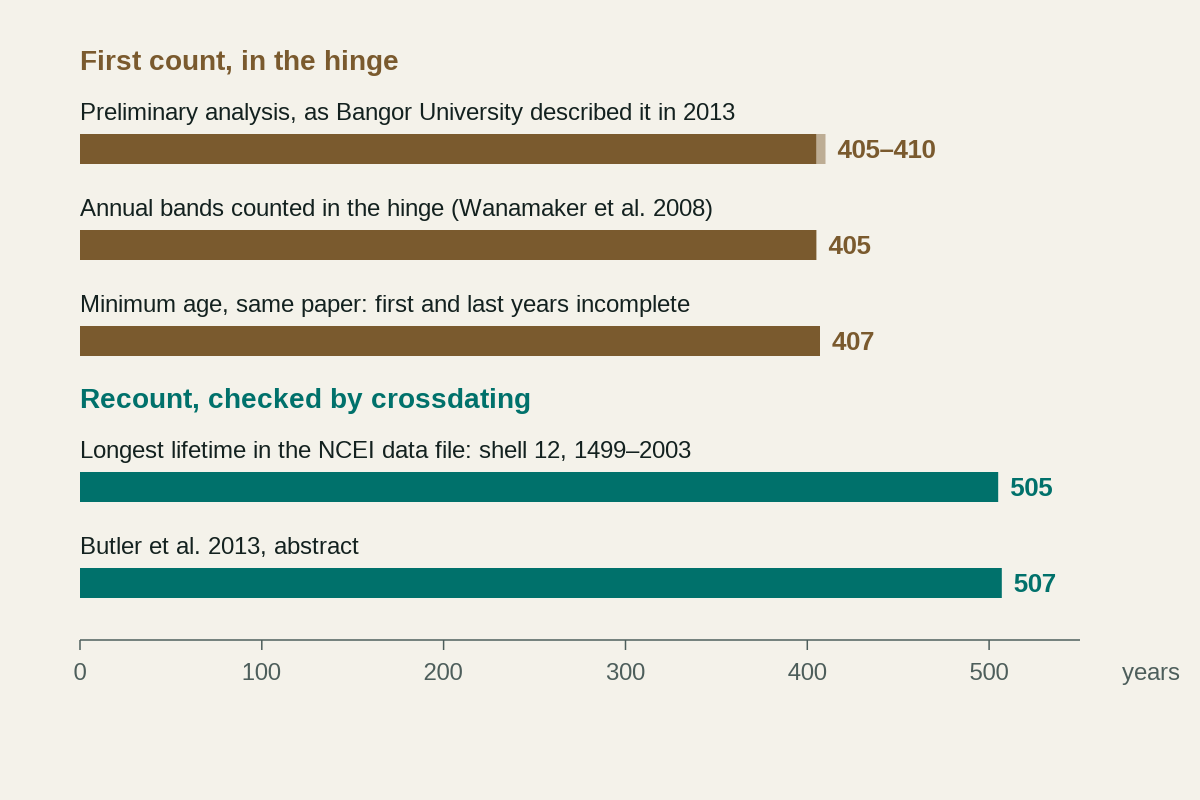
Wanamaker and colleagues counted 405 annual bands in the sectioned hinge and reported in 2008 that the clam had lived "more than 405 yr," at least 407 years once the incomplete first and last years were allowed for. Bangor University's 2013 statement describes the preliminary analysis as finding 405 to 410 years.
ScienceNordic explained the gap in 2013, after interviewing Butler. Ming was so old that more than 500 rings had been packed into a hinge area only a few millimeters across. For the recount, the team read the lines in the outer shell, where they spread over a wider surface, and found many more. They then checked Ming's pattern of wide and narrow years against other shells: none was as old as Ming, Butler explained, but each had lived through a different part of Ming's life.
The 2013 abstract gives 507 years. The NCEI lifetimes file for that study lists a longest shell lifetime of 505 years, from 1499 to 2003; this page reports both figures and does not try to reconcile them. Rob Witbaard of the Royal Netherlands Institute for Sea Research, who was not part of the study, told ScienceNordic that the age had been confirmed by several methods, including carbon-14, and that any error could be only one or two years.
Open full-size chart, or scroll it sideways to read every label
Ages reported for Ming, and the longest lifetime in the study's NCEI data file, grouped by count. The 505 and 507 are shown as published; this page does not reconcile them.
Credit and data
"Ming: 405, then 507" by Ocean Life & Lore, https://oceanlifeandlore.com/shells/shell-growth-lines/, licensed under CC BY 4.0 (https://creativecommons.org/licenses/by/4.0/).
Data: Wanamaker et al. 2008, Very long-lived mollusks confirm 17th century AD tephra-based radiocarbon reservoir ages for North Icelandic shelf waters, Radiocarbon 50(3): 399–412 (https://hdl.handle.net/10150/654085), all rights reserved; values cited as facts, retrieved 2026-10-15; Bangor University, Clam found to be over 500 years old, news release, 14 November 2013 (https://www.bangor.ac.uk/news/archive/clam-found-to-be-over-500-years-old-16781), copyright Bangor University; values cited as facts, retrieved 2026-10-15; NOAA/WDS Paleoclimatology – North Icelandic Shelf Arctica islandica Shell Measurement 1357 Year Record, Butler et al. 2013 (https://doi.org/10.25921/afe4-v605), no use restrictions (NOAA NCEI), retrieved 2026-10-15; Butler et al. 2013, Palaeogeography, Palaeoclimatology, Palaeoecology 373: 141–151, abstract as archived by NOAA NCEI (https://www.ncei.noaa.gov/access/paleo-search/study/14609), values cited as facts, retrieved 2026-10-15.
How do many shells make one chronology?
One clam covers one lifetime, so a longer record needs shells whose lives overlap. Matching works because quahogs living in the same area at the same time grow in step, the "synchronous nature of growth" that Reynolds and colleagues describe. Wanamaker's team showed the method in 2008, matching a dead shell with 284 bands to Ming's early years (correlation 0.66).
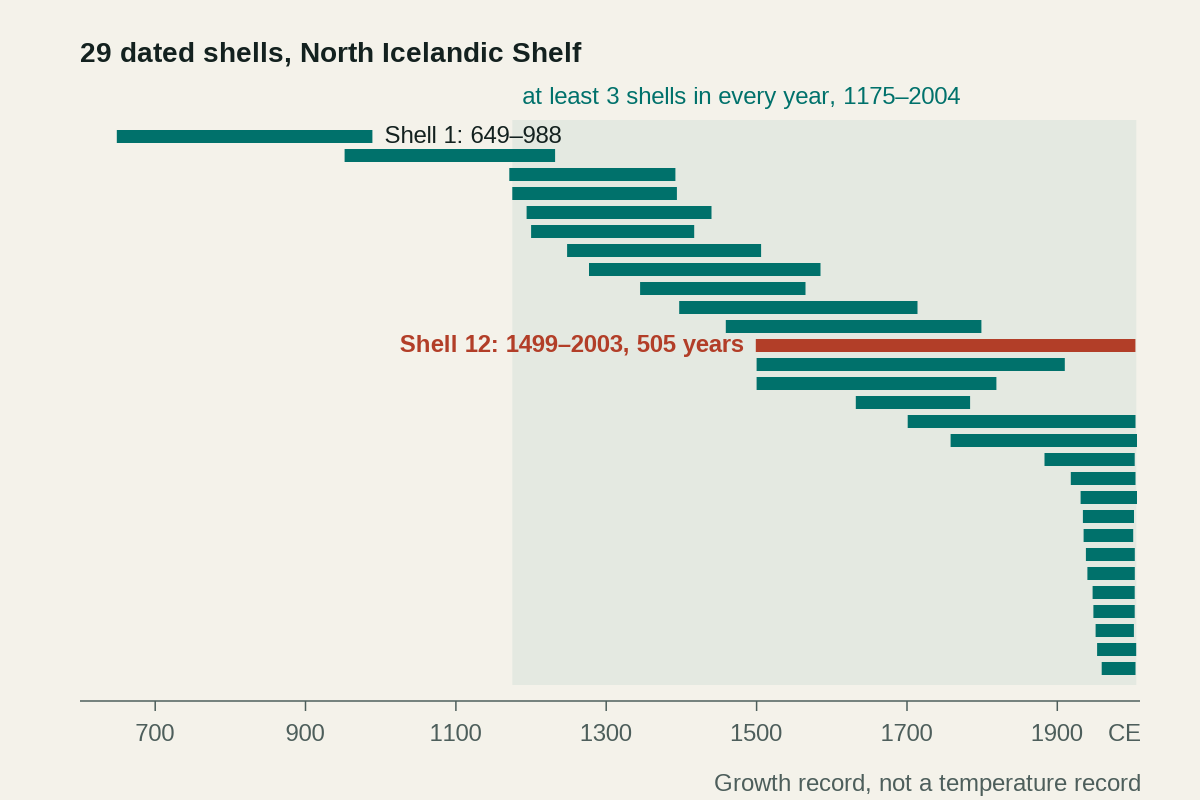
In 2013 Butler and colleagues published a record built this way for the North Icelandic Shelf, running from AD 649 to 2005; NOAA's National Centers for Environmental Information (NCEI) archives its data. By this page's count of the NCEI lifetimes file, 29 dated shells cover every year from 649 to 2005; at least three of them were alive in every year from 1175 to 2004, and two in 2005. The abstract gives a sample depth of at least three shells after AD 1175.
Open full-size chart, or scroll it sideways to read every label
Each bar is one shell's life as dated by crossdating, from the NCEI lifetimes file for Butler et al. 2013; the longest, shell 12, runs 1499–2003 (505 years). The bars record growth, not temperature.
Credit and data
"Many shells, one chronology" by Ocean Life & Lore, https://oceanlifeandlore.com/shells/shell-growth-lines/, licensed under CC BY 4.0 (https://creativecommons.org/licenses/by/4.0/).
Data: NOAA/WDS Paleoclimatology – North Icelandic Shelf Arctica islandica Shell Measurement 1357 Year Record, Butler et al. 2013 (https://doi.org/10.25921/afe4-v605), no use restrictions (NOAA NCEI), retrieved 2026-10-15.
The result is a growth record, not a thermometer. The abstract reports that the growth indices correlate only weakly with regional sea surface temperatures (r about 0.2), and the authors conclude that "a more complex combination of environmental forcings is driving growth."
A North Sea chronology points the same way. For shells from the Fladen Ground, spanning CE 1410 to 2021, Reynolds and colleagues found in 2025 that growth was poorly correlated with sea surface temperature but tracked summer seawater temperature at 35 m (115 ft), winter salinity and surface productivity. The team found that those three variables together explained 34 percent of the variation in the chronology, or 39 percent with a few more variables added.
Why was Ming killed?
The story goes that scientists knew they had found the world's oldest animal and killed it anyway. Bangor University addressed that charge in a 2013 statement. Butler told ScienceNordic that people had contacted the team, upset that the clam had been killed.
Bangor's statement says the 2006 cruise belonged to a project investigating climate changes over the last 1,000 years, and that the research needs live clams as well as dead shells. The live ones were frozen on board, Wanamaker and colleagues write, which is how Ming died. Butler told ScienceNordic that the team caught 200 ocean quahogs in total, and Bangor says the number of live animals taken was restricted to limit the effect on the population.
No one could tell Ming's age until its shell had been opened.
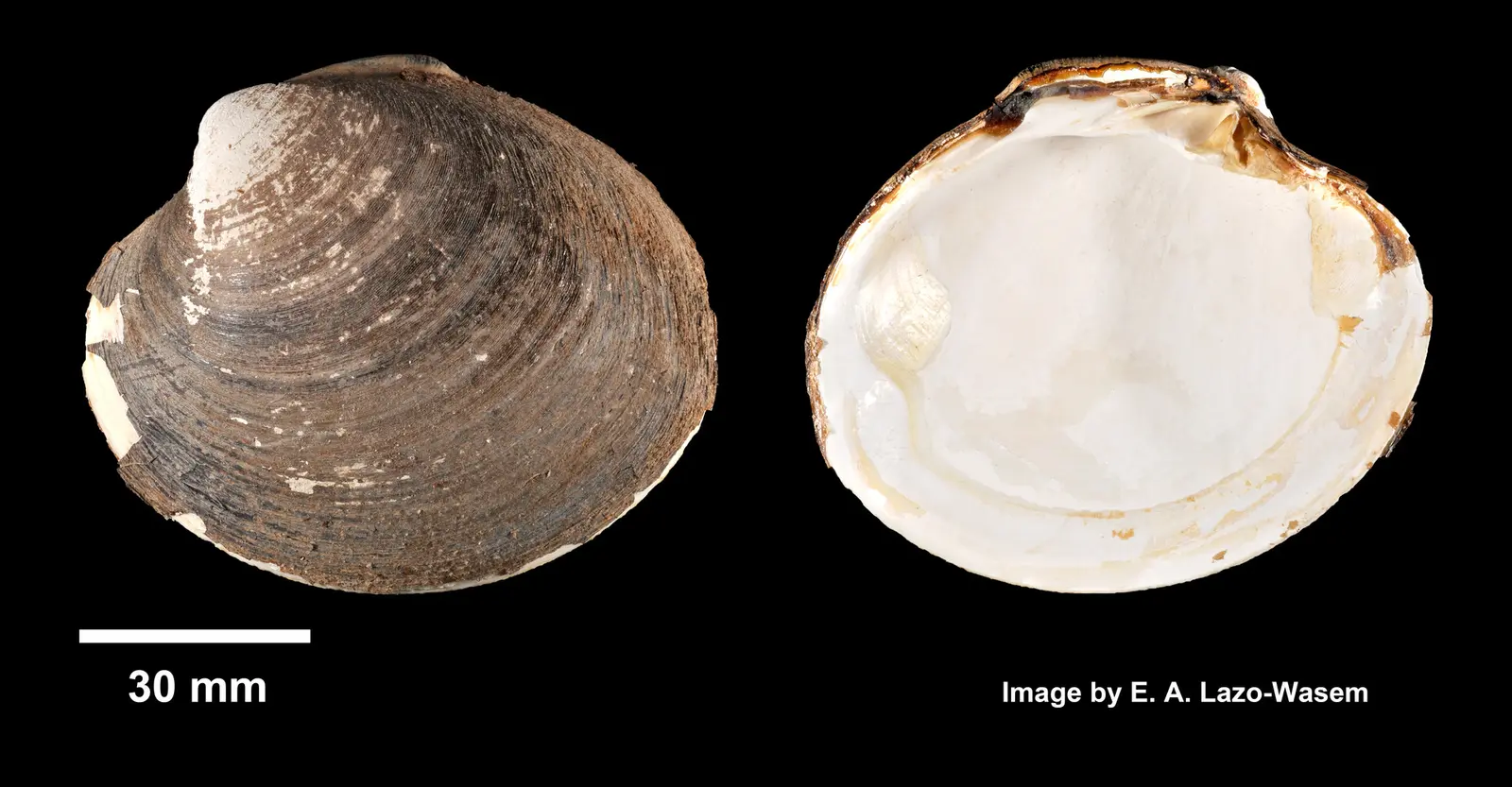
An ocean quahog valve held by the Yale Peabody Museum, outside and inside, taken in 1966 from about 18 m (60 ft) in Cape Cod Bay. The museum record gives no age.
"Arctica islandica (YPM IZ 033067)" by Eric A. Lazo-Wasem, Yale Peabody Museum — https://commons.wikimedia.org/wiki/File:Arctica_islandica_(YPM_IZ_033067).jpeg — CC0 1.0 (https://creativecommons.org/publicdomain/zero/1.0/)

Nothing about the clam's size suggested its age either. Bangor's statement says that "based on previous information and its size, this species was believed to live for around 100 years," and calls the idea that the team knew in advance and deliberately destroyed the clam "plainly incorrect."
So the story bends. Researchers did kill Ming, by freezing it with the rest of the catch, but no one knew its age at the time, and the record it set is narrower than "world's oldest animal," as the next section shows.
Is Ming the oldest animal ever found?
The story goes that Ming is the oldest animal ever found. The claim appears in headlines such as ScienceNordic's 2013 "New record: World's oldest animal is 507 years old" and in the plain-language summary of a 2025 genome paper by Gerhard and colleagues: "The longest-lived animal is the ocean quahog." Butler's abstract claims less: the longest-lived non-colonial animal so far reported whose age at death can be accurately determined.
The oldest colonies outlast every individual on this page. Deep-sea corals grow at about 300 to 3,000 m (980 to 9,840 ft) on seamounts and continental margins. In 2009 Roark and colleagues dated colonies of Leiopathes at up to 4,265 years and Gerardia at up to 2,742, a genus name that WoRMS now lists as unaccepted. Butler's wording leaves colonies out.
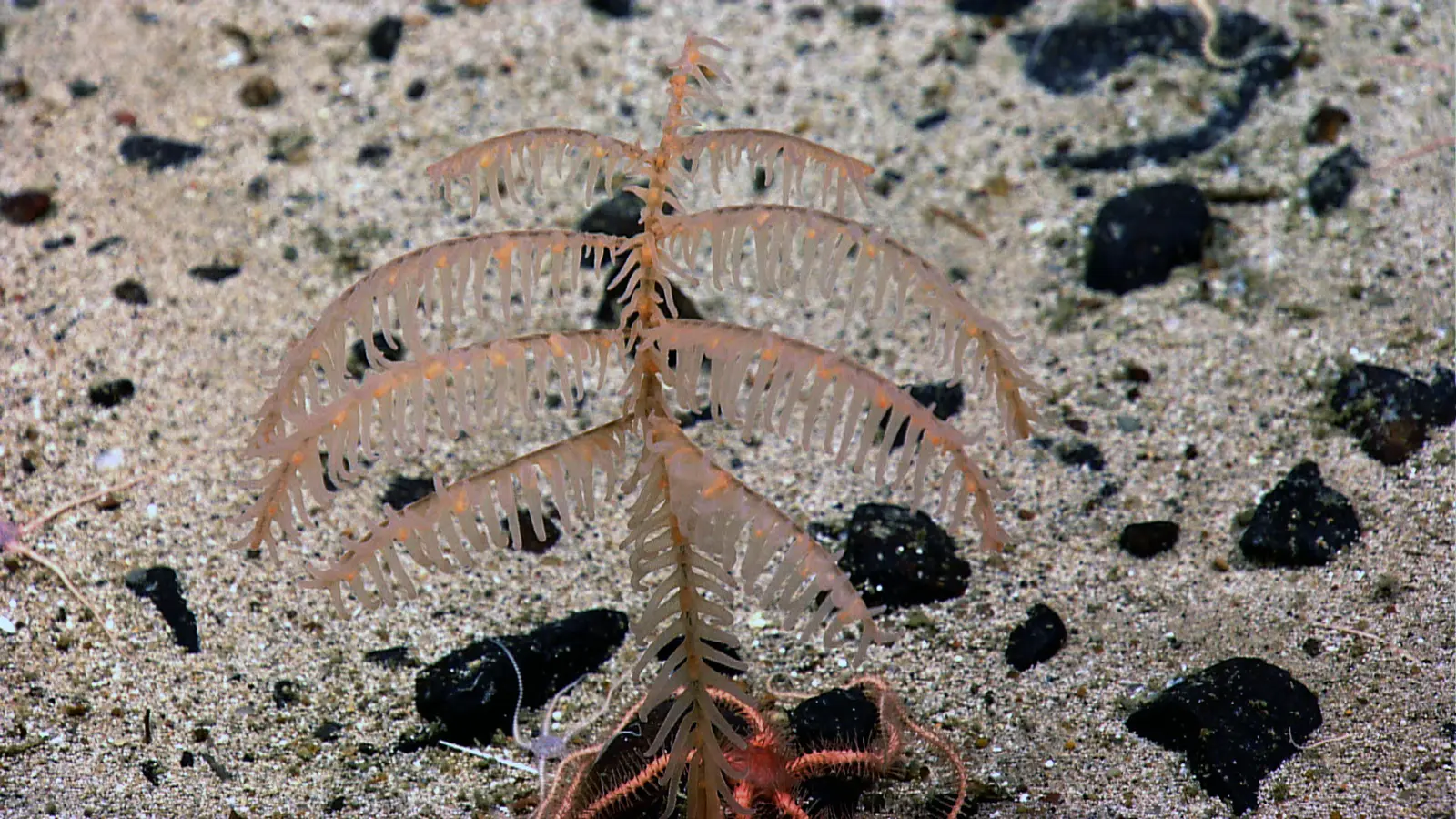
A small colony of the black coral Bathypathes at 2,004 m (6,575 ft) on Retriever Seamount in the Atlantic, photographed in 2014 on a NOAA Ocean Exploration expedition. No age was reported for it.
Credit and data
"Black coral - Retriever Seamount" by NOAA Office of Ocean Exploration and Research, Exploring Atlantic Canyons and Seamounts 2014 — https://commons.wikimedia.org/wiki/File:Black_coral_-_Retriever_Seamount.jpg — Public domain (US federal government work, NOAA Office of Ocean Exploration and Research)

Other long lives are estimates rather than counts. The Greenland shark lives in deep, cold northern water (Chiavacci et al. 2026). Nielsen and colleagues estimated its age in 2016 from tissue at the core of the eye lens. The largest of their 28 sharks came out at 392 ± 120 years, a range whose upper end, 512, lies just past Ming's 507.
Sponge ages are estimates too. Antarctic glass sponges are generally found deeper than 30 m (98 ft), and Dayton and colleagues noted in 2013 that the largest, Anoxycalyx joubini, had never been seen to settle or grow, which had led to estimates of extreme longevity. Their long-term study then found that it had settled and grown on artificial structures sometime between 1989 and 2004. The same paper cites an estimate of about 440 years for a 15 cm Rossella sponge from the Ross Sea (Fallon et al. 2010).
Among counted shells of its own species, Ming has company. Butler's abstract reports several animals with lifetimes of more than 300 years, and Wanamaker's 2008 paper cites a museum shell, caught alive on the south Icelandic shelf in 1868, that Schöne and colleagues had aged at about 374 years. Before Ming, ScienceNordic reported, the Guinness record for a mollusk was a 220-year-old ocean quahog caught in American waters in 1982.
NOAA Fisheries describes the same slow pace off the US East Coast, where it puts ocean quahogs at depths of 25 to 1,300 ft (about 8 to 400 m). There, it says, they "grow very slowly," begin to reproduce at around age 6 and can live for at least 200 years.
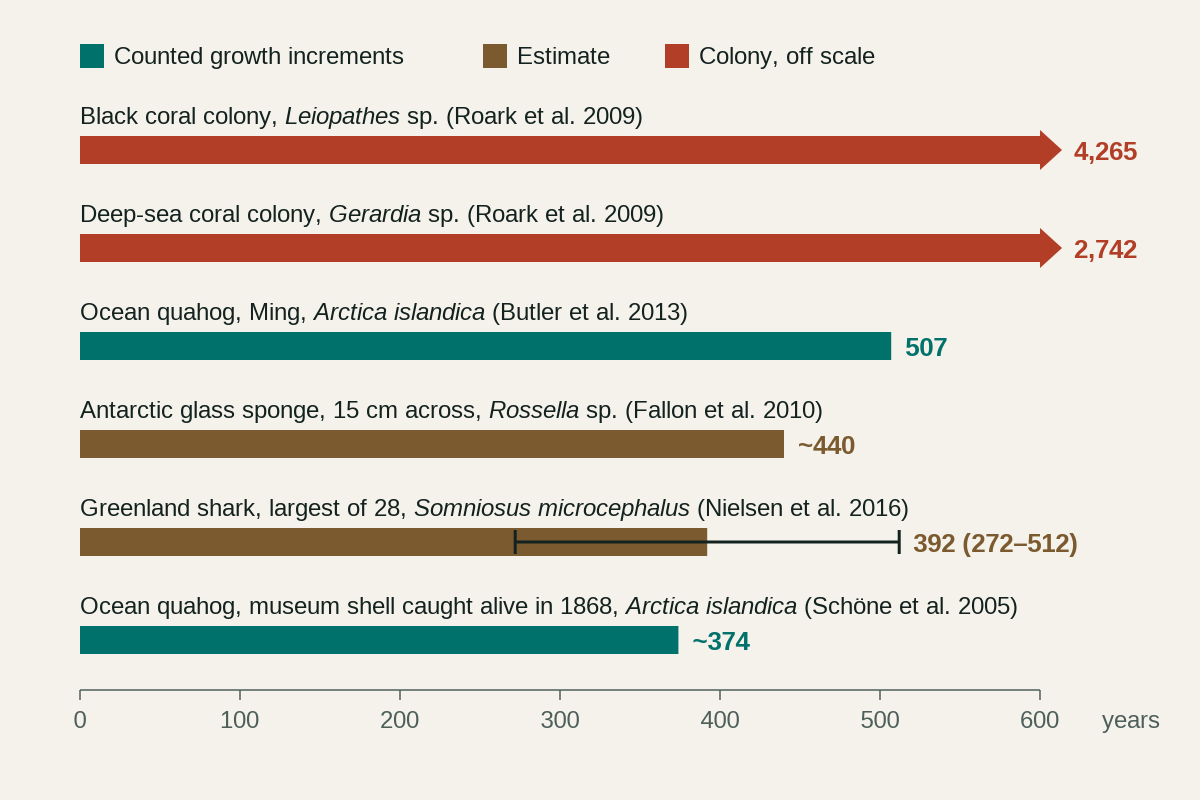
Open full-size chart, or scroll it sideways to read every label
Reported maximum ages, by method; the coral colony bars run off the scale. Greenland shark: 392 years, with a 95.4% probability range of 272–512 (Nielsen et al. 2016).
Credit and data
"Older than Ming?" by Ocean Life & Lore, https://oceanlifeandlore.com/shells/shell-growth-lines/, licensed under CC BY 4.0 (https://creativecommons.org/licenses/by/4.0/).
Data: Butler et al. 2013, Palaeogeography, Palaeoclimatology, Palaeoecology 373: 141–151, abstract as archived by NOAA NCEI (https://www.ncei.noaa.gov/access/paleo-search/study/14609), values cited as facts, retrieved 2026-10-15; Wanamaker et al. 2008, Very long-lived mollusks confirm 17th century AD tephra-based radiocarbon reservoir ages for North Icelandic shelf waters, Radiocarbon 50(3): 399–412 (https://hdl.handle.net/10150/654085), all rights reserved; values cited as facts, retrieved 2026-10-15; Roark et al. 2009, Proceedings of the National Academy of Sciences 106(13): 5204–5208 (https://doi.org/10.1073/pnas.0810875106), published values cited as facts (abstract), retrieved 2026-10-15; Nielsen et al. 2016, Science 353(6300): 702–704 (https://doi.org/10.1126/science.aaf1703), published values cited as facts (abstract), retrieved 2026-10-15; Dayton et al. 2013, PLoS ONE 8(2): e56939 (https://doi.org/10.1371/journal.pone.0056939), CC BY, retrieved 2026-10-15; Chiavacci et al. 2026, Aging Cell 25(5): e70505 (https://doi.org/10.1111/acel.70505), CC BY 4.0, retrieved 2026-10-15; Reimer, J.D. and F. Sinniger (2026), World List of Zoantharia, Gerardia Lacaze-Duthiers, 1864, AphiaID 100791, accessed through World Register of Marine Species (https://www.marinespecies.org/aphia.php?p=taxdetails&id=100791), CC BY 4.0, retrieved 2026-10-15.
Bangor's 2013 statement called it statistically inconceivable that no longer-lived ocean quahogs exist in Icelandic waters, and Butler told ScienceNordic that fishing boats may well have caught clams as old as Ming or older. None of the sources on this page reports a counted age above 507 years, so whether an older quahog has already come up in a dredge, uncounted, is still unsounded.
Lore check
3 claims sounded: bends ×2sinks ×1
| Claim | Verdict | Evidence |
|---|---|---|
| Scientists killed the world's oldest animal | bends | Ming died when the cruise's live clams were frozen on board in 2006 (Wanamaker et al. 2008); its age could not be known until the shell was opened (Bangor University 2013). The record is narrower than "oldest animal" (next rows). |
| Ming was 405 years old | sinks | Wanamaker et al. 2008 counted 405 bands and put the age at 407 or more; Butler et al. 2013 (abstract): 507 years, counted from annual growth increments. |
| Ming is the oldest animal ever found | bends | Butler et al. 2013 (abstract) limit the record to non-colonial animals so far reported whose age at death can be accurately determined. Coral colonies reach 4,265 years (Roark et al. 2009); a Greenland shark estimate is 392 ± 120 years (Nielsen et al. 2016). |
Further down:
- Nautilus shell: deeper, at 130 to 700 m (427 to 2,297 ft) off Osprey Reef in the Coral Sea, the chambered nautilus keeps a growth record of another kind, and its spiral is measured against the golden-ratio story.
- Geography cone: cone snails dissolve the inner walls of their own shells as they grow, thinning the next-to-last whorl from several millimeters to less than 50 µm, so pages of their "growth diary" are, in effect, torn out (Kohn et al. 1979).
Sources
- 1Butler, P. G., A. D. Wanamaker, J. D. Scourse, C. A. Richardson, and D. J. Reynolds. "Variability of Marine Climate on the North Icelandic Shelf in a 1357-Year Proxy Archive Based on Growth Increments in the Bivalve Arctica islandica." Palaeogeography, Palaeoclimatology, Palaeoecology 373 (2013): 141–151. doi:10.1016/j.palaeo.2012.01.016 https://www.ncei.noaa.gov/access/paleo-search/study/14609 Read: abstract.
- 2Butler, P.G.; Wanamaker, A.D.; Scourse, J.D.; Richardson, C.A.; Reynolds, D.J. (2013-06-24): NOAA/WDS Paleoclimatology - North Icelandic Shelf Arctica islandica Shell Measurement 1357 Year Record. Lifetimes file (butler2013-lifetimes-noaa.txt). NOAA National Centers for Environmental Information. https://doi.org/10.25921/afe4-v605. Accessed 2026-10-15. https://www.ncei.noaa.gov/access/paleo-search/study/14609 Read: data file and study description.
- 3Wanamaker, A. D., Jr., J. Heinemeier, J. D. Scourse, C. A. Richardson, P. G. Butler, J. Eiríksson, and K. L. Knudsen. "Very Long-Lived Mollusks Confirm 17th Century AD Tephra-Based Radiocarbon Reservoir Ages for North Icelandic Shelf Waters." Radiocarbon 50, no. 3 (2008): 399–412. doi:10.1017/S0033822200053510 https://hdl.handle.net/10150/654085 Read: full text.
- 4Bangor University. "Clam found to be over 500 years old." News release, 14 November 2013. https://www.bangor.ac.uk/news/archive/clam-found-to-be-over-500-years-old-16781 Read: full text.
- 5Reynolds, D., E. Genelt-Yanovskiy, A. Genelt-Yanovskaya, E. Northey, P. Butler, T. Trofimova, M. Conti, K. Penkman, Q. Huang, B. Schöne, and J. Scourse. "A Sclerochronology Defined 600-Year Baseline of Marine Dynamics in the North Sea." Philosophical Transactions of the Royal Society B 380, no. 1930 (2025): 20240036. https://doi.org/10.1098/rstb.2024.0036 Read: full text.
- 6Mette, M. J., C. Andersson, B. R. Schöne, F. G. W. Bonitz, V. Melvik, T. Trofimova, and M. W. Miles. "Two Centuries of Southwest Iceland Annually-Resolved Marine Temperature Reconstructed from Arctica islandica Shells." Estuarine, Coastal and Shelf Science 294 (2023): 108525. https://doi.org/10.1016/j.ecss.2023.108525 Read: full text.
- 7Stemmer, K., G. Nehrke, and T. Brey. "Elevated CO₂ Levels Do Not Affect the Shell Structure of the Bivalve Arctica islandica from the Western Baltic." PLoS ONE 8, no. 7 (2013): e70106. https://doi.org/10.1371/journal.pone.0070106 Read: full text.
- 8Höche, N., E. O. Walliser, N. J. de Winter, R. Witbaard, and B. R. Schöne. "Temperature-Induced Microstructural Changes in Shells of Laboratory-Grown Arctica islandica (Bivalvia)." PLoS ONE 16, no. 2 (2021): e0247968. https://doi.org/10.1371/journal.pone.0247968 Read: full text.
- 9Roark, E. B., T. P. Guilderson, R. B. Dunbar, S. J. Fallon, and D. A. Mucciarone. "Extreme Longevity in Proteinaceous Deep-Sea Corals." Proceedings of the National Academy of Sciences 106, no. 13 (2009): 5204–5208. https://doi.org/10.1073/pnas.0810875106 Read: abstract.
- 10Nielsen, J., R. B. Hedeholm, J. Heinemeier, P. G. Bushnell, J. S. Christiansen, J. Olsen, C. B. Ramsey, R. W. Brill, M. Simon, K. F. Steffensen, and J. F. Steffensen. "Eye Lens Radiocarbon Reveals Centuries of Longevity in the Greenland Shark (Somniosus microcephalus)." Science 353, no. 6300 (2016): 702–704. https://doi.org/10.1126/science.aaf1703 Read: abstract.
- 11Dayton, P. K., S. Kim, S. C. Jarrell, J. S. Oliver, K. Hammerstrom, J. L. Fisher, K. O'Connor, J. S. Barber, G. Robilliard, J. Barry, A. R. Thurber, and K. Conlan. "Recruitment, Growth and Mortality of an Antarctic Hexactinellid Sponge, Anoxycalyx joubini." PLoS ONE 8, no. 2 (2013): e56939. https://doi.org/10.1371/journal.pone.0056939 Read: full text.
- 12Chiavacci, E., K. F. Steffensen, P. Delaroche, E. Astoricchio, A. B. Poulsen, D. Brayson, F. Garibaldi, L. Lanteri, C. Pinali, G. R. Valente, F. Vignati, J. F. Steffensen, H. Shiels, E. T. Tozzini, and A. Cellerino. "Resilience to Cardiac Aging in Greenland Shark Somniosus microcephalus." Aging Cell 25, no. 5 (2026): e70505. https://doi.org/10.1111/acel.70505 Read: full text.
- 13Gerhard, G. S., J. B. Allard, S. Kaniper, D. Lynch, H. Lee, and S. Kumar. "Genome Assembly of Arctica islandica, the Longest-Lived Non-Colonial Animal Species." Animals 15, no. 5 (2025): 690. https://doi.org/10.3390/ani15050690 Read: full text.
- 14Kohn, A. J., E. R. Myers, and V. R. Meenakshi. "Interior Remodeling of the Shell by a Gastropod Mollusc." Proceedings of the National Academy of Sciences 76, no. 7 (1979): 3406–3410. https://doi.org/10.1073/pnas.76.7.3406 Read: abstract.
- 15Dunstan, A. J., P. D. Ward, and N. J. Marshall. "Vertical Distribution and Migration Patterns of Nautilus pompilius." PLoS ONE 6, no. 2 (2011): e16311. https://doi.org/10.1371/journal.pone.0016311 Read: abstract.
- 16WoRMS Editorial Board (2026). World Register of Marine Species. Arctica islandica (Linnaeus, 1767), AphiaID 138802; record: MolluscaBase eds. (2026), MolluscaBase, accessed through World Register of Marine Species. Available from https://www.marinespecies.org at VLIZ. Accessed 2026-10-15. doi:10.14284/170 https://www.marinespecies.org/aphia.php?p=taxdetails&id=138802 Read: catalogue record.
- 17Reimer, J. D., and F. Sinniger (2026). World List of Zoantharia. Gerardia Lacaze-Duthiers, 1864, AphiaID 100791. Accessed through: World Register of Marine Species at https://www.marinespecies.org/aphia.php?p=taxdetails&id=100791 on 2026-10-15 Read: catalogue record.
- 18NOAA Fisheries. "Ocean Quahog." Species directory, National Oceanic and Atmospheric Administration. https://www.fisheries.noaa.gov/species/ocean-quahog Read: full text.
- 19Brix, Lise. "New Record: World's Oldest Animal Is 507 Years Old." ScienceNordic, 6 November 2013. https://www.sciencenordic.com/ageing-denmark-geochemistry/new-record-worlds-oldest-animal-is-507-years-old/1392743 Read: full text.
- 20INFOMAR (Geological Survey Ireland and Marine Institute). "RMS Lusitania." https://www.infomar.ie/rd-and-education/publications/rms-lusitania Read: full text.
- 21NOAA National Ocean Service. "How far does light travel in the ocean?" Ocean Facts. https://oceanservice.noaa.gov/facts/light_travel.html Read: full text.
- 22NOAA Ocean Exploration. "How deep is the ocean?" https://oceanexplorer.noaa.gov/ocean-fact/ocean-depth/ Read: full text.
- 23NOAA Ocean Exploration. "Titanic Bow." Daily image, from the R.M.S. Titanic Expedition 2003. https://oceanexplorer.noaa.gov/multimedia/daily-image-media-20210415/ Read: full text.
Cite this page
Ocean Life & Lore. “Ming the Clam: Counted at 405 Years, Recounted at 507.” Ocean Life & Lore. Published 2026-10-15; last substantive revision 2026-10-15. https://oceanlifeandlore.com/shells/shell-growth-lines/ (accessed the date you read it).
Download the data: Ming's age estimates (CSV) CSV (source and license record) Data: Wanamaker et al. 2008, Very long-lived mollusks confirm 17th century AD tephra-based radiocarbon reservoir ages for North Icelandic shelf waters, Radiocarbon 50(3): 399–412 (https://hdl.handle.net/10150/654085), all rights reserved; values cited as facts, retrieved 2026-10-15; Bangor University, Clam found to be over 500 years old, news release, 14 November 2013 (https://www.bangor.ac.uk/news/archive/clam-found-to-be-over-500-years-old-16781), copyright Bangor University; values cited as facts, retrieved 2026-10-15; NOAA/WDS Paleoclimatology – North Icelandic Shelf Arctica islandica Shell Measurement 1357 Year Record, Butler et al. 2013 (https://doi.org/10.25921/afe4-v605), no use restrictions (NOAA NCEI), retrieved 2026-10-15; Butler et al. 2013, Palaeogeography, Palaeoclimatology, Palaeoecology 373: 141–151, abstract as archived by NOAA NCEI (https://www.ncei.noaa.gov/access/paleo-search/study/14609), values cited as facts, retrieved 2026-10-15. · Shell lifetimes, NCEI (CSV) CSV (source and license record) Data: NOAA/WDS Paleoclimatology – North Icelandic Shelf Arctica islandica Shell Measurement 1357 Year Record, Butler et al. 2013 (https://doi.org/10.25921/afe4-v605), no use restrictions (NOAA NCEI), retrieved 2026-10-15. · Longevity records (CSV) CSV (source and license record) Data: Butler et al. 2013, Palaeogeography, Palaeoclimatology, Palaeoecology 373: 141–151, abstract as archived by NOAA NCEI (https://www.ncei.noaa.gov/access/paleo-search/study/14609), values cited as facts, retrieved 2026-10-15; Wanamaker et al. 2008, Very long-lived mollusks confirm 17th century AD tephra-based radiocarbon reservoir ages for North Icelandic shelf waters, Radiocarbon 50(3): 399–412 (https://hdl.handle.net/10150/654085), all rights reserved; values cited as facts, retrieved 2026-10-15; Roark et al. 2009, Proceedings of the National Academy of Sciences 106(13): 5204–5208 (https://doi.org/10.1073/pnas.0810875106), published values cited as facts (abstract), retrieved 2026-10-15; Nielsen et al. 2016, Science 353(6300): 702–704 (https://doi.org/10.1126/science.aaf1703), published values cited as facts (abstract), retrieved 2026-10-15; Dayton et al. 2013, PLoS ONE 8(2): e56939 (https://doi.org/10.1371/journal.pone.0056939), CC BY, retrieved 2026-10-15; Chiavacci et al. 2026, Aging Cell 25(5): e70505 (https://doi.org/10.1111/acel.70505), CC BY 4.0, retrieved 2026-10-15; Reimer, J.D. and F. Sinniger (2026), World List of Zoantharia, Gerardia Lacaze-Duthiers, 1864, AphiaID 100791, accessed through World Register of Marine Species (https://www.marinespecies.org/aphia.php?p=taxdetails&id=100791), CC BY 4.0, retrieved 2026-10-15. · Sounding line (CSV) CSV (source and license record) Data: Wanamaker et al. 2008, Very long-lived mollusks confirm 17th century AD tephra-based radiocarbon reservoir ages for North Icelandic shelf waters, Radiocarbon 50(3): 399–412 (https://hdl.handle.net/10150/654085), all rights reserved; values cited as facts, retrieved 2026-10-15; NOAA Ocean Service, How far does light travel in the ocean? (https://oceanservice.noaa.gov/facts/light_travel.html), public domain (US federal government work), retrieved 2026-10-15; NOAA Ocean Exploration, How deep is the ocean? (https://oceanexplorer.noaa.gov/ocean-fact/ocean-depth/), public domain (US federal government work), retrieved 2026-10-15; NOAA Ocean Exploration, Titanic Bow, daily image from the R.M.S. Titanic Expedition 2003 (https://oceanexplorer.noaa.gov/multimedia/daily-image-media-20210415/), public domain (US federal government work), retrieved 2026-10-15.
Corrections
No corrections yet.
Every correction on the site is listed in the Corrections logbook. To report an error on this page, use Report a correction with the page URL, the sentence and your source. How claims are sounded sets out the sources, recalculations and verdict rules behind each page.
More from Shells
-
Lore check
Nautilus Shell: Not a Golden Spiral, as Measured in 1838
Nautilus pompilius: 130–700 m
-
Entry
Geography Cone: The Snail That Hunts Fish With Insulin
Conus geographus: 0–20 m